Sri Lanka’s agricultural total factor productivity grew by just 0.3% a year over the past decade, against 1.6% across South Asia, according to an analysis by the Institute of Policy Studies.
The IPS argues that accelerating agro-processing and value-chain development is critical both to improving climate resilience and to raising smallholder incomes, as reported by Hiru News.
Where Sri Lanka actually sits
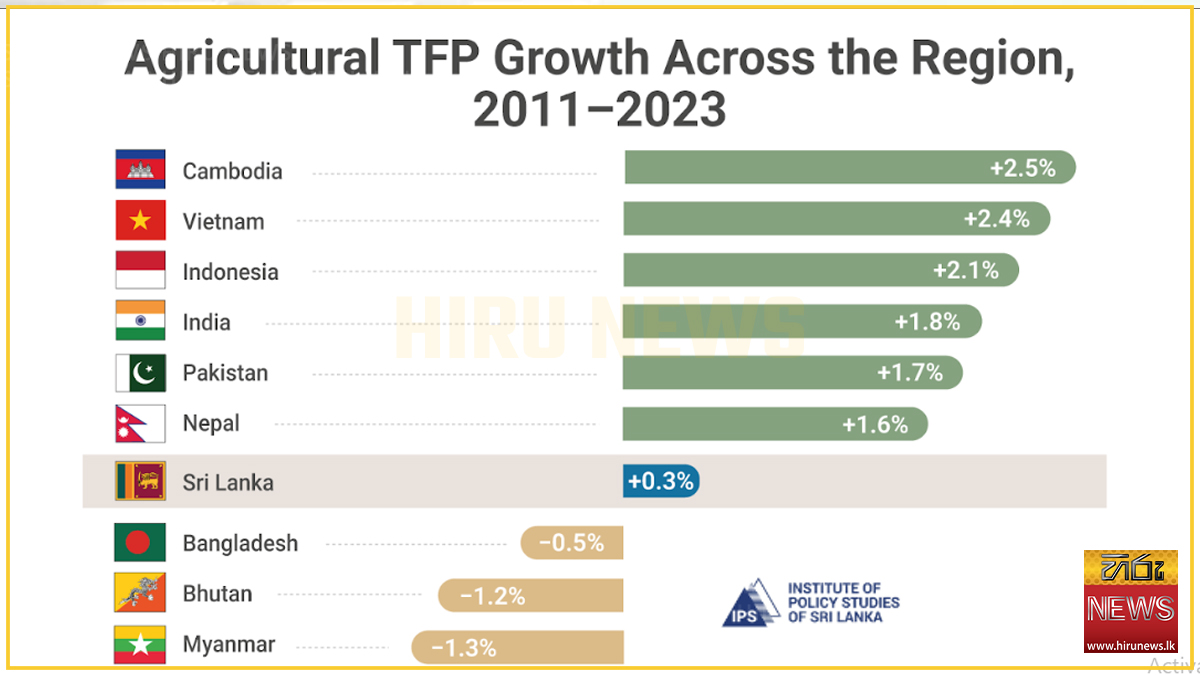
The chart published with the analysis is the IPS’s own, and it dates the comparison precisely: 2011 to 2023. It also places Sri Lanka against nine regional peers rather than South Asia alone:
| Country | Agricultural TFP growth, 2011–2023 |
|---|---|
| Cambodia | +2.5% |
| Vietnam | +2.4% |
| Indonesia | +2.1% |
| India | +1.8% |
| Pakistan | +1.7% |
| Nepal | +1.6% |
| Sri Lanka | +0.3% |
| Bangladesh | −0.5% |
| Bhutan | −1.2% |
| Myanmar | −1.3% |
The ranking is worth reading carefully. Sri Lanka is not the weakest performer in the group — Bangladesh, Bhutan and Myanmar all recorded contractions. It is the lowest of the countries that grew at all, and the gap to the next one up is wide: Nepal’s 1.6% is more than five times Sri Lanka’s rate.
Total factor productivity measures output gained from better use of the same land, labour and inputs rather than from farming more land or employing more people. A rate close to zero means the sector’s output has been expanding largely in proportion to what is put into it.
What is holding it back
The analysis lists limited land availability, declining productivity, rising input costs, labour shortages and post-harvest losses as persistent constraints. Climate uncertainty — including the effect of El Niño on crop yields — compounds them.
Beyond the farm gate, poor storage, weak market coordination and limited access to higher-value markets restrict what farmers can earn from what they do produce.
What the IPS proposes
Its central recommendation is that a programme to cut post-harvest losses and modernise the agricultural value chain be treated as a priority, with better post-harvest management and agro-processing framed as a way to improve climate resilience and profitability at once.
On fiscal measures, it suggests grants, loans, guarantees and tax incentives directed at investment in packing, grading, storage, refrigeration, ripening, processing and certification facilities, along with support for technology adoption, producer organisations, and certification, traceability and marketing systems.
It also calls for public investment in shared facilities for farmer organisations and cooperatives, so producers can consolidate output, obtain group certification and improve their bargaining power — and for measures connecting SL-GAP certified producers and farmer groups to processors, supermarkets, exporters and institutional buyers.
Sourcing note
The material appears in a piece titled “Beyond the crisis: Sectoral paths to Sri Lanka’s durable growth”, published by EconomyNext on September 23 under its Op-ed/Special Reports section and bylined to the Institute of Policy Studies of Sri Lanka. It is an IPS analysis published as a commentary rather than a news report of a separately released study, which is how Hiru presents it.
The EconomyNext article page returned a server error on repeated attempts through two different fetchers; the citation above rests on the outlet’s own index listing, which carries the title, the IPS byline and the section. The figures and recommendations reported here are taken from Hiru’s account and from the IPS chart published with it.