The National Chamber of Commerce of Sri Lanka has written to President Anura Kumara Dissanayake asking him to immediately rescind Ministry of Energy directives that it says threaten the rooftop solar industry, warning of an energy shortfall of 450 megawatt-hours by early 2027.
The letter, reported by Hiru News, is signed by Chamber President Anura Warnakulasooriya and Renewable Energy Committee Chairman Dr Lakmal Fernando. It argues that rapid expansion of rooftop solar photovoltaic systems and battery energy storage remains the most practical answer to the projected deficit.
What the directives changed
The Chamber’s objections centre on directives issued by the Ministry of Energy’s acting secretary on 11 September 2026:
- Net Metering and Net Accounting abolished. New systems are confined to the “Net Plus” scheme, with agreement terms capped at 12 years.
- Loss of self-generation rights. Consumers must sell electricity they generate to the Ceylon Electricity Board at lower rates while buying power for their own use at higher domestic tariffs — raising business operating costs and, the Chamber argues, eroding competitiveness.
- Employment exposure. More than 20,000 direct and indirect jobs across over 800 solar companies are said to be at risk.
Rooftop solar currently contributes about 2,600 megawatts to the national grid and saves roughly Rs. 20.4 billion a month on imported fossil fuels, according to the Chamber.
What the letter itself shows
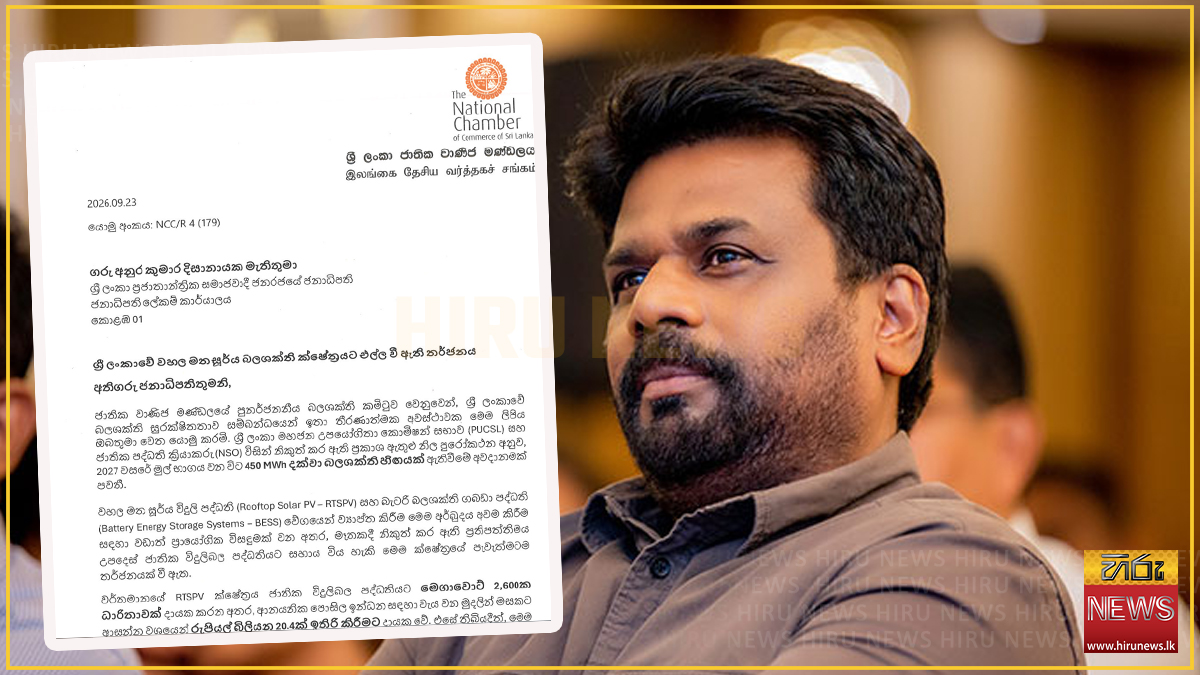
The document reproduced by Hiru is dated 23 September 2026 and carries the reference NCC/R 4 (179), addressed to the President at the Presidential Secretariat. Its Sinhala text attributes the 450 MWh projection to studies by the Public Utilities Commission of Sri Lanka and the National System Operator — attribution that does not appear in the English report.
Two points of description warrant correction. Hiru’s report opens by naming the Ceylon Chamber of Commerce, but the letterhead, the reference number and both signatories are those of the National Chamber of Commerce of Sri Lanka — a separate body. The two chambers are distinct organisations, and this appeal comes from the National Chamber.
The policy change itself has been reported independently: trade press confirms Sri Lanka has closed net metering and net accounting to new rooftop connections, with the rules applying to grid clearances granted after 11 September and existing agreements left undisturbed. No verified Sri Lankan newsroom other than Hiru had carried the Chamber’s letter at the time of writing, and the Ministry of Energy has not publicly responded.