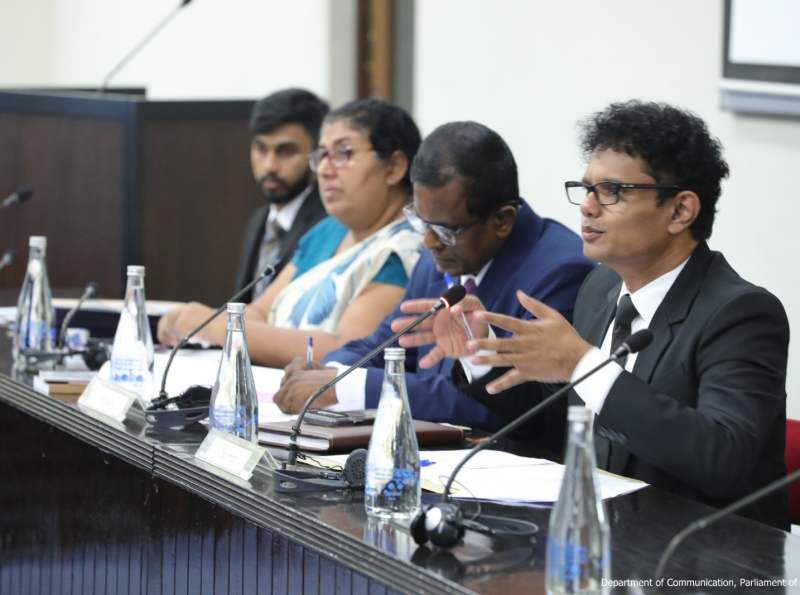
Parliament’s Sectoral Oversight Committee on Education, Manpower and Human Capital has decided to appoint a subcommittee to examine the salary disparities that arise when teachers move into the Sri Lanka Principals’ Service, and to recommend remedies. The decision was taken at a recent meeting chaired by MP Hesha Withanage, Attorney-at-Law.
At the centre of the problem is the Sri Lanka Principals’ Service Minute of 22 October 2014, under which entry from the Teachers’ Service is classified as a “new appointment” rather than a “promotion”. Officials said the effect is compounded by the gap in increments when a teacher moves from Grade 1 of the Teachers’ Service to Grade III of the Principals’ Service.
An adjustment allowance under Circular No. 03/2014 was meant to close that shortfall at appointment. But the committee heard a gap re-opens later, because principals forgo the higher increments they would have earned had they stayed teaching.
The result, officials said, is that experienced teachers in Grades 1 and 2-I are discouraged from sitting the Principals’ Service examination at all. The committee backed amending the Service Minute so that entry becomes a promotion.
Teacher recruitment and B.Ed. graduates
The committee also reviewed Teachers’ Service promotions, noting a graduate entrant takes roughly 19 years to reach Grade 1.
Members were told a verbal agreement with the Public Service Commission allows Bachelor of Education graduates to be recruited under the existing system until 2030, and that a Cabinet Memorandum has been submitted to bring B.Ed. graduates into Grade 2 this year — separately from the ongoing process to fill 23,000 teaching posts, and matched to subject-specific vacancies at provincial level.
The committee also urged specialised B.Ed. degrees in science, mathematics and primary education.
Rs. 50.8 million overpaid in the Southern Province
The committee separately took up the recovery of excess salary paid to 261 laboratory attendants and security guards in the Southern Province. About Rs. 50.8 million was overpaid after the employees were placed on the 12th step of the salary scale instead of the initial step in 2008 and 2009. Identified in 2016 and examined by audit query in 2022, it has been clawed back to the tune of Rs. 15.1 million through suspended increments and salary deductions.
Representatives said the employees were not at fault and their appointment letters had specified the higher scale. The committee decided to write to the Southern Province Governor seeking his intervention.