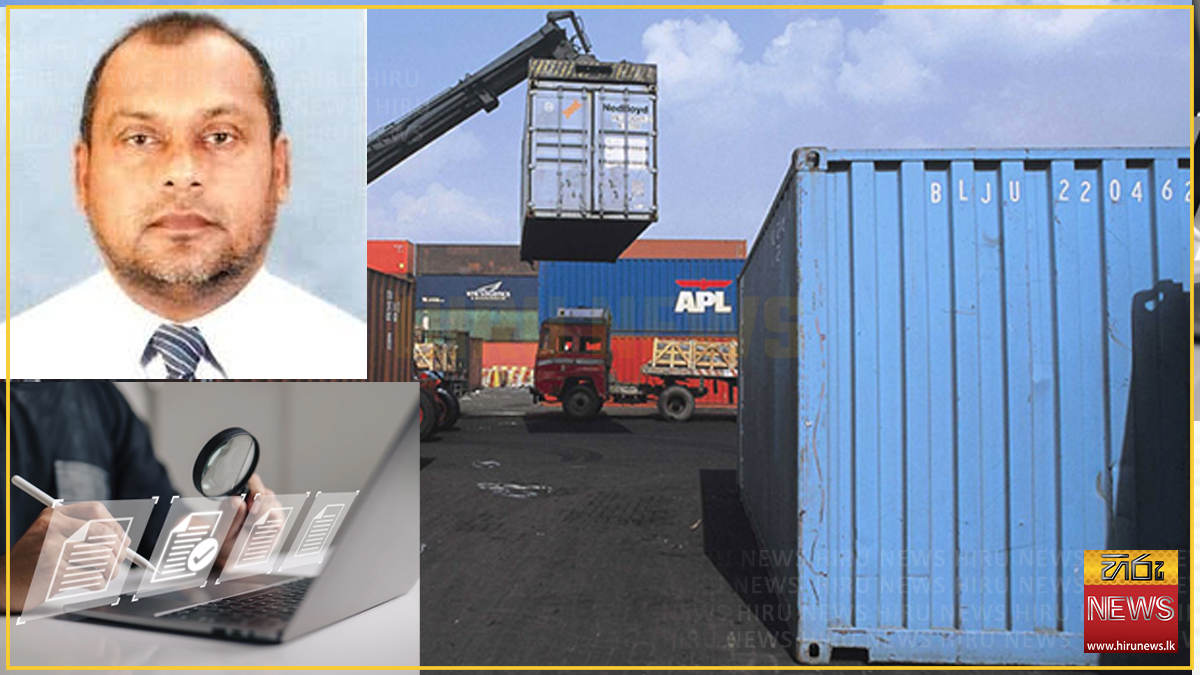
The trade body whose members file Sri Lanka’s customs declarations has warned that the paperless system going live on October 1 will not by itself speed up cargo clearance, Hiru News reported on Thursday.
The Customs House Agents & Traders Association (CHATA) said the real bottlenecks lie well beyond the use of paper. Its president, Mohamed Niyas, welcomed the switch as a step towards digitalisation and trade facilitation, but put the expectation gap bluntly:
“Expecting a dramatic improvement in clearance speed under the present conditions is like expecting Ferrari performance from a Morris Minor configuration.”
What CHATA says is actually slowing cargo
Niyas identified the obstacles as limitations in the existing ASYCUDA World platform, excessive regulatory intervention by Other Government Agencies (OGAs), multiple approvals, physical examinations, manual interventions, fragmented processes and institutional constraints.
Unless those are addressed, he said, the initiative risks becoming another “copy-and-paste road show” — the existing complex process simply transferred onto a digital platform without being changed.
“Digitising a slow process does not make the process fast. It only makes the slow process digital.”
A genuinely paperless environment, he said, should eliminate unnecessary physical movement, repeated document submissions, manual endorsements, avoidable approvals and waiting time. “What Sri Lanka needs is not simply paperless Customs, but process-less Customs, where unnecessary processes are removed.”
The association’s asks
CHATA said the launch should be accompanied by measures to simplify the declaration and approval workflow, fix ASYCUDA World’s functional limits, and cut unnecessary physical examinations through effective risk management. It also called for:
- OGA approvals integrated into one coordinated digital platform
- An end to repetitive document submissions and physical endorsements
- Pre-arrival processing and approvals
- Adequate digital document-upload capacity
- Clear service-level timelines for Customs and OGAs
- An end to brokers having to physically chase files, officers and approvals
The metric that matters
Niyas argued the rollout should be judged on actual cargo dwell time, not on how many declarations arrive electronically.
“The real question is: how much faster does an import container move from vessel arrival to Customs release? If the answer is not significantly faster, then we have not achieved trade facilitation. We have simply digitised bureaucracy.”
“Paperless is the beginning, not the destination,” he said.
Why this is the first dissenting voice on the record
The October 1 date has been public since July, when Secretary to the President Dr. Nandika Sanath Kumanayake set it. Since then the coverage has been almost entirely official: the Ceylon Chamber of Commerce briefed importers on obtaining digital signatures in August, and Customs briefed IMF representatives at the Presidential Secretariat in September.
CHATA’s intervention matters because its members are the people who will operate the system daily — and because it answers a question that run of announcements left open. Our report on the IMF briefing noted that no official account had given any figure for the expected saving in clearance time. CHATA’s position is that, on the current design, there may not be much of one.
There is also a history here. When the deadline was announced in July, Dr. Kumanayake specifically addressed the concern that had followed the programme since it was floated — that clearing agents could lose their work — saying the shift would not cost them their jobs, though the nature of the work would change. CHATA is the clearing agents’ association, and its objection now is not that the system threatens its members but that it does not go far enough.
A note on sourcing
This report rests on a single outlet. A search of the other verified newsrooms found no other same-week account of CHATA’s statement; the Sunday Times raised similar industry doubts in August, but that report falls outside our sourcing window and is not relied on here. Hiru does not say where or in what form the statement was issued, gives no current dwell-time figure for Colombo, and carries no response from Sri Lanka Customs.