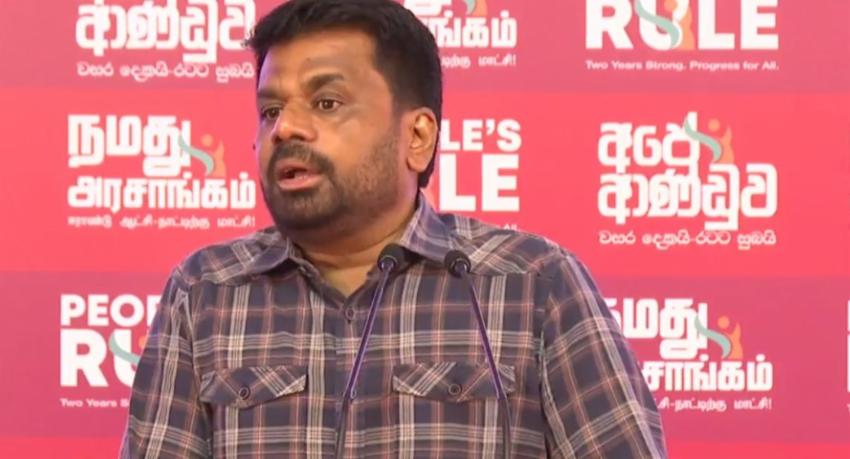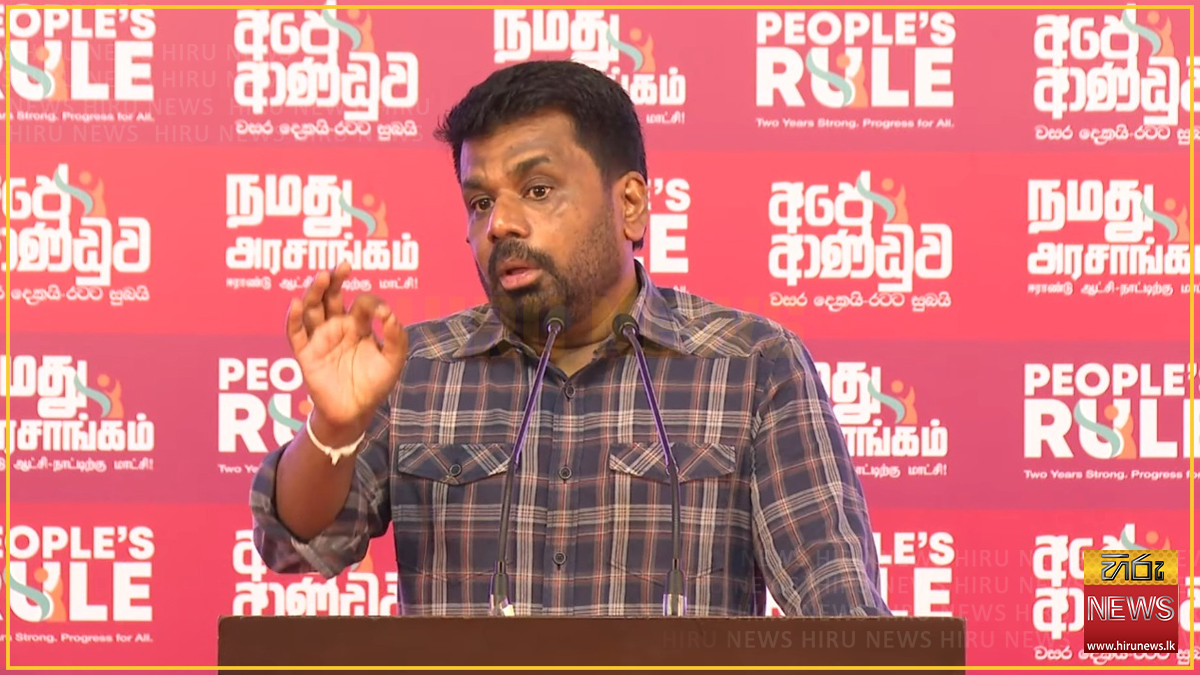
President Anura Kumara Dissanayake said on Sunday that his government has deferred a property tax that the previous administration had agreed with the International Monetary Fund to introduce in 2025, and has kept it out of the third budget, Hiru News reported.
He was speaking at the “Our Government — Two Years Good for the Country” public rally in Gampaha, part of the NPP’s series of events marking two years in office. The President spoke at the same rally about a Rs. 41 billion fuel subsidy going before Cabinet on Monday.
What the President said
Dissanayake said that when his administration took office, the outgoing government had already reached an agreement with the IMF to levy an additional tax on property, and that the new government was bound to introduce it in 2025.
He said speculation was circulating at the time that property would be confiscated. The government’s counter-argument, he said, was that if a person buys property out of income on which tax has already been paid, that property has in effect already been taxed. On that basis, he said, the government made its case and took steps to defer the levy.
Why “the third budget” matters
The third budget is the 2027 Budget, which the Finance Ministry has scheduled for presentation to Parliament on 12 November. It is the third annual budget this government will present.
That timing is what gives the statement its weight, because the tax has been repeatedly pushed back rather than dropped.
The President’s account of the origin of the commitment matches the documented record. Sri Lanka’s 2023 undertaking under the Extended Fund Facility envisaged a conventional nationwide property tax by 2025. An IMF technical mission in February 2024 found the measure blocked on two fronts: the Thirteenth Amendment assigns property-related tax revenue to the provinces, ruling out a straightforward central levy, and the Valuation Department held no usable current data on the country’s roughly five million properties.
The Fund’s workaround, published in August 2024, was an Imputed Rental Income Tax — taxing the deemed rental value of an owner-occupied home as income, which sidestepped the constitutional obstacle. It was targeted for April 2025 and abandoned after the November 2024 election, when the incoming government judged it unworkable.
The measure then resurfaced for the 2027 cycle. The Sunday Times reported on 26 July that the IMF had proposed a tax on secondary residential property for the 2027 budget and that the government had pushed back, telling the Fund its other revenue measures were sufficient to meet the targets and that a proper ownership database would take time to build.
The President’s remarks on Sunday are the clearest statement so far that the measure will not appear in that budget either.
What is not settled
Hiru’s report does not say whether the deferral is permanent or simply moved to a later year, whether the IMF has formally agreed, or what replaces the revenue the tax was expected to raise. The Sunday Times reported in July that the Fund was likely to keep pressing for the tax even if it did not make the 2027 proposals — so a deferral is not the same as an abandonment.
Ada Derana, which also covered the Gampaha rally, could not be retrieved for this report.