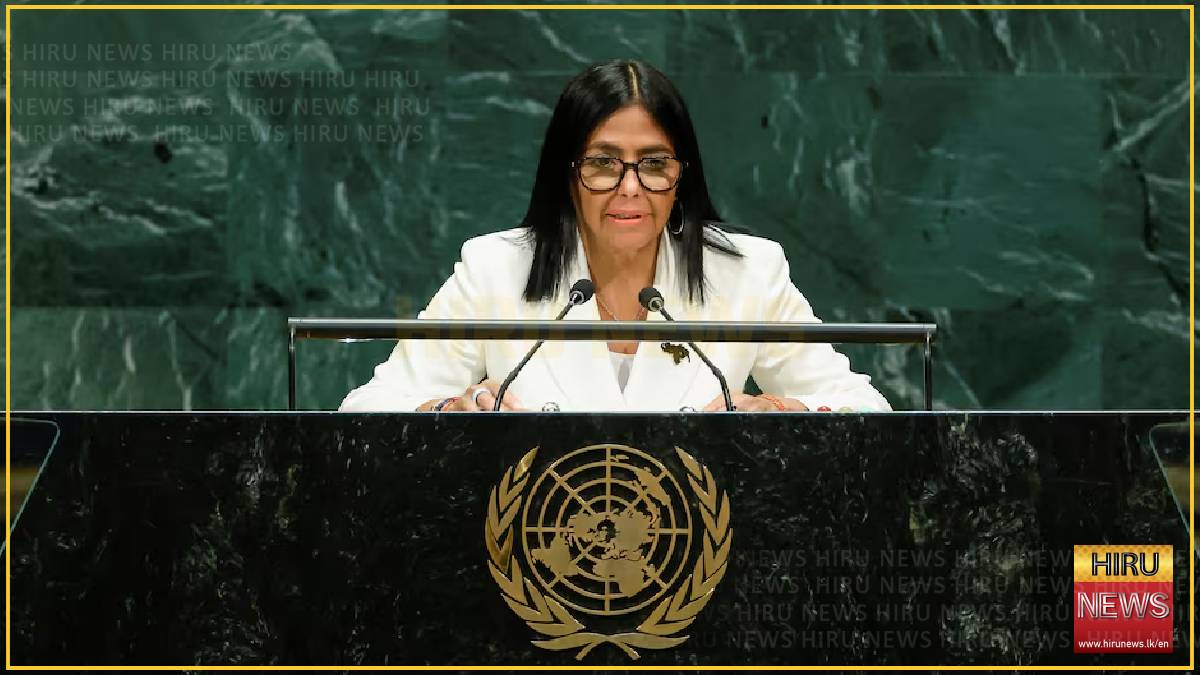
Venezuela’s interim President Delcy Rodriguez came to the United Nations General Assembly in New York this week looking for agreements on debt, energy and mining, and went home without any of them, Hiru News reported, carrying a Reuters analysis.
It was her first visit to the United States since American forces captured then-President Nicolas Maduro in a raid in January. In her speech to the assembly she pledged that the OPEC member would hold elections as part of a transition to “full democracy”, but set no date.
Talks with US officials, multilateral lenders, allied governments and energy and mining companies had been expected to produce signed agreements, even preliminary ones, sources told Reuters before the delegation travelled. As of Saturday none had been announced.
“Rodriguez enjoyed a week of high visibility. Yet, when we make a list of concrete results, the outcome is modest,” said Washington-based analyst Antonio De La Cruz. “Where are the disbursements, the reconstruction package or the business deals? They did not materialize on the scale that would have allowed New York to be portrayed as Venezuela’s great financial comeback."
"To the victor belong the spoils”
US President Donald Trump used his Tuesday address to the assembly, with Rodriguez in the hall, to remind the chamber that Washington stood ready to use its “unmatched military might”. “To the victor belong the spoils,” he said.
Trump did not name Rodriguez in the speech, and no readout was published of their brief “pull-aside” meeting. Afterwards, Secretary of State Marco Rubio said the two had discussed restructuring Venezuela’s sovereign debt and that Washington had pressed for political change. “For this project to be successful, it culminates in a free and fair election,” Rubio said.
The White House and Venezuela’s information and foreign affairs ministries did not respond to requests for comment.
Isolated inside the hall
Leftist leaders who once backed Maduro kept their distance. The Cuban delegation — Caracas’s closest ally for decades — walked out when Trump’s speech turned to Cuba, while Rodriguez stayed as he called Maduro an “outlaw dictator”. Officials from the two countries avoided one another.
When Rodriguez crossed the floor to greet Spanish Prime Minister Pedro Sanchez, he finished a phone call before standing to receive her. Sanchez later called the greeting “normal”.
Brazil’s President Luiz Inacio Lula da Silva told CNN that the United States treats Rodriguez as though it were her boss, and that in her position he would call elections.
Outside the building, more than 50 protesters carried signs reading “New Face, Same Regime” and chanted that Rodriguez should join Maduro in the Brooklyn jail where he is held pending trial. Venezuelans living in the US also protested with placards depicting her in a jail-style orange jumpsuit.
Money and oil still in play
The head of the Inter-American Development Bank said the lender was working to secure approval for a US$2.5 billion bridge loan for Venezuela, though some board members oppose it.
A source told Reuters that the Russian delegation sought a meeting with Foreign Minister Felix Plasencia over Moscow’s stakes in Venezuelan oil projects. ExxonMobil has reportedly been negotiating a return to the large Petromonagas development, part-owned by Russia’s state firm Roszarubezhneft. Russia’s foreign ministry, its UN mission and its embassy in Caracas did not immediately respond to requests for comment.
The election question
For nine months Rodriguez avoided signalling when Venezuelans would vote, while US officials played down expectations by saying it would take time. Analysts and opposition parties now say the clock is running; experts estimate at least 12 months would be needed to appoint credible electoral authorities and organise a vote.
While she was in the US, opposition leader Maria Corina Machado — a potentially strong candidate — was again prevented from returning home from Panama, according to media reports.
Nicmer Evans, a political analyst and former supporter of the late President Hugo Chavez, wrote on X that Rodriguez had allowed herself to be “doubly humiliated” in exchange for Trump withholding support from Machado. “There will be elections, but when the United States sees fit,” he wrote.
De La Cruz said the week showed Washington shaping the new Venezuelan landscape and Rodriguez establishing herself as its key interlocutor — at a price. “She now bears an additional consequence: she will have to explain when Venezuelans will actually vote.”
This report is based on a Reuters analysis carried by Hiru News. We were unable to retrieve a second verified newsroom’s independent account of the visit.