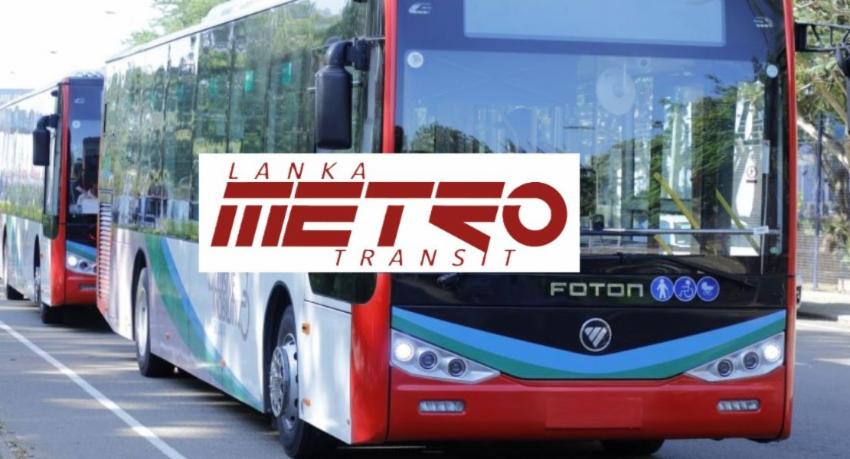
Sri Lanka’s state-run Metro Bus network began operating on five additional routes on Tuesday, taking the total to seven corridors across the Western Province. The service was launched at the Thalangama depot under the patronage of President Anura Kumara Dissanayake.
Lanka Metro Transit’s expansion comes “in addition to the two routes that were already in operation,” NewsFirst reported. Timetables, designated stops and travel information are available through the LMT GO App, the digital platform supporting the service — the first time a commuter-facing information channel has been named at a Metro launch. The initial network covers roughly 188.7 km.
What the Minister announced
Transport, Highways and Urban Development Minister Bimal Rathnayake used the launch to set out the next phase, Newswire reported:
- A further 50 buses to be imported before the Sinhala and Hindu New Year, for intercity services to Jaffna, Kandy and Galle.
- The Chinese Government has agreed to provide 100 buses to Lanka Metro Transit, agreed during the President’s visit to China.
- An urban transport permit system to be introduced as the network expands, with the private sector to be brought in later.
- A call to mayors to establish Park & Ride parking near bus terminals.
- Government investment of about Rs. 7.5 billion in establishing the service.
A fully digitalised operations system — fleet management, passenger information, fare collection and monitoring — has been designed and procurement has begun. The Road Development Authority and Colombo Municipal Council are working on bus-stop improvements.
Metro Bus Company chairman S.M.P. Thilakaratne confirmed the service is running across Colombo from Tuesday. The launch is paired with enforcement: police began strictly enforcing the Western Province bus priority lanes the same morning — lanes that are open to any passenger transport bus, not to Metro alone.
The fleet figure does not reconcile
No two outlets agree on how many buses entered service, and the reason appears to be that they are counting different things.
Newswire puts the number launched at 122, then breaks it down as 104 received by Sri Lanka and eight provided by the Government of Japan. Those two components sum to 112, not 122. Hiru’s Sinhala filing gives a third figure: 114 imported buses (ආනයනය කළ මෙට්රෝ බස් රථ 114) joining operations from Tuesday. NewsFirst’s launch-day coverage gives no fleet total at all.
Two separate problems sit underneath the spread.
First, the categories differ. “Received”, “imported” and “launched” are not the same set — the 10 Metro buses already running in Colombo before Tuesday were neither received nor imported this month, and Newswire’s breakdown omits them, which accounts for most of its own 112-versus-122 gap.
Second, the Japanese donation is misstated. When it was handed over on September 2, the Daily Mirror, Ada Derana, NewsFirst and Hiru all reported seven buses, not eight.
That single-bus error propagates. Taking 104 imported plus 10 in service plus seven from Japan gives 121 — the figure the Daily Mirror used in September, and the figure the Minister himself used on August 1. The ministry’s July announcement said 122.
LankaNewz is not asserting a total. The one figure with four independent verified outlets behind it is the seven-bus Japanese donation; the rest remains unreconciled by the ministry, as it has been since July.
The 104 imported buses were supplied by FOTON International Corporation of China under a May agreement — branding visible on the vehicles at Tuesday’s launch.
Jaffna, Kandy and Galle: a timeline that has moved
The intercity expansion is not new. Rathnayake said on August 1 that the service would reach Jaffna and Kandy before the end of this year, with depots in both districts. Tuesday’s announcement adds Galle, and reframes the commitment as 50 buses before the Sinhala and Hindu New Year — April 2027.
On the buses’ origin the account has also changed. In August the Minister said the 50 additional buses were due from Japan; Newswire’s report of Tuesday’s remarks does not name a supplier for them, and introduces the 100 Chinese buses as a separate commitment.
Still unpublished
Fares, service frequencies and headways remain unpublished — the same gap flagged when the route maps appeared on September 17 and again at Monday’s pre-launch coverage. Neither outlet says how many buses are assigned to each route. Without those figures the network cannot be compared against the private buses already working the same corridors.