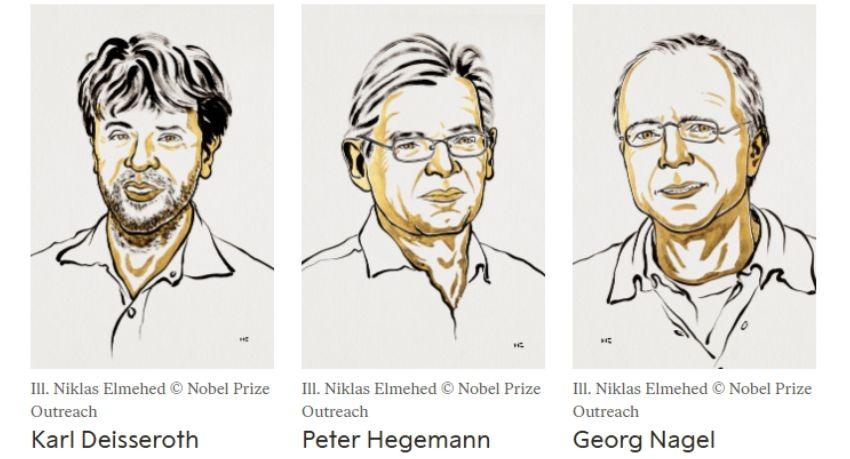
The 2026 Nobel Prize in Physiology or Medicine has been awarded jointly to Karl Deisseroth, Peter Hegemann and Georg Nagel for their discoveries concerning light-gated ion channels and optogenetics — a technique that lets researchers switch individual nerve cells on and off with light.
The Nobel Assembly at Karolinska Institutet announced the award in Sweden on Monday.
From pond algae to the living brain
The work began with channelrhodopsin, a protein the German researchers Hegemann and Nagel found on the surface of the single-celled alga Chlamydomonas, which swims towards light. The protein is unusual in being both light-sensitive and able to generate an electrical impulse; whichever cell it was placed in became light-sensitive.
Deisseroth, an American who worked in a psychiatric clinic before becoming a neurosurgeon, introduced the gene coding for the protein into nerve cells taken from rats and used blue light to trigger nerve signals. He later showed the method worked in the brains of living mice, according to CNN.
The method acts as a “light-sensitive switch”, allowing scientists to “map which cells are responsible for which function” in the brain, said Anna Wedell, a member of the Nobel committee. The committee said the work had “laid the foundation for a new era in neuroscience”, letting researchers study the neural circuits governing “specific memories, feelings, and behaviors relevant for neurological and psychiatric disorders”.
’Definitely asleep’
All three laureates were “very surprised” to learn of the award shortly before it was made public, said committee secretary-general Thomas Perlmann.
“Karl Deisseroth was very tired when he answered, he was definitely asleep, but he woke up,” Perlmann said. “All three said the same thing, that they thought it was absolutely wonderful to receive the prize with the other two.”
Deisseroth is 54; Hegemann is 71 and Nagel 73.
A note on headlines
Hiru News carried the story under a web address describing the technique as decoding “the mysteries of the immune system”. The award is for work on the brain and nervous system, as the outlet’s own headline and report make clear.