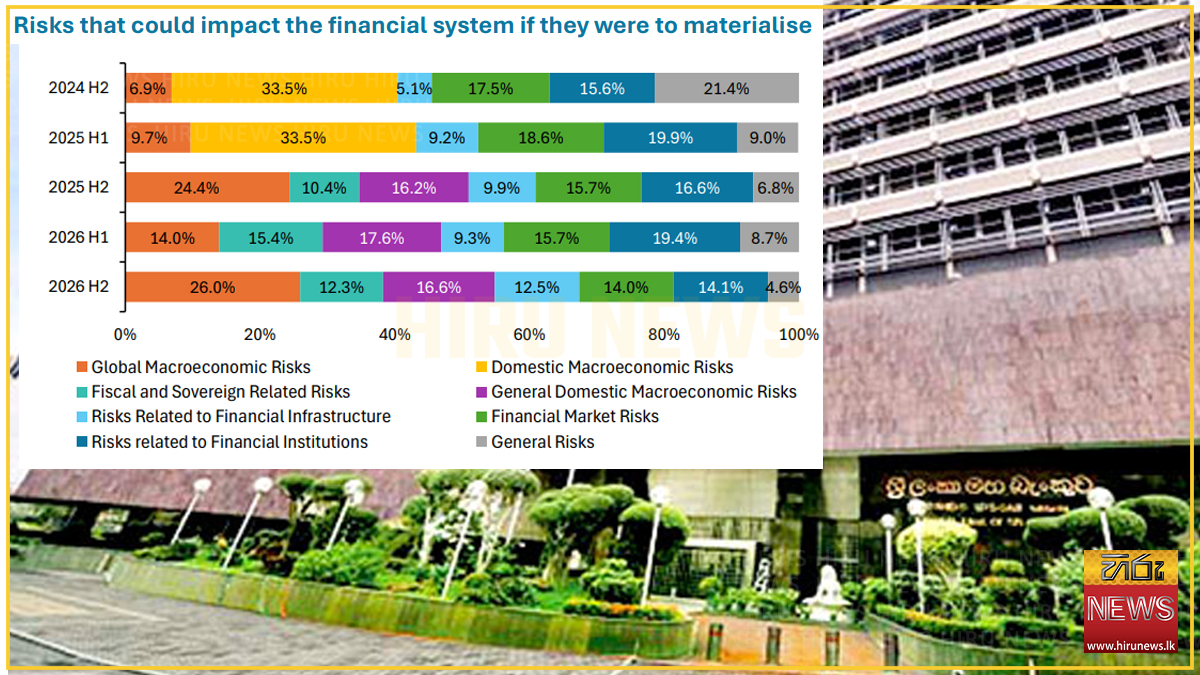
Sri Lanka’s financial institutions now rank global conditions as the single biggest threat to the stability of the country’s financial system — a sharp reversal from six months ago, according to the Central Bank’s Systemic Risk Survey for the second half of 2026, released on Tuesday.
Global macroeconomic risks accounted for 26.0% of risk perceptions in H2 2026, up from 14.0% in H1 — nearly double, and the highest share recorded in the series shown. The Central Bank attributes the jump to “heightened concerns over geopolitical tensions and potential spillovers from other countries, together with uncertainty surrounding the global economic outlook.”
The shift came at the expense of domestic worries. Risks related to financial institutions fell from 19.4% to 14.1%, and general risks dropped from 8.7% to 4.6%.
Reading the domestic figures correctly
A direct comparison across the full series is not possible without one adjustment. Until H2 2025 the survey used a single “domestic macroeconomic risks” category; from that round onward it was split into “fiscal and sovereign related risks” and “general domestic macroeconomic risks.”
Combining the two successor categories gives a like-for-like domestic figure of 33.0% in H1 2026 against 28.9% in H2 2026. Domestic macroeconomic concern therefore eased by about four percentage points while global concern rose by twelve — the movement is a genuine reweighting towards external risk, not merely a relabelling.
Confidence up, short-term probability slightly up
Separately, respondents reported that confidence in the financial system increased over both the short and medium terms, reflecting what the Central Bank describes as improved sentiment towards financial system stability.
The two findings pull in mildly different directions on timing. Respondents perceived a slight increase in the probability of a high-impact negative event over the short term — the next year — while the perceived probability over the medium term, the next three years, declined slightly against the previous round.
About the survey
The survey ran from 17 July to 14 August 2026. All 158 institutions approached took part, a 100% response rate. Respondents are the risk officers of licensed banks, finance companies, insurers, primary dealers, unit trust managers, margin providers and underwriters, stock brokers, licensed microfinance companies, rating agencies, financial infrastructure providers and mobile e-money providers.
Risks are classified into seven major categories covering 46 sub-risks. The Central Bank has run the survey twice yearly since H1 2017 through its Macroprudential Surveillance Department. From this round onward it moved to a fully online platform.
The Central Bank stresses that the findings record the perceptions of respondents and “should not be interpreted as the views of the Central Bank,” as Hiru News also noted.
Note on figures: the percentages above are read from the Central Bank’s own published chart in the key-findings document. The category shares for each round sum to 100%, which is consistent with a complete reading.