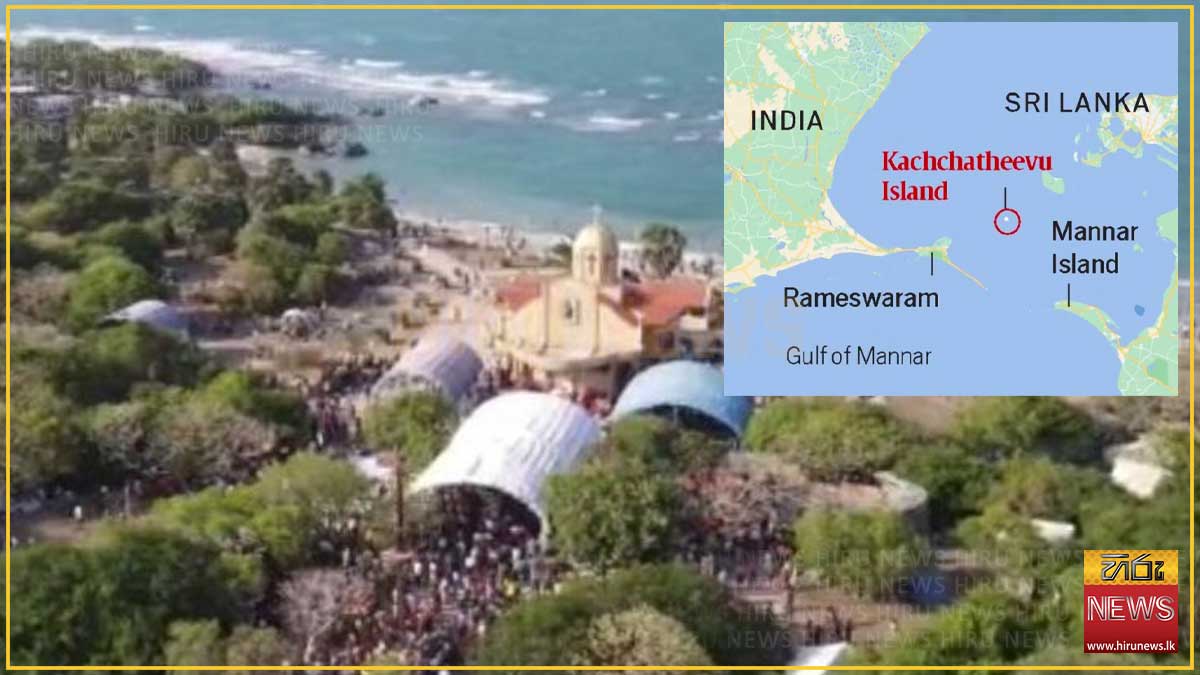
The Indian government has told India’s Supreme Court that it has no intention of reopening the 1974 and 1976 agreements governing Katchatheevu and fishing rights in the Palk Strait, citing the importance of its relationship with Sri Lanka, Hiru News reported.
The submissions were made by Attorney General R. Venkataramani before a bench of Justice Sanjay Kumar and Justice Sanjeev Sachdeva, hearing long-pending petitions that challenge the arrangements.
The court’s direction to fishermen
The same bench directed Indian fishermen not to cross into Sri Lankan waters near Katchatheevu while fishing, NewsFirst reported, and stressed the need for greater awareness among Tamil Nadu fishermen about where the maritime boundary runs.
Venkataramani submitted that fishermen need to be sensitised against crossing the international boundary, and that the Tamil Nadu state government also has a part in the matter. He told the court that concerns about Indian fishermen are being pursued through diplomatic channels, and that India cannot compel Sri Lanka to accept or comply with its position.
What is being challenged
The petitions attack two separate instruments: the 1974 bilateral agreement under which Katchatheevu was recognised as lying on the Sri Lankan side of the maritime boundary, and the 1976 pact restricting Indian fishermen from fishing in Sri Lankan waters.
NewsFirst reports the petitions before the court as having been filed by the AIADMK and the DMK Fishermen’s Wing, seeking the return of Katchatheevu to India. Hiru identifies the lead matter as A.K. Selvaraj v. Union of India, in which Senior Advocate P. Wilson appeared for the petitioners and argued that the 1974 agreement involved a transfer of territory and therefore required an amendment to Schedule I of the Indian Constitution. Wilson also raised repeated arrests of and alleged attacks on Indian fishermen.
The petitions have been pending since 2008. They argue that the arrangements damage the livelihoods and security of Tamil Nadu fishermen.
What the court did not decide
The bench made no ruling on the constitutional or legal validity of either agreement. Both challenges remain pending, and the case has been listed for further hearing in February 2027.
During the hearing, Justice Sanjay Kumar observed that Sri Lankan environmental practices might explain the movement of fish towards Sri Lankan waters — a point raised against the petitioners’ account of why Tamil Nadu boats cross. Hiru reports depletion of fish stocks on the Indian side as the driver of the crossings.
A note on the proceedings
This is a case in India’s Supreme Court, brought by Indian petitioners against the Union of India. Sri Lanka is not a party to it, and no Sri Lankan court is involved. The Sri Lankan government’s position, stated repeatedly in past years, has been that the matter was settled by the 1974 agreement.
The island’s name is rendered variously across the filings — Katchatheevu, Kachchativu and Kachchatheevu. This report uses the spelling carried in the body text of both sources.
Not reported
Neither filing carries a response from the Sri Lankan government, the Ministry of Foreign Affairs or the Sri Lanka Navy to Wednesday’s submissions. Neither says how the court’s direction to fishermen is to be enforced, what form it takes as an order, or whether it binds the Tamil Nadu government to any particular action.
No report gives the number of Indian fishermen currently in Sri Lankan custody, or says whether the Indian government’s position was stated in a written affidavit or only orally through the Attorney General.