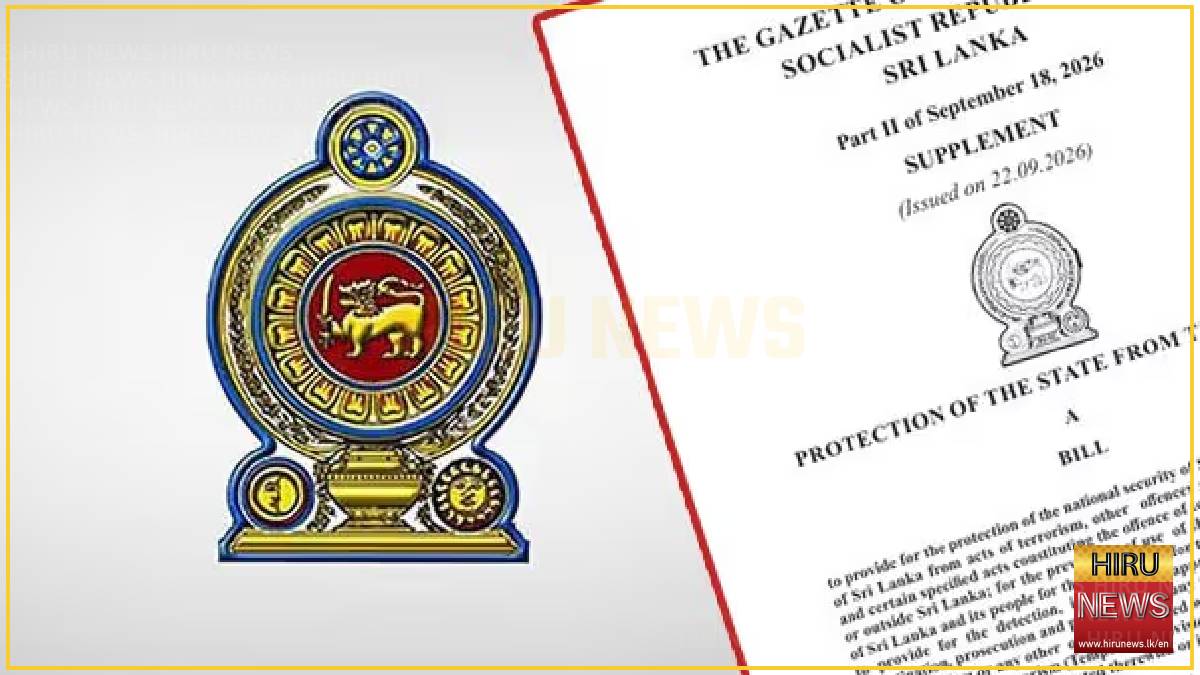
Publishing material that encourages the public to commit an act of terrorism would itself amount to an act of terrorism under the Protection of the State from Terrorism Bill, according to clause-level accounts of the Bill published on Wednesday — a day after the legislation was presented to Parliament.
The detail answers a question our report on Tuesday’s tabling left open: what the Bill actually says about the press.
Section 9: the offence
The Daily Mirror quotes Section 9 directly:
“Any person who, with the knowledge of directly or indirectly inducing the public or section of the public, to commit, to attempt, abet, conspire to commit, or prepare to commit an offence of terrorism, publishes or causes to be published any statement, or speaks any word or words or make any sign or visible representation commits an act under the Bill.”
The clause reaches beyond publication to speech, signs and “visible representation”, and covers inducement that is indirect as well as direct.
Section 11: the carve-outs
Section 11 sets out what will not be treated as an act of terrorism, Hiru News reports:
- fair and accurate reporting, commentary or analysis by journalists or media organisations
- academic, scientific or educational research or discussion
- work of civil society organisations, including human rights documentation, advocacy and public-interest communication
- artistic, literary, cultural or religious expression, including satire, parody and creative work
- expression of an opinion, belief, criticism or dissent, including legitimate political discourse
- dissemination of information on matters of public interest
What else the Bill classes as terrorism
Both newsrooms list the substantive offences: causing death, grievous hurt or hostage-taking; serious damage to any place of public use, public property, or public and private transport systems and infrastructure; and causing serious risk to public health. Damage to cyber environment domains, hacking, and destruction of tangible cultural property are also included. Hiru adds that failure to provide information is treated as an act under the Bill.
A further provision extends the powers police officers hold under the Criminal Procedure Code to any member of the armed forces or a coast guard officer, who would be able to stop and search any vehicle on the road, any vessel or any aircraft.
Journalists protested, and rights groups say the safeguards fall short
The Bill did not reach the House unopposed. The Sri Lanka Working Journalists Association and the Social Media Communicators Collective protested in Colombo on Tuesday, demanding the Bill’s immediate withdrawal and saying it threatens freedom of speech and expression, Tamil Guardian reports.
Human Rights Watch said in a statement on 5 October that the Bill retains the abusive powers of the 1979 PTA it is meant to replace. “Sri Lankan authorities have long used draconian counterterrorism legislation to persecute minorities and target the victims of rights abuses and activists seeking justice and accountability,” said Elaine Pearson, the group’s Asia director. HRW objects that the Bill’s definition of terrorism includes “unduly compelling a government or an international organization, to do or to abstain from doing any act”, and that police and the armed forces could stop, search, question and detain on “reasonable suspicion”.
The World Organisation Against Torture warned on 4 October that the definition creates a “serious risk of arbitrary application and abuse against political opponents”. It said the executive could issue detention orders of up to two months without prior judicial authorisation, renewable for up to a year, with remand and detention combined running to two years before indictment; that the armed forces could hold a person for 24 hours before handing them to police, with travel time excluded and no clear maximum; and that the Attorney General could suspend proceedings for up to 20 years on conditions such as rehabilitation or community service. It called for judicial review within 48 hours of arrest.
The Human Rights Commission of Sri Lanka has called for the PTA’s repeal and for sweeping changes to the Bill, and Amnesty International has published a commentary on it.
A tension worth stating plainly
These criticisms sit awkwardly against the safeguards newsrooms reported from the gazetted text. That account had the Bill requiring production before a magistrate within 48 hours — a duty the PTA did not impose — capping ministry-ordered detention at two months at a time with High Court approval needed beyond that, and creating an Independent Review Committee chaired by a retired senior judge.
The two pictures are not necessarily contradictory: a requirement to produce an arrested person before a magistrate is a different thing from a magistrate being able to overturn an executive detention order, which HRW says the Bill does not allow. But no outlet has reconciled them, and this desk has not obtained the Bill text to do so independently.
Internet Media Action raised a related objection on 1 October, warning that the good-faith test built into the media exemption could itself encourage self-censorship.
Not reported
No filing gives the penalty attached to a Section 9 offence, says who decides whether reporting was “fair and accurate”, or explains how the Section 11 exemption operates in practice — whether it is a defence to be raised at trial or a bar to arrest.
No outlet reports the government’s response to the journalists’ protest or to the rights groups’ statements, and none gives a date for the second reading debate. President Anura Kumara Dissanayake has repeatedly pledged to repeal the PTA, and Justice Minister Harshana Nanayakkara has said it will be fully repealed by the end of the year.
Sources: Daily Mirror, Hiru News, Tamil Guardian.