Margaret Hamilton, the computer scientist who led the team that wrote the onboard flight software for NASA’s Apollo missions, has died aged 90, Hiru News reported, carrying a BBC report.
Her former employer, the Massachusetts Institute of Technology, confirmed the death and said she died on 30 September. The announcement came more than a week later, in MIT’s own obituary.
“To say Hamilton was a pioneer — to say she was ahead of her time — would be a dramatic understatement,” MIT said, noting she was a software engineer before the job existed as a recognised discipline. Hamilton is credited with coining the term “software engineering” itself.
The 1202 alarm
Hamilton worked at MIT from 1959 until the mid-1970s and ran its Software Engineering Division, where she led the engineers who wrote and tested all onboard in-flight software for Apollo 11.
Moments before the lunar module touched down in 1969, the onboard computer raised an alarm: it was overloaded, and for a moment the landing looked at risk. Hamilton’s team had anticipated exactly that failure. The software was built to shed lower-priority tasks and protect the critical ones, and the landing went ahead — carrying Neil Armstrong and Buzz Aldrin to the surface.
“I was attracted both by the sheer idea and the fact that it had never been done before. I was the first programmer to join and the first woman they hired,” she told the Guardian in 2019.
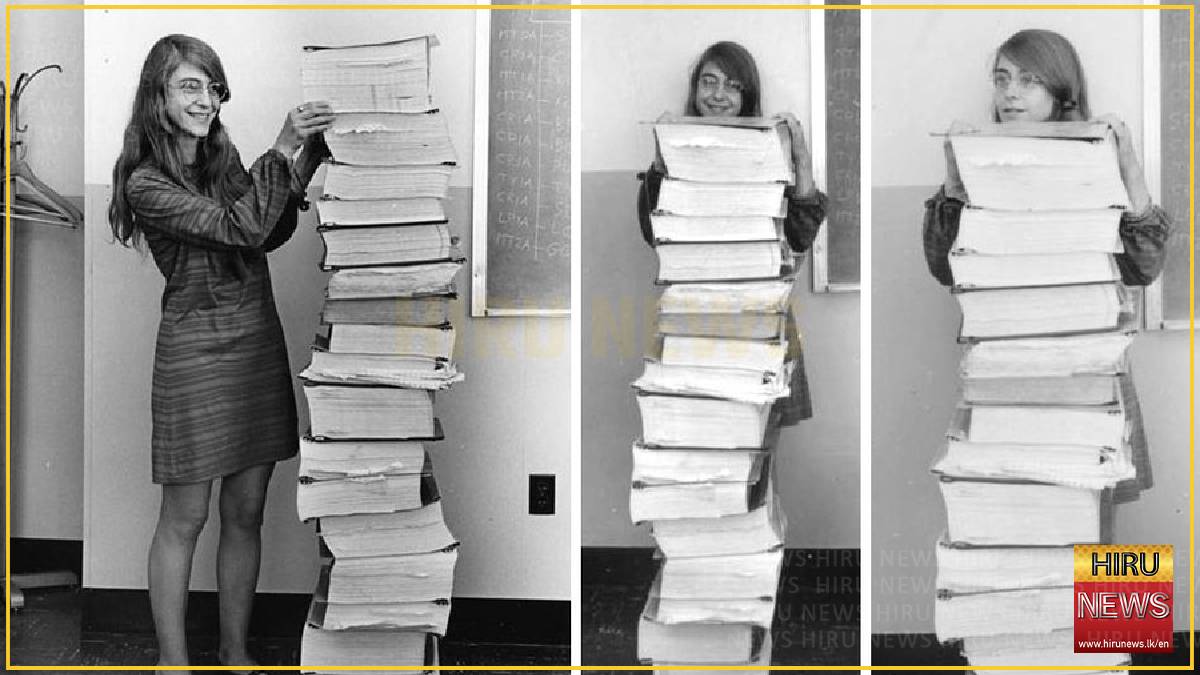
The photograph most associated with her — reproduced with the filing — shows Hamilton in 1969 standing beside a stack of printed Apollo source listings taller than she is.
Before and after Apollo
Born in Indiana in 1936, Hamilton studied mathematics at the University of Michigan from 1955 before moving to Earlham College, where she took a BA in mathematics in 1958. She moved to Boston a year later with her husband and originally took the MIT job to support him through his law degree.
From the 1970s she founded her own software companies, including Hamilton Technologies, still based in Massachusetts. In 2016 Barack Obama awarded her the Presidential Medal of Freedom, saying she “symbolises that generation of unsung women who helped send humankind into space”.
Earlham College said it was “saddened by her death, but grateful for the opportunity to have celebrated her extraordinary achievements throughout her long life,” adding that “her pioneering spirit and remarkable legacy will continue to inspire generations of Earlhamites.”
She is survived by her daughter, a son-in-law, two grandsons and four great-grandchildren, according to MIT.
Not reported: the filing does not give a cause of death or say where she died. It does not explain the gap between her death on 30 September and its announcement, and carries no comment from NASA or from her family.