President Anura Kumara Dissanayake said on Thursday that a committee will be appointed to amend the law governing how Buddhist monks are held in prison and how they are transported outside it, NewsFirst reported.
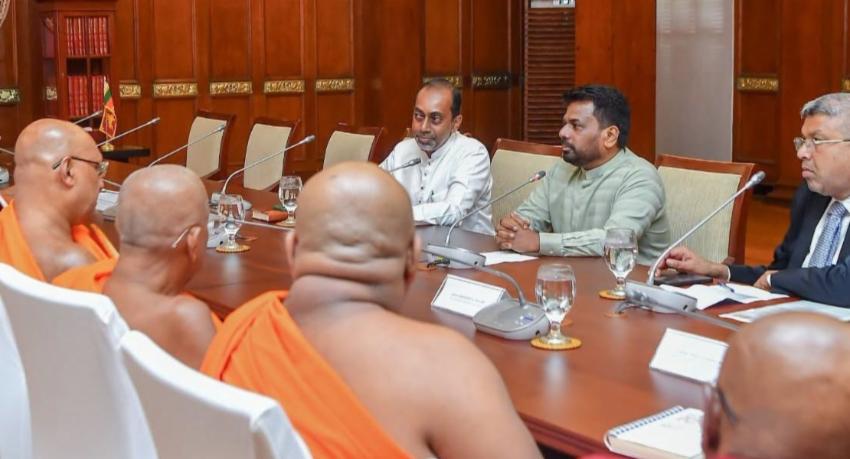
He announced the decision at a special discussion with the Maha Sangha at the Presidential Secretariat. Hiru News reported earlier in the day that the meeting was set for 1:00 p.m. and would bring together clergy representing the Chief Prelates of the three nikayas.
What the committee will cover
The panel is to comprise the Attorney General, representatives of the Ministry of Justice, the Ministry of Public Administration and the Ministry of Buddhasasana and Religious Affairs, prison officers and the Commissioner General of Prisons. It has been asked to study the matter and submit amendments within two weeks, and to propose new standing orders and regulations.
The President said he was not prepared to issue orders for particular individuals where general laws exist, and that the proper course, if current law is unsuited to present conditions, is to amend it.
The meeting followed the letter the Mahanayake Theras sent to the Commissioner General of Prisons after Ven. Galagoda Aththe Gnanasara Thera was produced in court in lay clothing. This newsroom reported on Tuesday that all four Mahanayaka Theras had told Prisons only the Maha Sangha may remove his robes, days after he was returned to Welikada Prison to serve a six-year sentence.
Two opposition parties attack the removal
Sri Lanka Freedom Party General Secretary Duminda Dissanayake told reporters the Government had “touched the robe” and should go no further, the Daily Mirror reported.
“The Government should not get ready to set fire to the robe. You are about to undermine our history, prosperity and civilisation.”
United National Party Chairman Vajira Abeywardena said in a statement that under the Vinaya Pitaka only the nikaya to which a monk belongs may disrobe him, and that the action raised questions under Articles 9 and 10 of the Constitution, which concern the foremost place given to Buddhism and freedom of thought, conscience and religion. He said the Justice Ministry should have sought the Mahanayake Theras’ views first.
Update, 8 October evening: the President’s reasoning, and a petition reaches the Supreme Court
A fundamental rights petition has been filed in the Supreme Court seeking an order preventing prison authorities from producing Gnanasara Thera before court in prison attire, the Daily Mirror reported. The petitioner is a retired Air Force officer, Shantha Jayathilaka, and the respondents are the Commissioner General of Prisons, the Secretary to the Ministry of Justice and the Attorney General.
The petition asks the court to direct that the Thera be produced clad in his bhikkhu robes, and to declare that disrobing him and producing him in prison attire violates Articles 10, 12(1) and 14(1)(e) of the Constitution. It invokes Article 9, which requires the State to protect and foster Buddhism, and cites Prison Standing Order 550, which the petitioner says requires that, prior to conviction, a person be permitted clothing corresponding to the style of dress he previously used. It further contends that under Buddhist disciplinary rules a monk does not cease to be a monk merely because he has been found guilty of a secular criminal offence.
That last argument runs alongside, not through, the committee the President announced: the petition seeks a judicial remedy on the existing law, while the committee is to propose changing it.
The President’s reasoning, in his own words. A fuller account of the Maha Sangha meeting was reported by the Daily Mirror and by Hiru News. President Dissanayake said he would not order officials to act contrary to existing law:
“I do not wish to issue an order saying, ‘Although the law exists in this form, do this instead.’ In such a situation, the law is set aside and it becomes my law. My personal wishes should not become the law.”
He added: “Laws are not eternal or unchanging historical entities. They are regularly amended.”
The President set out the legal framework at issue — the Prisons Ordinance enacted in 1877, regulations issued by the Minister, and standing orders issued by the Commissioner-General with ministerial approval. Most of those provisions, he said, were framed with ordinary prisoners in mind, with only limited provisions referring specifically to Buddhist monks. That is the gap the committee has been asked to close, and he said provisions affecting Buddhist monks would be discussed with the Maha Sangha before being amended.
Hiru’s account describes the committee’s remit as covering the treatment and transportation of monks in prison custody — the escorting of monks to court, as well as their detention — and renders the first member as representatives of the Attorney General’s Department rather than the Attorney General personally. The two-week deadline and the rest of the composition match.
Hiru also records the meeting as taking place in the afternoon, consistent with the 1:00 p.m. start reported earlier in the day.
Not reported
Neither the composition’s chair nor whether the committee’s amendments will be tabled as a bill is stated in any filing. No outlet reports the Prisons Department’s own account of why the robes were removed, nor whether the measure applies to the other ordained prisoners currently serving sentences.
On the petition: no filing reports when it will be supported before the court, which bench will take it, or whether the Attorney General has responded. Neither outlet reports whether Gnanasara Thera’s own counsel is party to it or whether he has any separate application pending — the petitioner is a retired officer acting in his own name, not the Thera or his lawyers. No filing reports a government response to the petition, and none says whether the committee’s work will be affected by it.