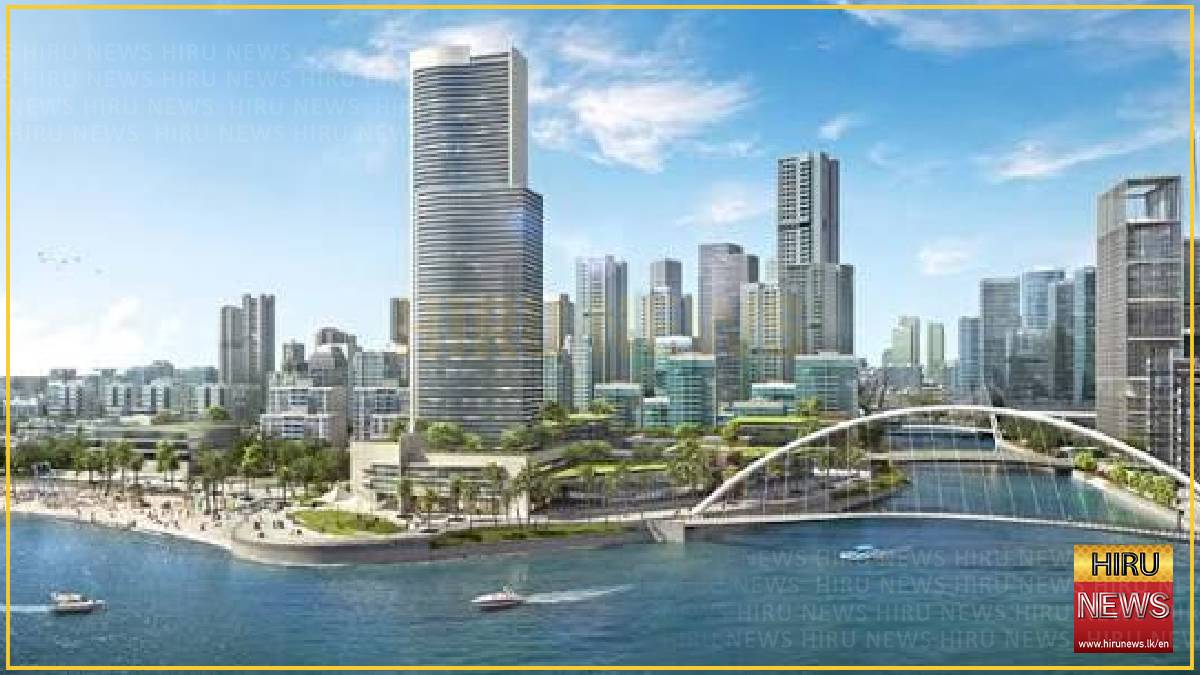
Tax exemptions granted to residential developments inside Colombo Port City create a “highly distortionary and unequal” regime for real estate businesses operating elsewhere in Sri Lanka, the Advocata Institute has said in a report carried by Lanka Business Online and the Daily FT.
What the four developers hold
All four companies registered with the Port City Commission as real estate developers are classified as Primary Businesses of Strategic Importance, under regulations issued in Gazette No. 2343/60 of 4 August 2023 and Gazette No. 2454/62 of 20 September 2025.
Prime Melwa Port City (Pvt) Ltd and Home Lands Port City (Pvt) Ltd each receive a 10-year exemption from corporate income tax once their project implementation periods expire. Marina Hotel Holdings (Pvt) Ltd receives eight years. ICC Port City (Pvt) Ltd holds a wider package: 25 years free of income, profit, dividend and withholding taxes, followed by a 50 percent reduction in the prevailing corporate rate for a further ten.
All four are also exempt from customs duty, the Ports and Airports Development Levy and Cess on approved business imports during implementation; ICC Port City holds those for 25 years, plus a 25-year VAT exemption on approved imports and local purchases.
The argument
Advocata’s case is that the concessions separate otherwise similar businesses on location alone, and are hard to justify when the zone already carries oceanfront sites, a planned urban environment and dedicated access from the Katunayake Expressway via the Port Access Elevated Highway — advantages capable of attracting investment on their own. It argues the government should instead address the governance and regulatory bottlenecks it has previously identified.
Incentives should be warranted by benefits that would not otherwise arise, it says — substantial positive externalities or catalytic effects such as knowledge spillovers or industrial development. On publicly available information, it finds limited evidence that the proposed residential projects produce benefits on that scale. Because typical projects finish within three to five years, many concessions effectively cover the entire development period.
Who the flats are for
Lower development costs need not mean lower prices. Port City residential stock is marketed predominantly as luxury housing at around US$500 per square foot — roughly LKR 160–165 million for a typical unit — with entry-level units near US$350. Housing aimed at middle- and lower-income buyers in Colombo is closer to US$100 or less per square foot, about LKR 30–33 million.
The buyers, Advocata notes, are higher-income households making up 0.1 percent of Sri Lankan households — about 6,000 families — while developments outside the zone serving middle, upper-middle and lower-income households receive no equivalent relief.
It closes on governance, pointing to the administration’s electoral pledge on corruption: concessions difficult to justify on economic grounds risk “serious questions about the integrity of the policymaking process” and heighten concerns about regulatory capture, eroding confidence in the wider reform agenda. It calls for a review.
A note on the sourcing
Lanka Business Online and the Daily FT carry the Advocata statement in near-identical terms, and Hiru News published a rewrite. These are three verified domains publishing one institute’s release, not three independent investigations of the Port City tax regime.
A figure to flag: Hiru’s rewrite gives the luxury marketing price as “around 350 dollars per square foot.” In the fuller text carried by Lanka Business Online, US$350 is the entry-level price and US$500 the luxury one. The fuller account is used above.
Not reported
No response from the Colombo Port City Economic Commission, the Treasury, the Finance Ministry or any of the four named developers appears in any filing. None gives the value of the tax expenditure involved, the length of the project implementation periods from which the exemption clocks run, or how many residential units are in the pipeline. The report’s own publication page is not linked by either outlet, and no government review of the concessions has been announced.
Sources: Lanka Business Online, Daily FT, Hiru News.
