Update, later on 14 October — the government says it will pay the family’s legal costs, and the account has moved from a Facebook post to a formal statement. A second Daily Mirror filing also describes the Supreme Court as having decided “to review” the verdict, a third formulation of what happened. See Update: the formal statement at the foot of this article.
The Supreme Court of Saudi Arabia has set aside the death sentence imposed on Sri Lankan migrant worker Anojan Sivarasa, Deputy Minister of Foreign Affairs Arun Hemachandra announced on Wednesday — three months after the 24-year-old was arrested over a Facebook post, and two days after his appeal was lodged.
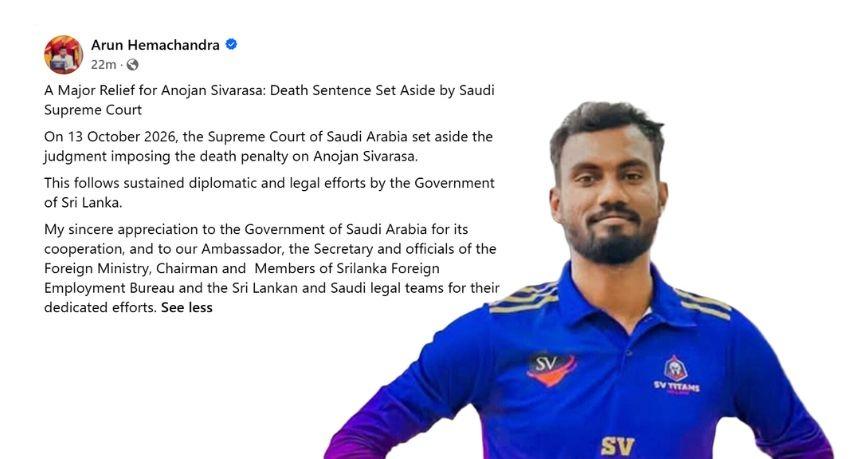
The decision was delivered on 13 October 2026, NewsFirst reported, citing Hemachandra’s account. The Deputy Minister made the announcement in a Facebook post on Wednesday morning, describing the ruling as a major relief for Sivarasa and his family and attributing it to sustained diplomatic and legal effort by the government.
“My sincere appreciation to the Government of Saudi Arabia for its cooperation, and to our Ambassador, the Secretary and officials of the Foreign Ministry, Chairman and Members of Srilanka Foreign Employment Bureau and the Sri Lankan and Saudi legal teams for their dedicated efforts,” Hemachandra said.
The Daily Mirror, filing at 10.44 a.m., reported the overturn as having happened “reportedly” — a hedge that reflects the sourcing. All three accounts rest on the Deputy Minister’s social media post. No filing reports a statement from the Saudi Supreme Court itself, from the Foreign Ministry as an institution, or from the Attorney General’s Department.
Which court decided — a conflict, and what settles it
The three newsrooms do not agree on which court acted.
| Court that set the sentence aside | |
|---|---|
| NewsFirst | Supreme Court of Saudi Arabia |
| Daily Mirror | Supreme Court, overturning the Court of Appeal’s verdict |
| Hiru News | Court of Appeal, setting aside “its earlier judgement” |
Hiru’s account has the court that imposed the death sentence reversing itself. That is not a trivial difference: it would mean the Supreme Court appeal filed on 11 October was not what produced the result.
The primary document supports the Supreme Court. Hemachandra’s post, reproduced in NewsFirst’s filing, is headed “Death Sentence Set Aside by Saudi Supreme Court” and states that “On 13 October 2026, the Supreme Court of Saudi Arabia set aside the judgment imposing the death penalty.” Two of the three outlets agree with it, and this newsroom’s own record has the appeal lodged before the Supreme Court on 11 October. Hiru’s body text is otherwise recycled background from its earlier filing on the case. Its court attribution should be treated as an error unless corrected.
Two days from filing to judgment
The sequence is unusually compressed. Amnesty International’s chronology, reported here on 10 October, dates Sivarasa’s arrest to 1 July 2026. The Al-Ahsa criminal court sentenced him on 27 July to five years and a fine of three million Saudi riyals — about US$800,000 — over a comment posted on Facebook. On 17 September, the Court of Appeal in the Eastern Region increased that to death on the public prosecutor’s appeal, classifying the offence as a hadd matter under Sharia law.
The appeal against that sentence was filed on 11 October. The Supreme Court ruled on 13 October — two days later.
No filing gives the court’s reasoning. It is worth recording what was argued, without claiming it was decisive: Hiru’s earlier reporting noted that the Supreme Court reviews lower-court judgments primarily on legal and procedural grounds rather than re-examining facts, and Amnesty had alleged that Sivarasa was denied access to a lawyer from his arrest until his first sentencing — a procedural ground covering the entire first-instance proceeding.
The legal team, and a name finally settled
NewsFirst publishes the fullest list of the Sri Lankan delegation yet, with formal names, and it resolves a discrepancy this newsroom has tracked across four spellings. The Additional Solicitor General — rendered variously as Asad, Azard and Azad Navavi across previous filings — is given as Hafeez Azard Navavi, PC, supporting Azard.
The five named are Navavi; Mohamed Faiszer Musthapha, MP and President’s Counsel; Justice M.T. Mohamed Laffar, Consul General of Sri Lanka in Jeddah; K.A. Upul Indika Kumarapperuma, PC; and Farisz Fazal Abdul Hafeel Mohomed, Attorney-at-Law. The Daily Mirror lists four, omitting Laffar — who earlier filings described as an official participant rather than a member of the legal team.
The Daily Mirror notes that Sri Lanka’s Ambassador to Saudi Arabia, Amir Ajwad, was instrumental in the diplomatic effort. He had visited Sivarasa at Dammam Central Prison on 8 October.
Not reported
What happens to Sivarasa now is the central unanswered question. Setting aside a sentence is not the same as release, and no filing says whether he will be freed, retried, resentenced by a lower court, or held pending further process. The Daily Mirror describes the government’s work as an effort “to secure Sivarasa’s release” — but reports no release.
None of the three says whether the Supreme Court remitted the case, gave reasons, or ruled on the underlying conviction as distinct from the sentence. None reports a response from his family, from Amnesty International, or from the Saudi authorities. The clemency petition to the King, which earlier reporting described as the step held in reserve, is not mentioned; nor is whether it is now moot.
The Daily Mirror places the outcome against the case of Rizana Nafeek, the Sri Lankan domestic worker executed in Saudi Arabia in 2013 despite clemency efforts — the comparison that has shadowed this case since the death sentence was first reported on 18 September.
Update: the formal statement, and who pays for the defence
Deputy Foreign Minister Arun Hemachandra has issued a formal statement on the case, thanking the Government of Saudi Arabia for its support and conveying Sri Lanka’s respect for the Saudi judicial system, the Daily Mirror reported at 11.57 a.m. on Wednesday — just over an hour after its first filing on the ruling.
The paper is already cited above, so this adds no source domain and no change to this article’s credibility rating. It adds three things of substance.
The government will pay, including retrospectively
The state has decided to cover the legal expenses of the case and to fully reimburse the legal costs the family had already incurred. Neither the morning filings nor Hemachandra’s Facebook post mentioned money.
This is the first reported financial commitment in the case, and the reimbursement element is the notable half: it means costs the family bore privately — through the first-instance trial at Al-Ahsa and the Court of Appeal proceeding that produced the death sentence — are to be repaid. The filing does not give a figure, a timeframe, or say whether the three million Saudi riyal fine imposed at first instance, about US$800,000, falls within the undertaking. That omission matters, because the fine is the largest sum named anywhere in this case and its status after the Supreme Court’s decision is unreported.
A third description of what the court did
The Daily Mirror’s second filing says the Supreme Court “decided on October 13, 2026, to review the death penalty verdict imposed on Shivarasah by the Court of Appeal,” and that “following the decision, the death penalty imposed under the earlier ruling was removed.”
That is not quite either of the formulations recorded above. The table of conflicting accounts dealt with which court acted; this is a difference in what it did — “decided to review” describes opening a process, while “set aside the judgment,” the wording of Hemachandra’s own post, describes concluding one. The outcome stated is the same in both: the death penalty is gone.
The hedge may be no more than loose drafting in a paper that had already reported the overturn “reportedly” an hour earlier. But it bears directly on the central open question below — whether anything further is pending — and this desk cannot resolve it from the filings. Both formulations are recorded here rather than one being preferred.
Independent corroboration of the sentence chronology
The filing states that Sivarasa “was initially sentenced to five years in prison in connection with a social media publication before the Court of Appeal subsequently imposed the death penalty.”
Until now the five-year first-instance sentence reached this desk only through Amnesty International’s chronology, relayed by Hiru. A verified newsroom has now stated it in its own reporting, which upgrades that part of the timeline from a rights group’s account to independently reported fact.
Who was involved
The statement names more of the machinery than the morning accounts did. President Anura Kumara Dissanayake, the Prime Minister and Foreign Minister Vijitha Herath guided the effort through diplomatic, consular and legal channels. Sivarasa’s family members, together with the President and Foreign Ministry officials, held discussions with Saudi authorities — the first report of the family meeting the Saudi side, and of the President’s direct participation. A special Sri Lankan legal team worked with Saudi legal experts.
Hemachandra also thanked Sri Lanka’s Ambassador to Saudi Arabia and embassy officials, the Secretary and senior officials of the Foreign Ministry, and the Sri Lanka Bureau of Foreign Employment.
What it does not close
The statement does not say what happens to Sivarasa now — the question this article leads its Not reported section with. It reports no release, no retrial date, no remittal, and no account of the Supreme Court’s reasoning. It carries no comment from the family in their own words, and none from the Saudi authorities, whose judicial system it thanks but who have still not been reported as saying anything about this case.
One presentational note: this filing renders the name “Anojan Shivarasah”, against “Anojan Sivarasa” elsewhere in the same paper’s coverage. The variant is a transliteration difference, not a second person.