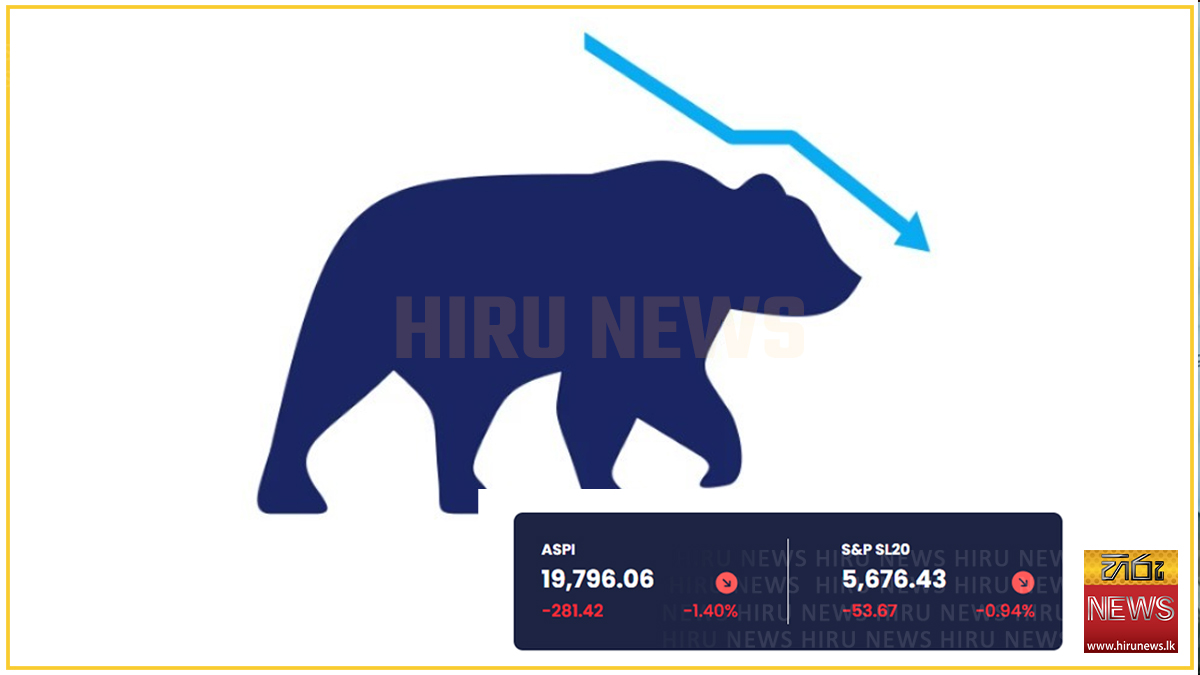
The All Share Price Index closed below 20,000 on Wednesday for the first time since 14 August 2025, falling 281.42 points, or 1.40%, to a new year-to-date low of 19,796.06.
The more liquid S&P SL20 fell 53.67 points, or 0.94%, to 5,676.43. Both figures are reported identically by the Daily Mirror and Hiru News, which supplied the August 2025 comparison.
The index broke through the 20,000 level during the session and kept weakening into the close.
The breadth number is the alarming one
Market breadth collapsed to 21 gainers against 203 decliners — an advance-decline ratio of 0.10. Nearly ten stocks fell for every one that rose.
Dialog Axiata was the largest negative contributor to the index, followed by Carson Cumberbatch, Distilleries, Commercial Bank and Tokyo Cement. Haycarb provided the strongest positive contribution.
Foreign investors were only marginal net sellers, with an outflow of about Rs. 4.88 million — small enough that this was a domestic sell-off, not a foreign exit.
Turnover rose, but read it carefully
Turnover improved to Rs. 1.93 billion on 104.30 million shares. Capital Goods led sector activity with Rs. 405.82 million, and Dialog Axiata recorded the highest single-counter turnover at Rs. 294.89 million.
Crossings accounted for around 35% of total turnover, led by Dialog Axiata with Rs. 264.60 million. DIMO, John Keells Holdings, Lanka IOC and Sampath Bank also recorded sizeable block transactions.
That is the same caveat this newsroom applied on 7 October, when crossings made up 44% of a similarly “improved” turnover figure. Block transactions negotiated off the open market are not evidence of renewed on-market appetite. Strip them out and roughly two-thirds of Wednesday’s value remains — against breadth of ten-to-one down.
A forecast the market has now run straight through
On 9 October, when the ASPI closed up 0.41% at 20,316.91, Raynal Wickremeratne, Head of Research and Strategy at NDB Securities, told EconomyNext that “20,000 is also a psychological limit” for the index — a level at which buying interest could be expected to emerge.
Three trading sessions later the index went through it without pausing. From that 9 October close, the ASPI has lost 520.85 points, or 2.56%. No filing on Wednesday revisited the forecast.
Where this sits in the year
The ASPI was down about 8.1% for the year at the end of September, after six monthly declines in the first nine months of 2026 against three monthly gains. September alone took 2.46% off the index.
Wednesday’s close extends that. The market’s ability to find support below 20,000 is what the next few sessions will test.
Not reported
Neither filing identifies a trigger for the sell-off — no policy announcement, earnings event or external shock is named. Neither gives the year-to-date percentage decline at Wednesday’s close, nor says whether the 14 August 2025 comparison refers to an intraday or closing level.