Sri Lanka will put four high-voltage transmission lines out to private tender, opening to private capital a part of the electricity industry that has never had any — and the government’s case for it rests on a tariff collapse already achieved in generation.
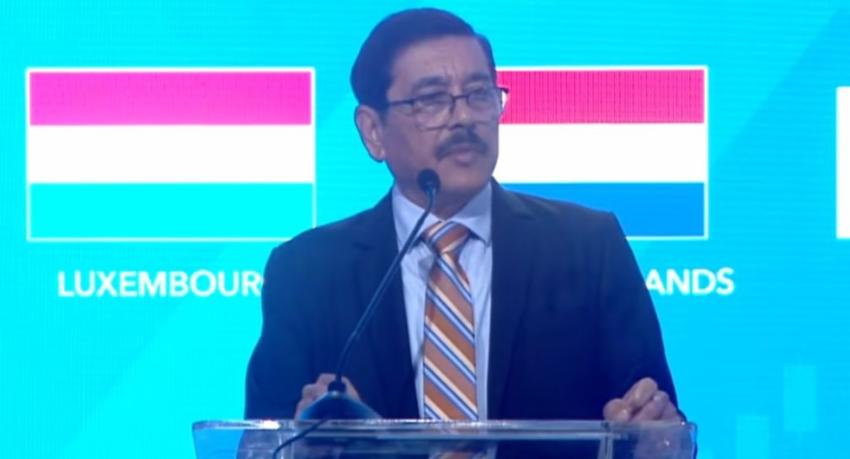
President Anura Kumara Dissanayake set out the plan at the Sri Lanka Economic and Investment Summit 2026, held at the Shangri-La Hotel in Colombo and organised by the Ceylon Chamber of Commerce.
“We have an expectation to bring in private investments for transmission systems. For that, we have already identified four grid lines; we will tender those four very soon. Then, I believe, the private sector can also join our transmission system,”
he said, according to EconomyNext.
What is being tendered, and what is not
The split between state and private money runs along specific corridors.
| Line | Who builds it |
|---|---|
| Kilinochchi–Habarana | The state, funded through continuing Asian Development Bank assistance |
| Puttalam–Wariyapola | Private tender |
| Dambulla–Habarana–Veyangoda | Private tender |
The two accounts render the private routes differently, and reading them together resolves an ambiguity in each. EconomyNext lists the prospective routes as “Puttalam–Wariyapola, Dambulla, and Habarana–Veyangoda” — three items for four lines, with Dambulla left as a bare place name rather than a corridor. Lanka Business Online’s 13 October filing writes the same thing as “Puttalam-Wariyapola and Dambulla-Habarana-Veyangoda”, which gives Dambulla an endpoint and makes sense of the list.
Even reconciled, the arithmetic does not fully close. Two named corridors are not four lines, unless Dambulla–Habarana and Habarana–Veyangoda are counted as separate segments. Neither filing states the four-line breakdown, and neither gives a cost or a tender date beyond “very soon”.
Energy experts put the cost of modernising the grid at between US$4 billion and US$5 billion, EconomyNext reports — a sector-wide estimate, not a price for these four lines. The expectation is that private capital on the transmission side reduces debt pressure on the Treasury while expanding the grid’s capacity to absorb renewable power.
Dissanayake framed the policy around two variables:
“If you take the energy sector, we focus our attention on two things: the stability and continuity of power, and the cost borne for power. It is upon these two factors that our power and energy policy is built.”
The monopoly being broken is not the CEB’s
Lanka Business Online reports the plan as “ending the Ceylon Electricity Board’s monopoly on transmission”. That description names an entity that no longer exists, and the correction matters for understanding what is actually changing.
The CEB was dissolved in March 2026, its functions unbundled into six state-owned successor companies covering generation, transmission, distribution and system operations. This desk recorded the point at which that became formal in credit markets: Fitch withdrew the CEB’s A(lka) national rating on the grounds that the utility no longer existed and would no longer be covered.
EconomyNext states the current position correctly. The national grid and all high-voltage transmission lines — 220kV and 132kV — are owned, managed and operated by the National Transmission Network Service Provider (Private) Limited, one of the six successors. Transmission in Sri Lanka is, as EconomyNext puts it, “currently completely state-owned.”
So what the tender opens up is not a vertically integrated state utility’s grip on the wires. It is the ring-fenced transmission company created barely seven months ago — a company that has held the asset for less than a year being asked to share new construction with private developers. Both readings describe private money entering transmission for the first time; only one describes the counterparty accurately.
The number doing the persuading
The strongest evidence the government offers for competitive tendering comes from generation, where it has already been tried.
A Mannar project had been negotiated at 8.22 US cents per kilowatt-hour. The developer would not go below 5 cents, and the project was dropped. Retendered competitively, two later 50-megawatt awards came in at 3.96 and 3.74 cents.
Set against the original price, that is a fall of 52% to 55%. Set against the 5-cent floor the original developer refused to cross, the best competitive bid came in about 25% lower still. Neither filing frames it that way, and it is the sharpest figure in the government’s case: the price the market would not go below under negotiation turned out to be a quarter above what it would accept under competition.
The President has questioned reliance on fixed feed-in tariffs set by the Public Utilities Commission on exactly this basis, a position recorded in his summit remarks on the wider project slate.
The two filings disagree on what Mannar was
Lanka Business Online’s 13 October account calls it “an abandoned wind power project at Mannar”. Its 14 October account calls it “a Mannar solar project”. Same outlet, consecutive days, same price and same two retender awards.
Mannar is Sri Lanka’s principal wind corridor, which favours the 13 October reading, and this article does not treat the discrepancy as settled. The prices are not in dispute in either version.
Renewables: the capacity claim, and where it does not add up
Renewable sources now account for about 69% of total generation capacity. On recent days, Lanka Business Online reports, as much as 77% of electricity was produced without burning a single litre of diesel.
Solar has carried most of the growth, and the two filings do not agree on its size:
- The 13 October filing: solar expanded by 1,500MW since the government took office, reaching 2,600MW in total once ongoing projects conclude next year.
- The 14 October filing: solar grew by 1,500MW in two years “from a base of 1,400”, with a further 1,100MW contracted for next year.
These cannot both hold. A 1,400MW base plus 1,500MW of growth is 2,900MW today, which already exceeds the 2,600MW the first filing puts at the end of next year. The discrepancy is left open here; the 1,500MW of added capacity is the one figure both carry.
Land scarcity is pushing the programme onto water. Floating solar is being developed on the Ibbankatuwa, Randenigala, Moragahakanda and Samanalawewa reservoirs.
Storage is the stated answer to daytime surplus
With solar concentrated in daylight hours, the government is moving on batteries:
- A 160MW grid-scale battery tender is under way, with the first 130MW expected complete by November.
- A further 250MW battery tender is under evaluation, with bids reported about 10% cheaper.
- Tax incentives are under review for household solar users installing battery systems under one megawatt.
Not reported
No cost, tender date or financing structure is given for any of the four transmission lines, and neither filing names the fourth line or says how the four map onto the two named corridors. Neither states what return a private transmission developer would earn, who would own the line once built, or how it would be regulated — the National Transmission Network Service Provider’s role as counterparty is not described at all.
Neither filing says whether Cabinet has approved the transmission tenders, whether the Public Utilities Commission has a role in approving them, or whether the trade unions in the six successor companies have been consulted. The US$4–5 billion modernisation estimate is attributed to unnamed “energy experts” with no breakdown and no timeframe.
On renewables, the two solar capacity accounts are not reconciled, the Mannar project’s technology is given two ways, and no filing says what the 160MW battery tender costs or who is bidding. The 77% diesel-free figure is given for “recent days” without naming them.
Sources
- Sri Lanka to open power transmission to private sector: President — EconomyNext, 13 October 2026
- Sri Lanka Accelerates Renewable Energy Transition, Grid Upgrades, and Competitive Tariff Reforms — Lanka Business Online, 13 October 2026
- Sri Lanka to open ports and power grid to private investors: President — Lanka Business Online, 14 October 2026