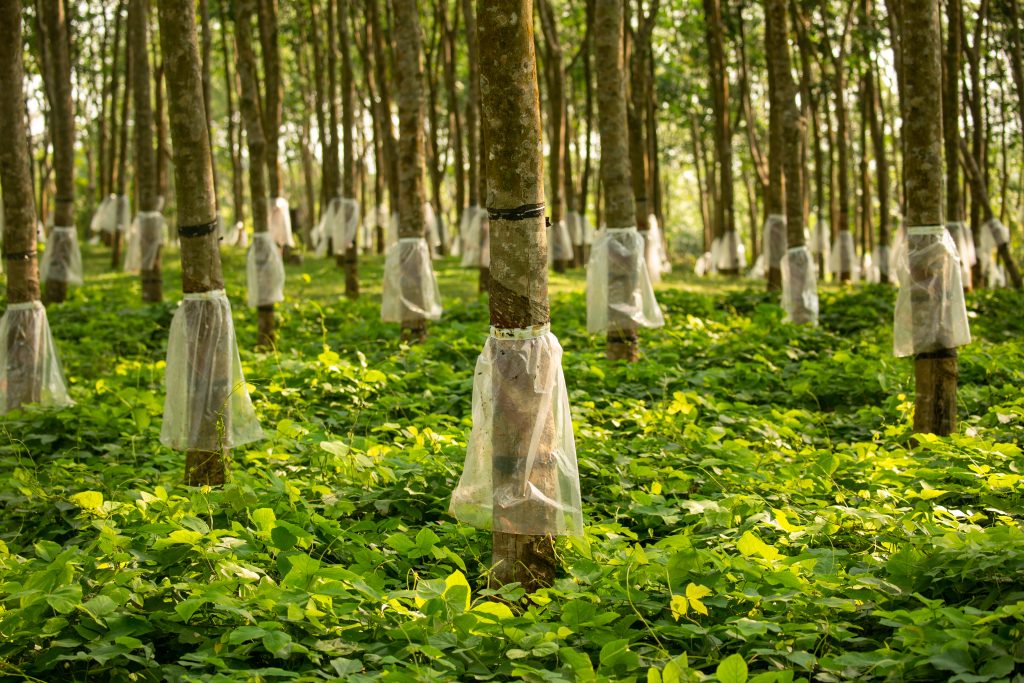
Sri Lanka marks 150 years of rubber cultivation this year, dating from the 1876 arrival of a shipment of young Hevea brasiliensis seedlings at the Henarathgoda Botanical Gardens in Gampaha — the consignment that put Ceylon at the origin of Asia’s commercial rubber industry.
The anniversary is being marked by the Planters’ Association of Ceylon, which represents the managers of the country’s plantation sector, in a commemorative account published by Lanka Business Online.
How the seedlings got there
The plants came out of the Amazon in a British operation to break Brazil’s monopoly on a material that had just become industrially indispensable. Seeds collected by the botanist Henry Wickham were germinated at Kew Gardens in London and shipped onward to Britain’s Asian colonies. The Planters’ Association’s own account calls them “smuggled seedlings”.
Two inventions had created the demand. Charles Goodyear’s discovery of vulcanisation in 1839 turned temperature-sensitive latex into a durable industrial material, and John Boyd Dunlop’s pneumatic tyre of 1888 created a global market Brazil’s forests alone could not supply.
Commercial planting took hold fast. By the early 1900s the acreage under rubber rose from roughly 25,000 to over 100,000 acres within a few years, as low-country planters switched to the new crop while tea prices slumped on world markets.
Two institutional legacies date from the period:
- The Rubber Research Institute of Sri Lanka, founded in 1909 and described as the oldest rubber research institute in the world.
- Sri Lankan Latex Crepe No. 1, a grade the association describes as the purest form of natural rubber available anywhere, still sold into medical and premium footwear markets.
Rubber also served as an instrument of foreign policy. In 1952 Ceylon signed the Rubber-Rice Pact with China, trading rubber for rice at a time when both countries faced shortages — an unusual case of a plantation crop carrying a diplomatic agreement.
Where the sector stands
Production first peaked in the mid-1960s at over 107,000 metric tons, which established rubber alongside tea and coconut as one of the island’s three defining exports. Output reached its historic high in 2011, at 158,000 metric tons.
Export earnings from rubber and rubber-based finished products reached USD 1.1 billion in 2024 — the most recent year the association cites — driven by surgical gloves, industrial products and solid tyres. Sri Lanka is the world’s largest manufacturer of solid tyres. The sector sustains an estimated 300,000 livelihoods, many of them rural women in the traditional growing districts.
The value, in other words, is now in processing rather than in the crop. That is the live end of the industry: this desk reported last week on Dipped Products’ new Rs. 4.2 billion glove plant at Katunayake, one of the manufacturing operations the USD 1.1 billion figure rests on.
The figure the anniversary leaves out
For a sector review, the account is notably silent on one number: current production. It gives the 1960s peak and the 2011 high, and then stops.
The roadmap it sets out implies the direction. The association’s phased plan begins, in the short term, with bringing untapped land back into productive use and targeting improved national yields by 2027 — followed in the longer term by replanting, expansion into non-traditional growing regions, and modern traceability systems for export markets.
Those are the priorities of an industry recovering ground, not one at capacity. Untapped land and yield improvement are only short-term priorities if there is idle acreage and sub-par yield to address. The anniversary piece does not say how far output has fallen from the 158,000 tons of 2011, and this article does not estimate it.
A note on sourcing
This article rests on a single verified source, and the nature of that source should be stated. The account is the Planters’ Association of Ceylon’s own commemorative copy, published under the opinion-style headline “A milestone worth celebrating” and written in a celebratory register. The historical and economic claims above are the association’s.
A search of the verified Sri Lankan newsrooms this desk monitors found no other current filing on the anniversary — the other results were unrelated or years-old features on the rubber sector. The milestone appears to be genuinely uncovered elsewhere rather than under-reported here, but a second independent account would be worth having, and the figures above have not been checked against the Rubber Research Institute, the Department of Census and Statistics, or the Export Development Board.
Lanka Business Online serves no machine-readable publication date on this item; the date above is taken from its permalink path, which is the standing practice for this publisher.
Not reported
No current annual production figure, no acreage under cultivation today, and no export figure more recent than 2024. The roadmap carries no quantified yield target for 2027, no hectare figure for the untapped land to be recovered, no replanting rate, and no cost or funding source for any phase.
The account does not say which non-traditional regions are being considered for expansion, what the traceability systems would comply with, or whether government bodies — the Ministry of Plantation Industries or the Rubber Research Institute — are party to the roadmap or whether it is an industry plan alone. Smallholders, who hold a large share of Sri Lanka’s rubber land, are mentioned only in passing and the roadmap’s application to them is not described.