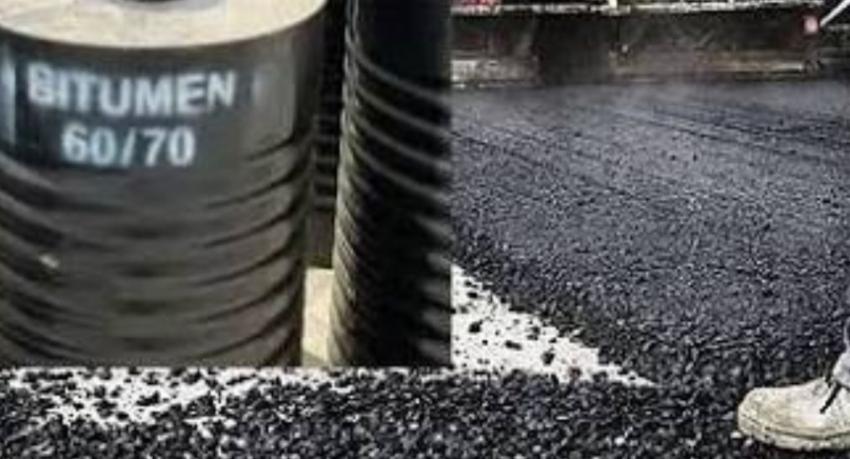
Sri Lanka has begun importing bitumen from alternative markets after a halt of roughly seven months, but shipping companies are refusing to carry it and insurers are reluctant to cover the cargoes, the Road Development Authority has said, NewsFirst reported at 8.46 a.m. on Thursday.
Director General N. A. Hettiarachchi said Sri Lanka previously imported large quantities of high-quality bitumen produced in Iran, and that imports stopped in March because of the Middle East conflict and the blockade of the Strait of Hormuz.
The country requires at least 20,000 metric tonnes a month for road maintenance and development. Limited quantities are now arriving through alternative routes from Kazakhstan, Bahrain, China, India, Malaysia and Thailand.
Despite the availability of alternative markets, many shipping companies are refusing to transport bitumen to Sri Lanka for fear of U.S. sanctions and the risk of vessels coming under attack, and international insurance providers have been reluctant to offer cover.
The first confirmation that anything is arriving
The significant word is “begun”. For seven months the RDA’s position has been that it could not import at all.
In June, the Authority said it had been unable to import road-construction tar since February and had opened diplomatic-level talks with five countries to find alternative supply. Thursday’s filing is the first report this desk has seen that those efforts have produced actual cargoes rather than negotiations.
How much is arriving is not stated. “Limited quantities” against a stated requirement of 20,000 tonnes a month leaves the gap unquantified, and the RDA does not say what share of need is being met.
Three things changed between June and October
Read against the June account, the RDA’s own description of the problem has shifted in three ways.
The halt date moved by a month. In June the Authority said imports had stopped in February. On Thursday it said March. Both statements are the RDA’s own, about the same interruption. The discrepancy is small but it is not reconciled anywhere, and it changes the duration of the shortage from about eight months to about seven.
The supplier list was rebuilt. June’s five candidate countries were Malaysia, Thailand, India, Oman and Russia. October’s six actual sources are Kazakhstan, Bahrain, China, India, Malaysia and Thailand.
| Country | June talks | October imports |
|---|---|---|
| India, Malaysia, Thailand | ✓ | ✓ |
| Oman, Russia | ✓ | — |
| Kazakhstan, Bahrain, China | — | ✓ |
Three of the five countries the RDA approached are supplying; Oman and Russia are absent from the October list, and three suppliers appear that were not in the original diplomatic effort. Indonesia, which the construction industry suggested in September as the obvious alternative market, appears in neither list.
The obstacle changed entirely. In June the RDA said the central difficulty was technical: products from the candidate countries “do not meet Sri Lanka’s technical standards and specifications”, and “tar of such quality is scarce in other countries.”
That objection has disappeared from the Authority’s account. Thursday’s constraint is logistical and financial — carriers declining the voyage, and underwriters declining the risk. Whether the specification problem was solved, waived or simply superseded is not addressed. For a road agency, those are very different outcomes: the first means equivalent material, the second means roads built to a different standard.
Dubai was the port; Iran was the refinery
One apparent contradiction between our own filings resolves rather than conflicts.
June’s report said Sri Lanka sourced 100 per cent of its road-construction tar from Dubai. Thursday’s says the material was produced in Iran. In September, the Chamber of Construction Industry’s Secretary General Eng. Col. (Rtd) Nissanka N. Wijeratne told a weekend newspaper that most of the bitumen was obtained from Iran itself.
The straightforward reading is that these describe the same trade at different points: Iran the producing refinery, Dubai the trading and re-export hub through which the cargo was bought. The RDA has now named the origin where it previously named the point of purchase, and the industry had already named the origin a month before that. This desk offers that as the most plausible reconciliation rather than as a reported fact — no filing states it.
If it is right, it also helps explain the sanctions anxiety the RDA now describes among shipowners, since the trade’s established supply chain ran from a sanctioned producer.
What the shortage has already cost
This is not an abstract procurement problem. The Central Bank’s construction Purchasing Managers’ Index has been measuring it for months.
Construction activity grew more slowly in August, with the index easing to 59.4 from 61.4 in July — the third consecutive month in which surveyed firms named bitumen supply as a drag on roadworks. The Central Bank’s own summary said the shortage “continued to constrain road construction progress, limiting the overall growth momentum of the construction industry.”
Contractors told the same survey they expected activity to pick up over the following three months as newly awarded projects began — with the bitumen shortage named as one of the two risks attached to that expectation. Thursday’s filing is the first indication that the material is moving, which makes it the condition those contractors attached their forecast to.
The industry’s warning in September was blunter: Wijeratne pointed out that a significant share of the 2026 budget’s capital expenditure was set aside for road projects, and asked, “Even though money was allocated for road projects, where will bitumen come from?”
Not reported
NewsFirst does not say how much bitumen is actually arriving, against the stated 20,000-tonne monthly requirement — the figure that would determine whether this is a recovery or a trickle. It does not say when the first cargo landed, which of the six countries has actually shipped, or whether supply is continuous.
It gives no price. The September warning was explicit that alternative sourcing would carry high costs, and the RDA offers no comparison with the Iranian material, no landed-cost figure and no indication of the effect on project budgets.
It does not say whether the specification problem identified in June has been resolved, or whether the imported grades meet Sri Lankan standards. It does not say whether any road projects have restarted, how large the backlog of deferred resurfacing now is, or what the shortage has cost in delayed works.
It carries no comment from the shipping lines or insurers whose refusal it describes, does not name them, and does not say whether the government has sought sovereign guarantees, state insurance or any other mechanism to get cargoes moving. It does not say whether the Dubai route is permanently closed, or whether Iranian supply would resume if the strait reopened.
A note on sourcing
This account rests on a single verified newsroom. NewsFirst filed it at 8.46 a.m. on Thursday, and a domain-restricted search across Ada Derana, the Daily Mirror, EconomyNext, Daily FT, the Island, Hiru, Colombo Gazette, news.lk, Lanka Business Online and the Sunday Times returned no independent report of Hettiarachchi’s remarks. A check of the Daily Mirror’s breaking-news listing the same morning returned nothing on bitumen.
The comparisons drawn above are to this desk’s earlier reporting, which is separately sourced: the June account to NewsFirst, the September warning to Hiru News, and the August index to EconomyNext, Daily FT, the Central Bank and the Daily Mirror.
Source: NewsFirst.