The Sri Lanka Air Force took part in the second edition of Exercise Tarang Shakti, India’s multinational air exercise, which ended on 12 October at Air Force Station Jodhpur in Rajasthan, the Air Force said in its own announcement.
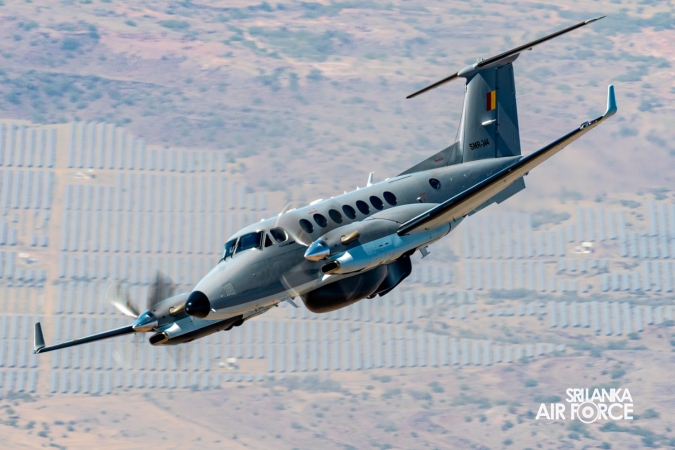
Sri Lanka’s contribution was a single Beechcraft King Air 360ER — a twin-turboprop surveillance and reconnaissance aircraft, not a combat type — and six personnel. The Air Force named the full contingent: Wing Commander PGGK Bowatte as captain pilot, Wing Commander DMTSB Kehelwarawe as co-pilot, Squadron Leader RHSH Rathnayaka as navigator and imprest holder, and Flight Sergeant Iroshan WAI, Sergeant Herath HMDL and Corporal Dissanayake ML as ground engineers.
The exercise ran from 26 September to 12 October 2026 under the theme “Power in Partnership”. It was hosted by the Indian Air Force and drew participating air forces from seven countries — Australia, Bangladesh, France, Germany, Sri Lanka, the United Arab Emirates and the United States — with 32 further nations attending as observers. India is the host and is counted separately from the seven.
Tamil Guardian reports that the drills covered counter-air, air defence, reconnaissance and air-to-air refuelling missions, citing India’s public broadcaster. The Air Force’s own account is narrower, describing the value of the deployment in terms of interoperability, knowledge-sharing and coordination between air and ground crews rather than any specific mission flown.
Smaller field, bigger audience
Neither the Air Force nor Tamil Guardian notes that Sri Lanka also flew a Beechcraft in the inaugural edition, or that the exercise has contracted since. This was not a debut.
The 2024 edition was reported at the time by the Daily Mirror, in a filing datelined Colombo, September 5 (Daily Mirror) and carrying a publication date of 5 September 2024. It is noted here for comparison only and is not cited as a current source. That filing described the first Tarang Shakti as running in two phases — Sulur Air Force Station in Tamil Nadu from 6 to 14 August 2024, then Jodhpur, concluding on 14 September 2024 — with 150 aircraft from 11 countries and 18 observer nations. A Sri Lanka Air Force Beechcraft took part then too.
Set against this year’s seven participating air forces and 32 observers at a single station, the pattern is a smaller flying contingent and a much larger watching one. The two counts are not strictly like-for-like: the 2024 figure of 11 countries appears to include India as host, while this year’s seven are explicitly foreign air forces alongside the Indian hosts. Even allowing for that, participation has fallen and observer numbers have nearly doubled.
The wider pattern
Tamil Guardian places the deployment in a run of foreign military engagements and frames it pointedly, reporting that the training continues “despite Sri Lanka being accused of war crimes, crimes against humanity and genocide”. That framing is the outlet’s own; neither the Air Force statement nor any other filing reviewed for this article raises it.
The engagements themselves are a matter of record. Last month the deputy commanding general of US Army Pacific, Lt. Gen. Joel Vowell, spent three days in Colombo pressing for joint exercises and interoperability, and in September 75 Sri Lanka Army personnel trained on Russian soil for the first time at Exercise Wolverine Path II in Primorye. Tamil Guardian adds that India and Sri Lanka exchanged 240 military personnel in a tri-service programme last week — an engagement this newsroom has not previously covered.
Not reported
No filing says what the King Air 360ER actually flew during the 17-day exercise, how many sorties it logged, or whether it operated with any other nation’s aircraft. Neither source gives the cost of the deployment, who bore it, or when Sri Lanka was invited.
No Sri Lankan newsroom appears to have reported the 2026 edition at all. Searches of the verified Sri Lankan outlets returned only their coverage of the 2024 inaugural exercise, published two years ago under near-identical headlines. This article therefore rests on one verified newsroom and the Air Force’s own release.
Sources: Tamil Guardian, Sri Lanka Air Force.