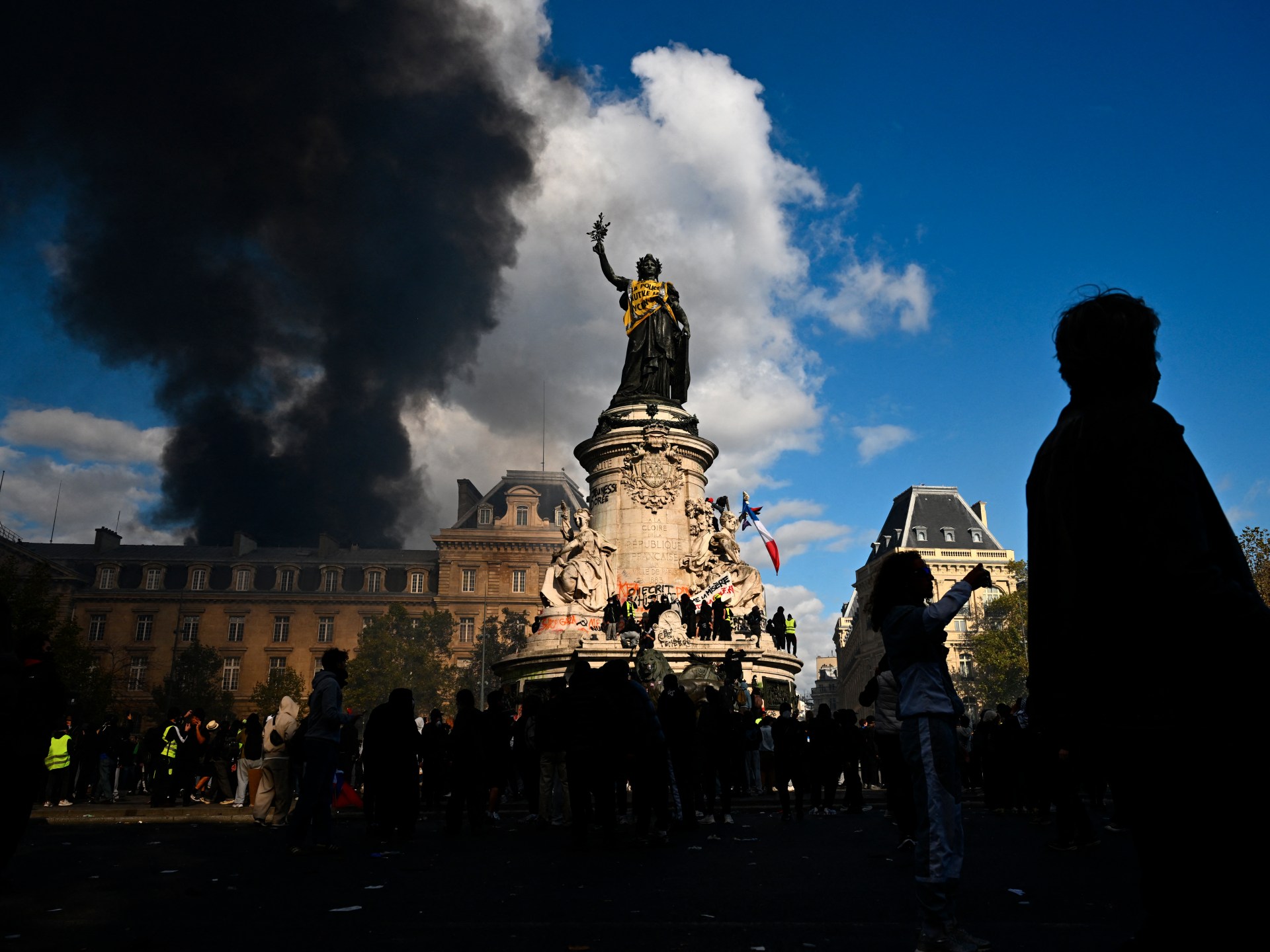
At least 400 people were arrested across France on Saturday as an estimated 550,000 protesters took to the streets, with 110,000 of them in Paris, France’s Ministry of the Interior said. Police used tear gas in several cities as demonstrations over schools, public services and the cost of living turned violent, Al Jazeera reported.
The arrests followed violent incidents involving hooded individuals in Paris, Marseille, Rennes, Toulouse and Angers, the ministry said.
What happened in each city
In Marseille, demonstrators breached the town hall and looted shops. In Lyon, a tourism office was reportedly set ablaze. In Paris, protesters threw firework mortars at officers and set fire to a car, a newspaper stand and street furniture, sending black smoke over the city.
Police deployed tear gas from around noon, when crowds were still sparse, and used it more heavily from 2 p.m. onwards as the main Paris march got under way.
A school protest that became something larger
The movement did not begin as a cost-of-living revolt. It started in mid-September at a single high school in Créteil, outside Paris, and had been running for over a month by Saturday.
What began as a student demand for education reform has since drawn in teachers, parents, nurses, human rights lawyers, firefighters, climate activists and farmers, alongside high school and university students — and remnants of the “yellow vests”, the grassroots cost-of-living movement that shook France in 2018. Saturday was the first day the older movement’s figures were widely expected to join the students in force.
President Emmanuel Macron addressed the demonstrations directly. “There is a constitutional right to protest and to express oneself,” he said. “But this right comes with the need to respect.”
Hiru News, filing at 1.01 a.m. Colombo time and citing the BBC, added that the Interior Ministry had accused protesters of attempted looting and of attacking police, describing those acts as “deliberate acts of violence.” A BBC correspondent quoted by Hiru reported repeated calls from the crowd for Macron to resign.
A note on the arrest figure
Saturday’s arrest total moved substantially during the day, and readers may encounter several versions of it. More than 160 was an early, point-in-time count; the figure was revised upward through the afternoon before the Interior Ministry settled on at least 400 by nightfall.
The Hiru filing cited above carries the earlier 160 figure and is written in the future tense — it describes the main Paris march as still “planned for 2 p.m. today” — although it was published at 9.30 p.m. Paris time, long after that march had taken place. It appears to relay a BBC live-coverage snapshot from earlier in the day. The 400 figure, not 160, is the day’s total.
The two accounts also differ on how long the student protests had been running: Hiru says three weeks, while Al Jazeera dates the start to mid-September, making it over a month. This article follows Al Jazeera, which gives the specific origin point.
Not reported
Neither source gives a total number of injuries — for protesters or for police — and neither says how many of the 400 arrested have been charged or released. Al Jazeera’s report does not carry a police casualty figure at all.
Organisers’ own turnout estimate is not given in either source; the 550,000 figure is the authorities’. Neither source says whether further action is planned, whether the unions that were called to join did so formally, or what the government intends to do about the original school demands that started the movement.
No filing reports any effect on Sri Lankan nationals, students or travellers in France, and this desk has no information either way.
Sources: Al Jazeera, Hiru News (Sinhala, citing the BBC).