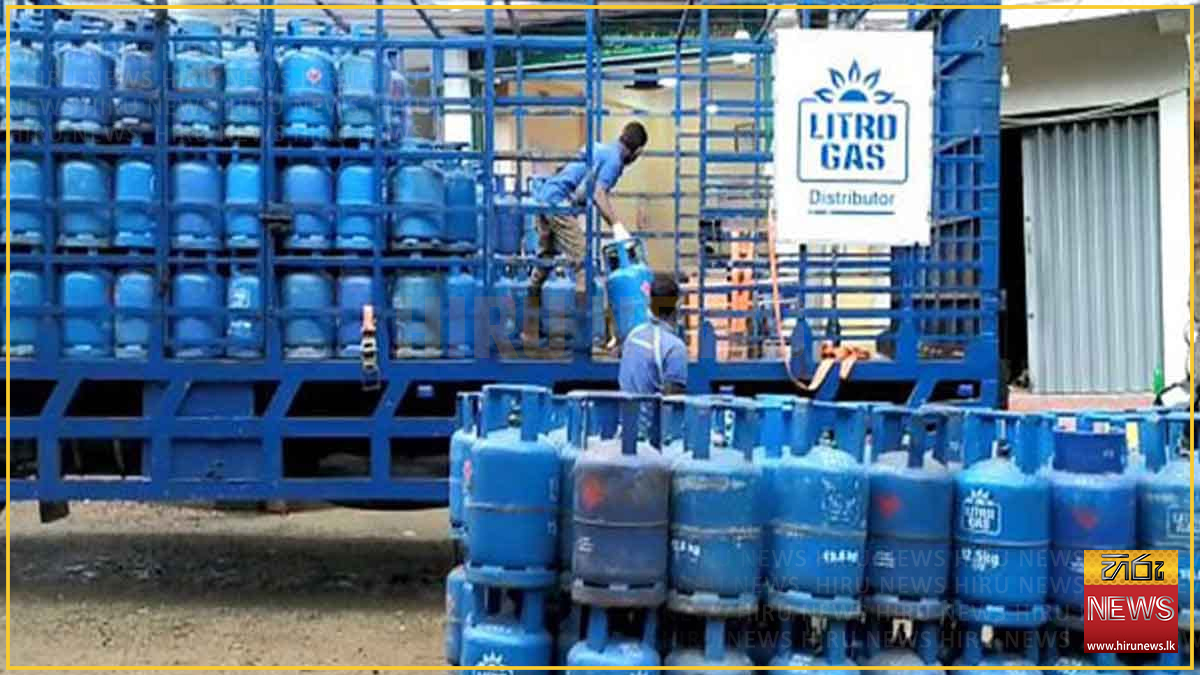
The shortage of Litro gas in the market will be completely resolved by Tuesday, the company’s chairman Channa Gunawardena has said, as the second of two cargoes is due to dock.
Asked by Hiru News about the continuing shortage, Gunawardena said it was caused by gas distribution not being carried out for two days, Hiru reported at 7.47 p.m. on Saturday.
A vessel carrying 3,900 metric tonnes of gas arrived in the country on Friday the 16th. On that day 100,000 domestic 12.5 kg cylinders were released to the market, and another 100,000 went out on Saturday. A further 85,000 are scheduled for Sunday, and a second vessel carrying another 3,900 MT is due to arrive on Sunday.
Three days of releases use up almost exactly one cargo
The two figures the chairman gave can be set against each other, and the result is the story the filing does not tell.
The three announced release days total 285,000 cylinders of 12.5 kg, which is 3,562.5 MT of gas — just over 91 per cent of a single 3,900 MT shipment. In other words, at the rate Litro is currently clearing the backlog, one cargo covers roughly three days of domestic cylinder distribution, before any commercial or smaller-cylinder demand is counted.
That is what makes a two-day interruption enough to empty the market. It also means the promise of resolution by Tuesday rests on the Sunday vessel arriving on schedule: the shipment that arrived on Friday is substantially committed by the end of the weekend.
Laugfs relief lands the same day
Laugfs Gas chairman Nalinda Kurukulasuriya said two gas vessels are due this month, on the 20th and the 24th. A cargo of 3,800 MT is to arrive at Hambantota Port and another of 3,500 MT at Colombo Port.
The 20th is Tuesday — the same day Litro says its own shortage will end. Both suppliers’ relief therefore converges on one date, which is reassuring for supply and unhelpful for redundancy: if either vessel is delayed, there is no staggered cover behind it.
This is a volume problem, not a price one
Litro held its prices unchanged for October, leaving the 12.5 kg cylinder at Rs. 4,365 — the first full month at September’s reduced price card. Nothing in Saturday’s filing concerns price. The constraint being described is physical availability at distribution points.
Two things the filing does not reconcile
First, the dates do not sit together. The chairman attributes the shortage to two days without distribution, while also stating that 100,000 cylinders were released on Friday and 100,000 on Saturday. The two-day halt must therefore have fallen before Friday’s shipment arrived. Hiru does not date the interruption, and this desk is not assuming which days it covered.
Second, no cause is given for the halt itself. Hiru does not say whether distribution stopped because stocks ran out, because a vessel was late, or for an operational reason at the company’s end. A chairman attributing a market shortage to his own company’s distribution pausing, without explaining why it paused, is the central unanswered question here.
One inference that should not be drawn: Sri Lanka suffered an islandwide power outage on Saturday the 17th, but the chairman’s two-day window closes before Friday’s cargo arrived, and no filing connects the grid failure to the gas distribution halt. This desk records the two as unconnected on the evidence available.
A note on sourcing
Hiru News is the only verified newsroom in this archive’s list to have filed on Saturday’s statement, and the item is in Sinhala only. Searches across the Daily Mirror, EconomyNext, NewsFirst, Daily FT, Island and news.lk returned only older gas-supply stories — several from the February 2026 shortage and the 2022 forex-crisis period — and the Daily Mirror’s breaking-news index carried no gas item at all up to its Saturday-evening ceiling. Ada Derana remains unreachable from this desk. This article is accordingly single-source and should be read as one company’s account of its own supply position.
Not reported
Hiru does not say which areas are worst affected, how long consumers have been queueing, or how large the shortfall is in cylinder terms. It gives no figure for Litro’s current stock, no distribution figures for the days before Friday, and no independent check on the company’s timeline.
Nor is there any comment from the Consumer Affairs Authority, the Ministry of Energy, or gas dealers’ associations — the parties who would ordinarily be asked whether a shortage is being managed or merely described. Whether any hoarding or over-pricing has been reported at the retail end is also unaddressed.
Source: Hiru News (Sinhala).

