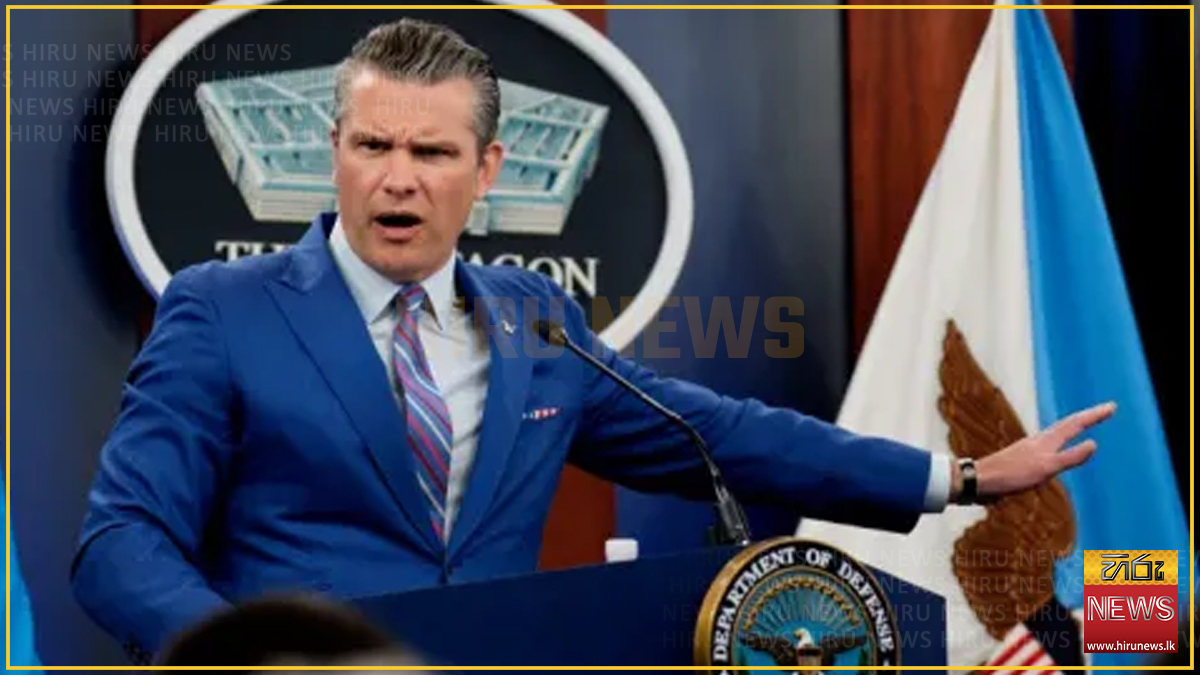
US Defence Secretary Pete Hegseth has said Iran must abandon its nuclear operations and come to an agreement, or face destructive military action, Hiru News reported on Sunday morning.
Speaking at a programme at a university in the United States, Hegseth said Iran must take a decision on the matter very soon, according to the report.
He also said that under President Donald Trump’s policy of reasserting American power, Washington was working to limit the influence held by Iran, China and Russia within South America — a second strand of the same address, and one that places the Iran warning inside a broader statement of hemispheric policy rather than a Middle East announcement on its own.
What this filing does and does not establish
Hiru attributes the report to “foreign media” without naming an outlet, and gives no date for the remarks themselves. It does not name the university, the audience, or the occasion. The filing is stamped 9.53 a.m. Colombo time on Sunday 18 October, which dates Hiru’s publication, not Hegseth’s speech.
That distinction matters here more than usual. A fresh filing relaying an undated wire report can carry an event that is days old, and nothing in the Sinhala text anchors the speech to a particular day.
International wire reports circulating over the weekend placed the remarks at an address to Reserve Officers’ Training Corps cadets and military recruits at the University of Tennessee on Saturday 17 October, and carried a direct quotation in which Hegseth framed the choice as one between giving up nuclear capability “at the table” or facing “the kind of devastation that America can bring.” This desk was unable to fetch any of those reports directly or to confirm them against a verified newsroom, so the venue, the date and the quotation are recorded here as wire-reported and unconfirmed rather than as established fact. What is verified is that a verified newsroom reported Hegseth making the warning, in the terms set out above.
Context
Hegseth’s language belongs to a pattern this desk has been recording through 2026. The US defence secretary has repeatedly warned Iran’s leadership that American strikes could resume if negotiations fail, and the current position — that Iran retains a conventional missile arsenal while continuing to pursue nuclear capability — has been the administration’s stated rationale for keeping military options open.
For Sri Lanka the Iran file is not purely distant. Earlier this month Iran asked India to intervene over tanker crews held off Galle, and attacks on Gulf energy infrastructure have fed directly into the fuel-price and shipping exposure that shapes the island’s import bill.
Not reported
No casualty, deployment or operational detail accompanies the warning — this is a statement of intent, not a report of action. Hiru gives no Iranian response, no reaction from any other government, and no indication of whether negotiations are currently under way or where.
The filing does not say what “nuclear operations” Hegseth was referring to specifically, what would count as an acceptable agreement, or what deadline he had in mind by “very soon.” Nor does it elaborate on the South America remarks — which countries are involved, what form the Iranian, Chinese or Russian influence is said to take, or what the US is doing to limit it.
A note on sourcing. This report rests on a single verified newsroom, and that newsroom is itself relaying an unnamed foreign report. No verified Sri Lankan or international outlet available to this desk had filed its own account of the speech at the time of writing. The account above should be read accordingly.
Sources: Hiru News (Sinhala).