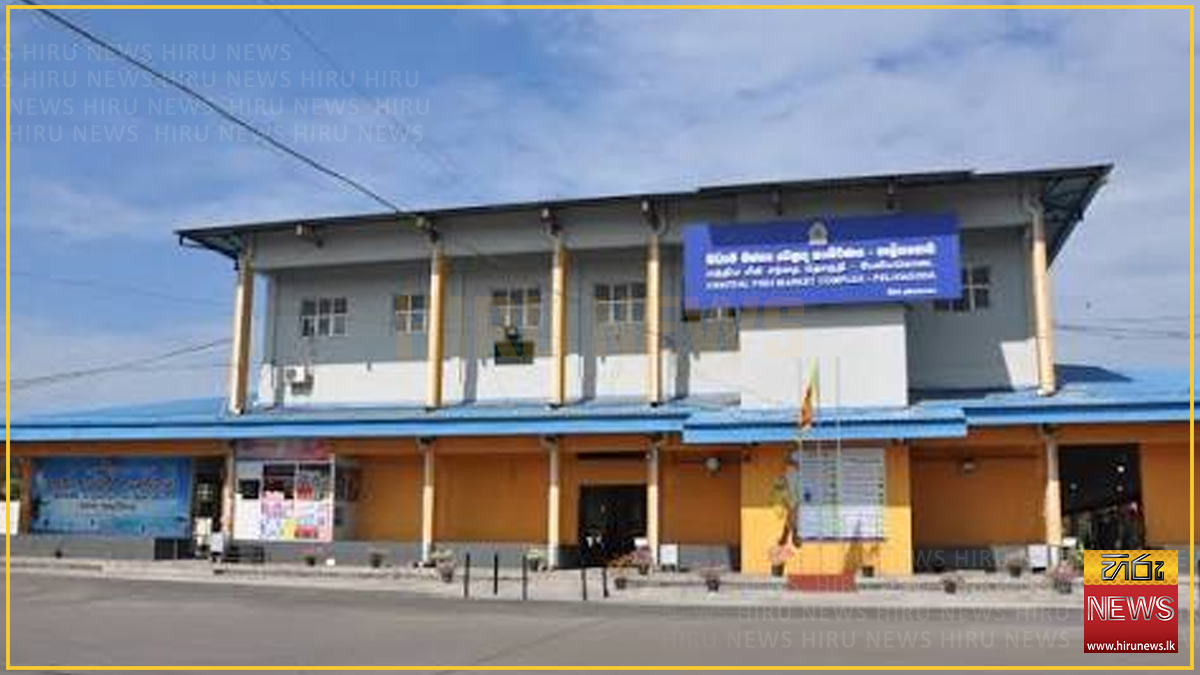
Traders at the Peliyagoda Central Fish Market — the country’s main wholesale fish trading complex — say the facility has fallen into such a state of filth that it risks being closed down entirely.
The complex was opened with international-standard facilities and has now become “a heap of garbage,” traders told Hiru News, blaming severe administrative irregularities and a failure to carry out proper maintenance. A strong stench has spread across the whole complex, they said, and thousands of people trade there daily.
If authorities do not intervene quickly, the traders said, the complex may have to be shut down completely.
What a visit found
The Sunday Times visited the 13.5-acre site and published an itemised account that matches the traders’ description independently.
Drains at the entrance were clogged and filled with rotting fish carcasses, intestines, blood and waste, along with plastic bottles and Rigifoam boxes. A greenish-white liquid was oozing from underneath the complex, giving off a pungent smell. Inside, blood, fish remains and water were scattered across the floors, with dogs, cats, crows and herons moving through the building; dog waste was found on rooftops and in gutters, as resident dogs occupy the upper floors.
A drain running from the property boundary towards the ice plant was filled with maggots. The flake ice plant is non-operational and showing signs of sinking. An unauthorised shop sits on top of the drainage line at one corner, partly covering the canal.
The cleaning contract is the specific failure
Both accounts converge on a single mechanism, which is what makes this more than a complaint about smell.
Jaysiri Wickramarachchi, president of the Peliyagoda Central Fish Market Traders’ Association, said a management team has been set up but maintenance is weak. The cleaning work “had been recently handed over to a third-party company, yet that company has failed to carry out proper cleaning due to a manpower shortage,” he said. “They hired unprofessional employees for cheaper daily wages.”
The scale explains why that matters. The market has 154 wholesale shops and 128 retail shops, and accumulates fish waste that Wickramarachchi said needs removing every few hours.
Traders speaking anonymously went further, saying the contractor is hiring drug addicts at Rs 1,200 to Rs 1,500 a day, who remove scrap metal and tin cans and leave the fish waste behind. Association secretary Jayantha Kumara said that if the waste were sent to the on-site recycling plant as intended, it would become animal feed, fish oil and fertiliser.
Management disputes the severity while confirming the cause
The complex’s assistant manager, Damith Diwaratne, said the odour “was not unbearable” — but in the same account confirmed the traders’ central allegation, admitting the third-party cleaning “was not that great,” describing the workers as “questionable characters,” and saying the Fisheries Ministry has been informed. He said the ministry is planning renovations.
That split is worth stating plainly: the official rejects the characterisation of the problem and corroborates its cause.
Diwaratne also redirected part of the blame to the water treatment plant and the fish waste recycling plant. The recycling plant’s operator, E.R.P.W. Kumara, rejected that. “We operate this plant from 4 am to 4 pm, yet people complain that the stench comes during the evening time,” he said, arguing a plant that reduces waste and produces feed and fertiliser “should not be branded as a place which creates foul odour.”
The Sunday Times also found the traders themselves divided, with some denying the health concerns that others raised.
Who else is affected
Herbert Fernando, a retired Grama Niladhari living nearby, said about 2,500 families live around the market and depend on it for work, but that it has become a health concern and a nuisance, drawing flies, dogs and crows.
Customers described changed habits rather than abstract concern. T.G. Saman, a regular, wears a mask to cope: “The stench is unbearable, yet I come because the fish is cheaper here. But the hygienic condition is the issue, as the fish are on the floor.” R. Priyangani Silva said she used to come every weekend and now comes only when the fisherman who visits her area does not.
Two Peliyagoda markets — a note for the record
The Central Fish Market Complex described here is a distinct facility from the Manning Market wholesale produce complex, also at Peliyagoda. The two are routinely confused. One trader interviewed outside the fish market, Ruwan Senanayake, 51, said he had set up a kiosk beside the drainage outflow because the government had not given him a place at the Manning complex — and that the fish market’s stench is now driving his own customers away.
This desk last covered the fish market in September, when larger stocks eased wholesale prices there.
Not reported
Neither account names the third-party cleaning company, gives the value or term of its contract, or says which authority awarded it. Neither says who the market’s “management team” reports to, when the Fisheries Ministry was informed, what the planned renovations involve or when they would begin. No public health authority is quoted, and no inspection finding or enforcement action is reported. Whether any step has been taken towards the closure traders warn of is unstated.
Sources: Hiru News, Sunday Times.

