President Anura Kumara Dissanayake said on Sunday that his government will abide by the decisions of the judiciary and will not take decisions beyond them — a position he stated as a general principle of the rule of law, without naming any case.
“We submit to the decisions given by the judiciary. Do not expect any other decisions from us beyond that,” the President said, the Daily Mirror reported at 1.24 p.m.
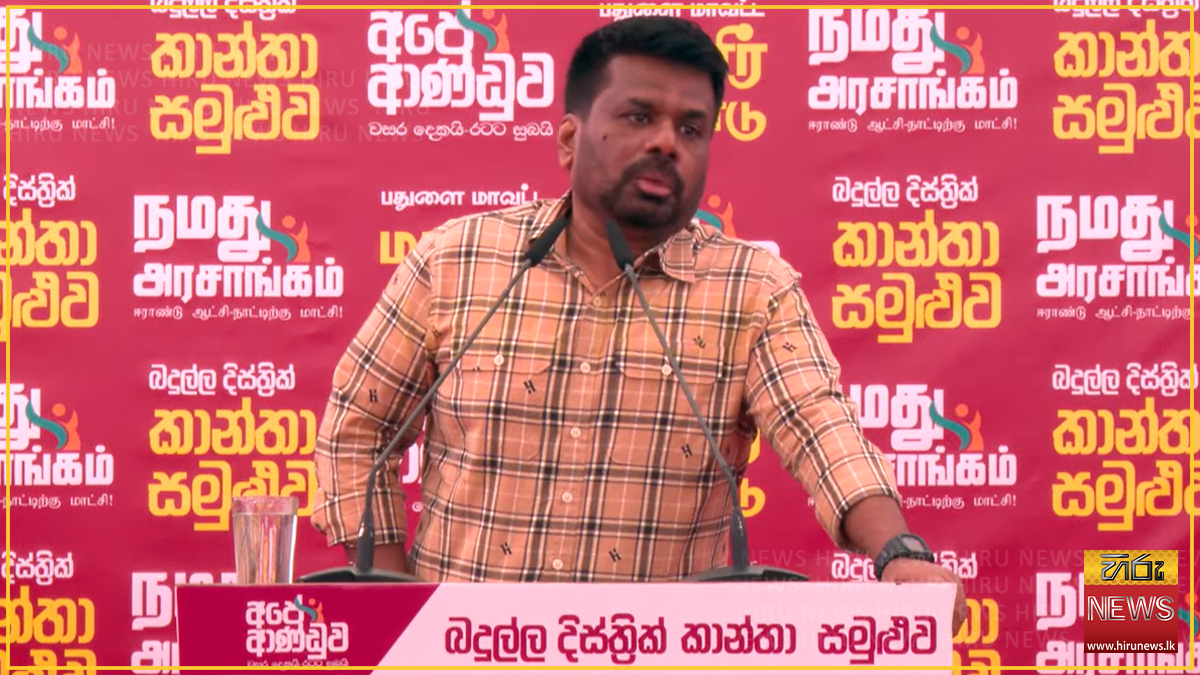
He was addressing the Badulla District Women’s Conference, Hiru News reported at 1.13 p.m. Both outlets carry the same closing quotation in near-identical terms.
What he said
The President said the law is now being applied equally to everyone, and that those who had previously enjoyed privileges and the protection of the law were now protesting against the legal process.
“Today the law is equal for all. So what do those who got privileges from the old law, who got the protection of the law, who thought they would be punished before the law — what do they do? They start shouting against it. This is the situation,” he said in Hiru’s Sinhala account.
He then set out the chain of institutions in order: Parliament enacts the statutes; the Attorney General’s Department and the Commission to Investigate Allegations of Bribery or Corruption file cases under them; the Bribery Commission, the Criminal Investigation Department and the police conduct the investigations; and the judiciary decides. At the end of that chain, he said, sits the Supreme Court.
“The Supreme Court gives a ruling. Once a ruling is given, some start shouting, ‘No, set that aside.’ Where is the rule of law then?” he asked.
A country could not function, he said, if judicial decisions were rejected whenever they did not suit particular groups. The government had entrusted the relevant institutions with the authority to enforce the law, and it respected the conclusions the judicial system reached.
Two live contexts — and neither filing names either
Neither the Daily Mirror nor Hiru connects these remarks to any specific case, and this desk is not asserting a connection on their behalf. But the President’s framing — that some demand a judicial decision be set aside — maps onto two disputes running at the same time, and readers will reach for both.
The first is the campaign to free Ven. Galagoda Aththe Gnanasara Thera, whose demand is a presidential pardon: precisely a decision from the executive going beyond what a court has decided. That campaign’s satyagraha at Viharamahadevi Park entered its fourth day on Sunday, and this is the first reported comment by the President in that window.
It is also the same argument his own minister used two days earlier. Minister K.D. Lal Kantha ruled out a pardon on Friday on the ground that granting one would breach the government’s mandate on equality before the law — the identical reasoning the President advanced in Badulla.
One detail does not fit neatly. Gnanasara Thera’s imprisonment follows a Court of Appeal sentence, not a Supreme Court ruling, and this desk’s own record notes that an appeal has been filed before the Supreme Court in a related matter. A statement framed around Supreme Court rulings is therefore not an exact description of his case. Whether the President was speaking loosely about the courts in general, or deliberately pointing to an appeal that has not yet been decided, is not established by either filing.
The second context is the corruption prosecutions. The President’s reference to people “who got privileges from the old law” and “thought they would be punished”, and his enumeration of the Bribery Commission, the Attorney General’s Department and the CID, reads naturally as a description of the cases against former office-holders rather than of a religious dispute. The Daily Mirror’s account places that passage in exactly the same position.
Both readings are available from the same paragraph. The honest statement is that the President set out a rule and left its application unstated.
A governing-party platform, not a state occasion
The venue is worth recording. NewsFirst, reporting the Prime Minister’s speech at the same event, describes it as the Badulla Women’s Rally organised by the National People’s Power — the governing party — and the backdrop visible in Hiru’s photograph of the President carries NPP campaign branding alongside the conference name in Sinhala and Tamil.
Prime Minister Dr Harini Amarasuriya also addressed the conference, on education. A statement about the limits of executive power over judicial outcomes was therefore made from a party platform rather than from a state podium.
Update — the fuller speech: equal justice, drugs and the underworld
NewsFirst filed two further accounts of the same speech later on Sunday afternoon, at 3.10 p.m. and 2.35 p.m., which set the Supreme Court passage inside a longer argument. They are added here as sources rather than written up separately, because all three filings report one speech.
The argument: equal law is a child-safety policy
The President’s starting proposition was that all developed countries share one principle — that the law applies equally to everyone, NewsFirst reported.
From there he made an argument that is unusual in its construction: he treated equality before the law not as a constitutional abstraction but as a precondition for children’s physical safety. Education reforms alone cannot secure children’s future, he said; the rule of law matters as much. Even parents who protect and educate their children cannot guarantee their safety if those children grow up in a society where the law is not applied equally.
That line also links his speech directly to the Prime Minister’s at the same event. Dr Harini Amarasuriya had spoken on education reform and teacher recruitment; the President’s point was explicitly that her programme is not sufficient on its own.
He said Sri Lanka has long struggled with selective enforcement, with people who had political connections escaping legal action, and named three areas where he said political protection had prevented accountability: illegal tree felling, sand mining, and the production and sale of illegal drugs. He asked how children can be safe in a country where the law is applied according to a person’s status, wealth or political connections.
The President used a specific image for that condition: the law in Sri Lanka, he said, has been like a spider’s web, in which the weak are trapped while the powerful break through.
He acknowledged the change would not be easy, because those who had enjoyed protection and privileges under the old system do not want the law applied equally — they want to keep their own protection while others face its full force — and said such people are becoming increasingly agitated as the change proceeds. That is the same passage the Daily Mirror and Hiru report in the Supreme Court context above, and it now has a fuller setting.
The crime figures
In the second NewsFirst filing, the President warned that organised crime extends beyond drug trafficking, with armed criminal gangs recruiting members and carrying out shootings, NewsFirst reported.
He gave one set of figures. Within this year, he said, authorities have seized:
| Weapon | Seized this year |
|---|---|
| T-56 assault rifles | 93 |
| Pistols | 141 |
| Revolvers | 105 |
That is 339 firearms, of which more than a quarter are military assault rifles.
Asking what kind of country was being left to the next generation, the President said building a safe environment for children requires dismantling both the drug trade and the underworld — closing the argument back onto the equal-justice case he had opened with.
One reference this desk can place only tentatively
NewsFirst reports that the President also referred to a recent arrest of a suspect found in possession of a revolver, citing it as evidence of the threat from armed criminals. It does not identify the case.
Earlier the same morning, this desk reported the Colombo Crime Division’s seizure of an arms cache inside a Kirindiwela cinema — an inventory that included exactly one revolver, alongside two pistols, two other firearms, two live grenades and 3,843 rounds. That arrest was reported at 10.42 a.m.; the President spoke at about 2.35 p.m.
No filing links the two, and this desk does not assert that the President was referring to this case. It is recorded as the one candidate visible in the day’s reporting, and flagged as unconfirmed, because a reader who saw both stories will otherwise make the connection silently.
What the figures do and do not settle
A widely circulating summary of this speech also attributes to the President a set of drug seizure totals — thousands of kilograms of heroin, “Ice” and cocaine over a period running from October last year. This desk could not confirm those figures against any reachable verified newsroom. They do not appear in either NewsFirst filing, which gives firearms only and uses a different time frame (“within this year”). They are therefore not reported here. The firearm figures above are stated because they are in the fetched NewsFirst text.
Ada Derana also filed on this speech but has returned an HTTP 403 from its content delivery network to this desk for 29 days, so its account could not be read or cited.
Not reported
Neither outlet reports which case or cases the President had in mind in the Supreme Court passage, and he is not reported to have been asked. Nothing in any of the four filings refers to Gnanasara Thera, to the satyagraha, to the hospitalisation of Ven. Balangoda Kassapa Thera on Saturday night, or to Opposition Leader Sajith Premadasa’s demand that the President intervene.
No filing reports whether the President addressed the pardon power itself — a constitutional power of his office exercised independently of the courts — or whether “decisions beyond” judicial rulings was meant to cover it.
On the crime figures, no filing gives the period’s starting date (“within this year” is not defined as calendar or fiscal), the agencies credited with the seizures, how many arrests or prosecutions followed, or any comparison with previous years — so the 339 firearms cannot be read as a rise or a fall. None reports how many shootings the President attributed to organised gangs.
There is no reported response from the campaign, from the opposition, or from the Maha Sangha. No outlet published the full speech.
Sources: Daily Mirror, Hiru News (Sinhala), NewsFirst — equal justice, NewsFirst — drugs and gangs.