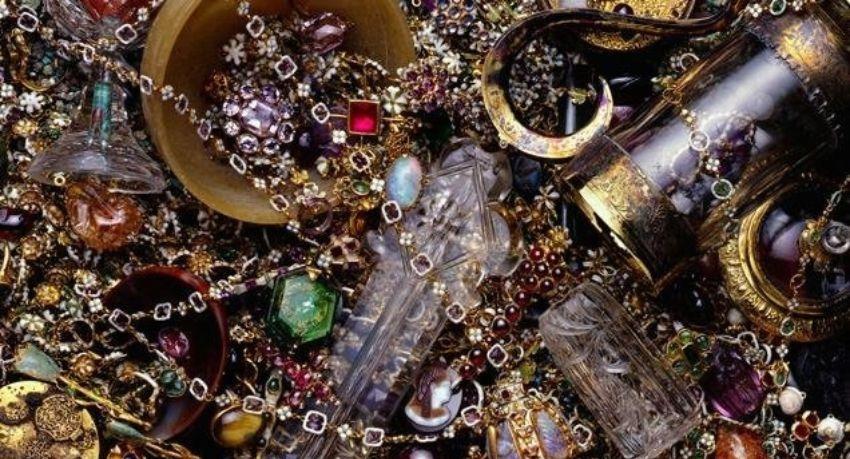
Sapphires and rubies traded out of Sri Lanka centuries ago will go on permanent display in London next month, as part of the Cheapside Hoard — a cache of nearly 500 gemstones and jewels found beneath a cellar floor in 1912.
The collection opens at the London Museum’s new Goldsmiths’ Gallery, NewsFirst reported at 11.11 a.m. on Monday. It is regarded as one of the finest surviving assemblages of Elizabethan and Jacobean jewellery ever discovered.
What is in it
Alongside the sapphires, spinels, diamonds and rubies attributed to India and Sri Lanka, the hoard holds nephrite jade from China, turquoise from Persia, pearls and opals. Two objects stand out in the account: a gold watch set within a large Colombian emerald, and a carving of the head of a Ptolemaic queen, believed made in Egypt between the 2nd and 1st centuries BC.
The hoard was found in 1912, when a workman digging out a cellar floor at 30–32 Cheapside in the City of London struck what appeared to be a decayed wooden box. The cellar had reportedly been sealed for around 270 years.
The island’s place in it is the trade route, not the jewellery
The reason this is a Sri Lankan story is narrower than a headline suggests, and more interesting for being narrow. Nothing in the hoard was made here. What the collection documents is that stones mined on the island were moving through a commercial network that reached a London goldsmith’s premises in the early seventeenth century — the same cache holding Chinese jade, Persian turquoise and a Colombian emerald.
A single buried box, in other words, maps a trading system that connected Sri Lankan gem pits to the European jewellery trade well before the island came under British rule. The gems are evidence of the route rather than of local craftsmanship, and the hoard’s value as a record lies in the combination of origins rather than in any one of them.
That reputation has not lapsed. Sri Lanka remains a working source of high-value sapphires, which is why NewsFirst frames the display as the island’s gem trade returning to international attention rather than as a purely historical curiosity.
Not reported
The filing does not say which specific pieces carry the Sri Lankan stones, how their origin was established, or whether the attribution rests on gemmological analysis or on documentary evidence about the trade. It gives no opening date beyond “next month”, no detail of the Goldsmiths’ Gallery, and no valuation — the collection is described only as “priceless”.
It also does not explain why the cellar was sealed for 270 years, who owned the hoard, or why it was buried. These are long-standing questions about the find rather than gaps in this report, and no verified Sri Lankan newsroom other than NewsFirst has covered the display.
Source: NewsFirst.