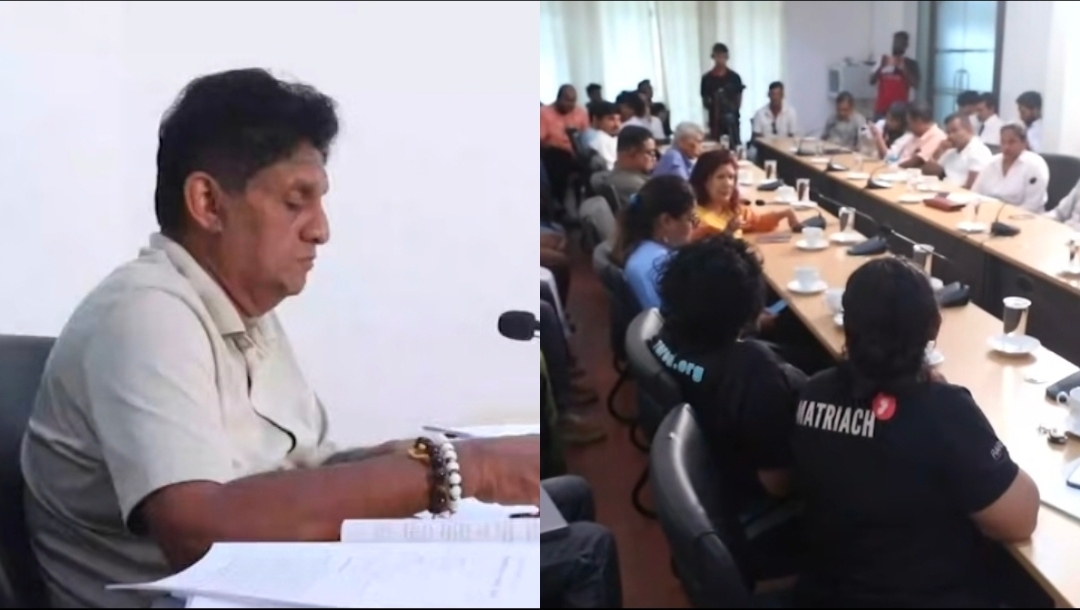
Opposition Leader Sajith Premadasa has formed a community-based organisation named after the dead tusker Kavantissa, and is proposing a constitutional amendment that would let wildlife and environmental interests be defended in court as fundamental rights.
The Kavantissa Elephant Protection Organisation was launched after a discussion at the Opposition Leader’s Office with civil society representatives and people concerned with wildlife and environmental conservation, the Daily Mirror reported at 10.08 a.m. on Monday. Its stated purposes are to investigate Kavantissa’s killing and to protect Sri Lanka’s elephant population and biodiversity.
Premadasa said several proposals to strengthen elephant protection were presented at the meeting, and that he would bring them to the attention of Parliament and the government.
The Daily Mirror does not say what the proposals were
That is the gap in the verified filing, and it matters, because the proposals are the substance. The Daily Mirror reports that proposals exist and that Premadasa will carry them forward, without listing one.
Newswire, reporting the Sunday meeting a day earlier, supplies them. Newswire is an aggregator and earns this article no credibility rating, but it is the only source this desk found carrying the content of the meeting.
The constitutional proposal is the significant one
Premadasa called for constitutional amendments recognising the rights of elephants, wildlife, biodiversity and the environment as fundamental rights, so that violations could be challenged before the courts.
His reasoning is specific and legally coherent. Fundamental rights under Chapter III of the Constitution are enforceable through the courts; the Directive Principles of State Policy under Chapter VI, where environmental protection currently sits, carry no equivalent remedy. He said the existing provisions were insufficient to ensure accountability, and proposed extending fundamental rights protection to wildlife, plants and the environment so legal action becomes available when their interests are threatened.
That is a diagnosis of why environmental obligations in Sri Lankan law have been hard to enforce rather than a general appeal for stronger protection, and it is the part of the announcement with the furthest reach — it would apply well beyond elephants.
The operational proposals
Premadasa also proposed:
- a dedicated hospital for elephants, an emergency veterinary response team, and a special protection unit for prominent tuskers, naming Mahasen and Agbo
- a national database of elephants, built with contributions from wildlife photographers, researchers and conservationists who have tracked individual animals over the years
- a national land-use plan based on scientific data to protect habitats and migration corridors, specifically in Wilpattu, Wilachchiya, Thabbowa, Anamaduwa and Kahalla-Pallekele
He repeated his call for an investigation into Kavantissa’s death involving local and international experts, and said he would seek details in Parliament on the elephant’s blood test results, post-mortem findings, veterinary treatment and the actions taken by wildlife authorities.
Two of these proposals are not new, and one has already been overtaken
The elephant hospital and the protection task force were part of Premadasa’s response in the days immediately after Kavantissa died, and this archive recorded at the time that no government response to them had been reported. That remains the case. Forming an organisation around proposals the government has not answered is itself the development.
His demand for foreign expert participation has already received an answer that did not match it. Environment Minister Dr. Dhammika Patabendi said on 18 October that an impartial and transparent investigation would be conducted through several channels including private laboratories — all of them domestic. No filing reports the government addressing the foreign-expert question directly.
The naming of Agbo in the protection-unit proposal is pointed. At the time of the meeting, a joint Army and wildlife operation was already searching for Agbo, whose location was unknown and who the Daily Mirror has since described as injured. A proposal for a unit to guard named tuskers was made while the state was unable to find one of them.
Not reported
Neither filing names a single other participant in the meeting, says who will run the organisation, whether it has any legal form, how it will be funded, or what powers it claims to “investigate” a killing already the subject of a court-ordered inquiry, a ministry investigation and a police case. Neither says when the proposals will be put to Parliament, nor whether the government has been approached.
No verified newsroom other than the Daily Mirror has reported the organisation’s launch, and no filing records a government response to it.
Sources: Daily Mirror, Newswire.


