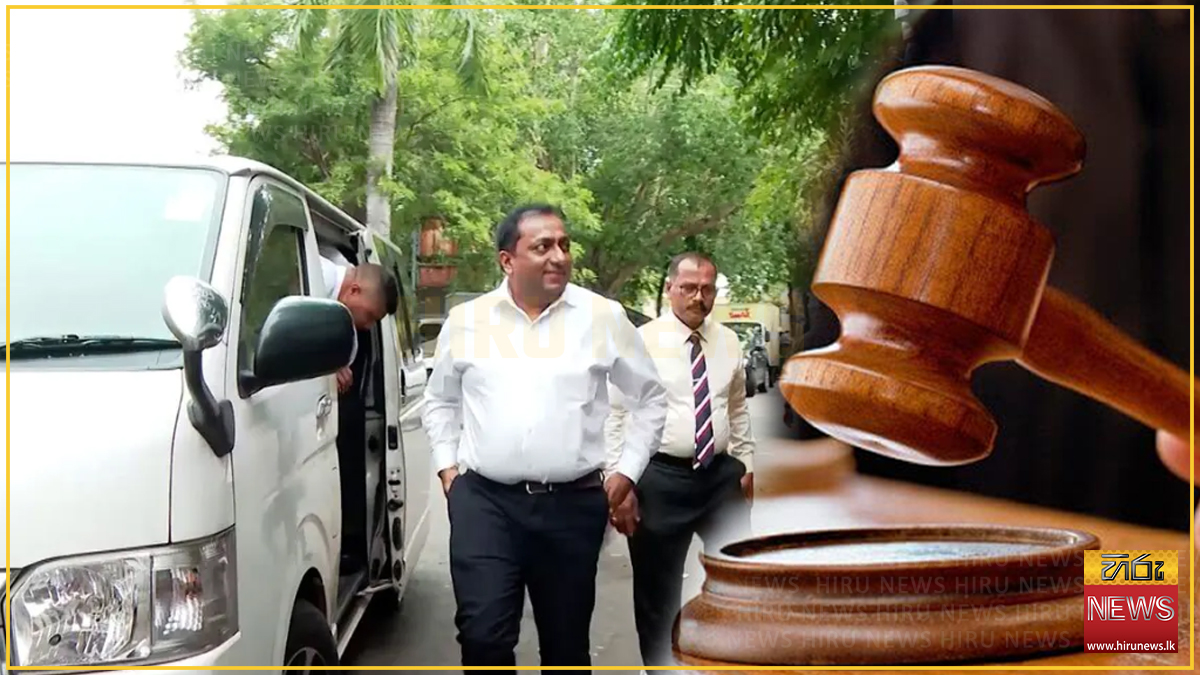
President’s Counsel Saliya Pieris has said the public argument over tattoos and hairstyles is obscuring what he calls the most serious risk in the proposed Organised Crimes Bill — the detention powers it hands to police officers, and the position it leaves magistrates in.
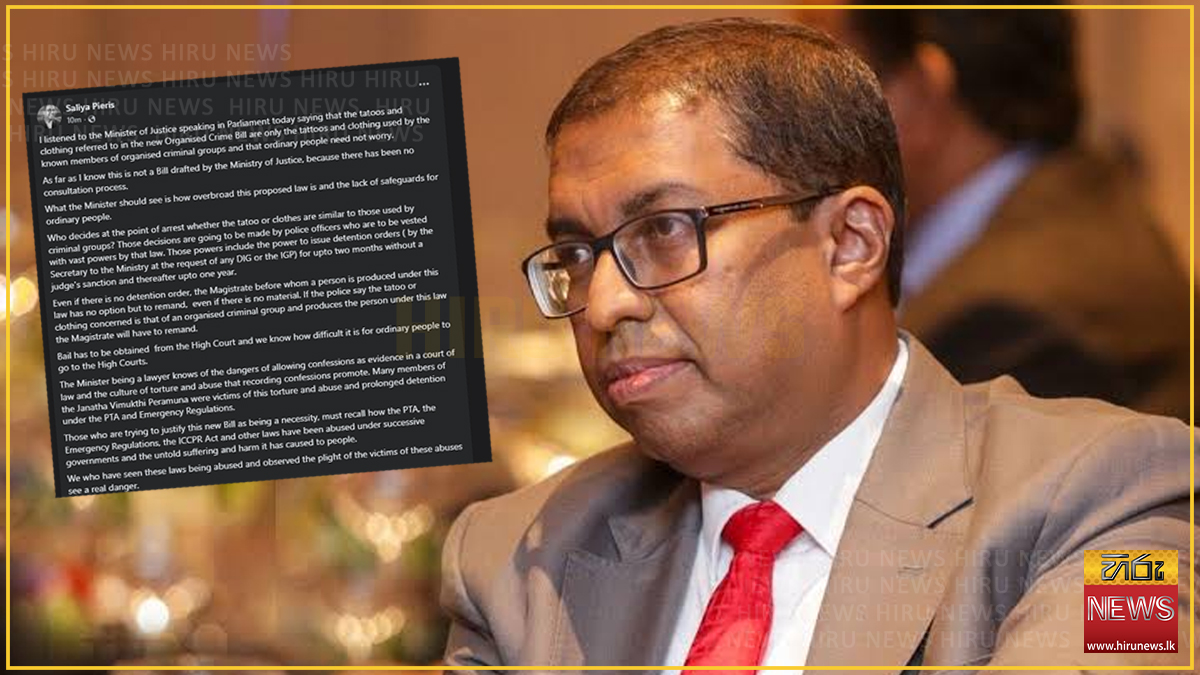
The Bill was presented to Parliament for its first reading on Tuesday, Justice and National Integration Minister Harshana Nanayakkara told the House. Pieris set out his objection in a post on his Facebook page the same day, which Hiru News reproduced in full.
What Pieris says the Bill does
Pieris does not dispute the minister’s account of the tattoo clause. He argues it is beside the point.
“What the Minister should see is how overbroad this proposed law is and the lack of safeguards for ordinary people,” he wrote.
His central question is who applies the test, and when. “Who decides at the point of arrest whether the tatoo or clothes are similar to those used by criminal groups? Those decisions are going to be made by police officers who are to be vested with vast powers by that law.”
Those powers, he says, include detention orders issued by the Secretary to the Ministry at the request of any DIG or the Inspector General of Police — for up to two months without a judge’s sanction, and thereafter up to one year.
He goes further on what happens in court. “Even if there is no detention order, the Magistrate before whom a person is produced under this law has no option but to remand, even if there is no material.” Bail, he adds, must then be sought from the High Court, “and we know how difficult it is for ordinary people to go to the High Courts.”
Pieris also says the Bill did not come through the Justice Ministry: “As far as I know this is not a Bill drafted by the Ministry of Justice, because there has been no consultation process.”
He raises the admission of confessions as evidence, and directs a pointed historical argument at the governing party: “Many members of the Janatha Vimukthi Peramuna were victims of this torture and abuse and prolonged detention under the PTA and Emergency Regulations.” Those justifying the Bill as necessary, he writes, “must recall how the PTA, the Emergency Regulations, the ICCPR Act and other laws have been abused under successive governments.”
The minister’s answer, and the clause number
Nanayakkara told Parliament that distorted readings circulating on social media were “completely false,” and that no clause permits arresting anyone merely for growing their hair or having a tattoo. He was speaking on an opposition adjournment motion.
He identified the provision for the first time. Section 4(1) covers membership of an organised criminal group; Section 4(2) lists 12 matters that may be weighed in deciding whether a person is such a member. One of the twelve — 4(2)(c) — asks whether the person uses the clothing, styles, hand signs, language or tattoos used by prominent members of an organised criminal group.
The distortion works, he said, by dropping those last words. “Remember, this Act has not been brought for individuals, but for members working with an organisation.” He noted that investigators internationally use gang tattoos and dress as indicators, and said bluntly: “Nowhere in this bill is there anything about hair. I don’t know how that came about.”
He said he welcomed both criticism and a Supreme Court challenge: “that is how a law is strengthened.”
Context
This closes two questions left open by our earlier report on the ministers’ denials, which recorded that none of the three filings on it gave the clause’s section number or reproduced Pieris’s original objection.
Note that Saliya Pieris PC, a former president of the Bar Association of Sri Lanka, is a different person from Prof. G.L. Peiris, who gave a statement to the Bribery Commission this week.
Not reported
Neither filing gives the Bill’s full title as tabled, the date set for the second reading, or the text of section 4(2) in full — the remaining 11 criteria are not listed by either outlet. Neither puts Pieris’s specific claims about detention orders and mandatory remand to the Justice Ministry for an answer, and the minister’s statement does not address them. No other verified newsroom reproduced Pieris’s post; Hiru alone carried it.