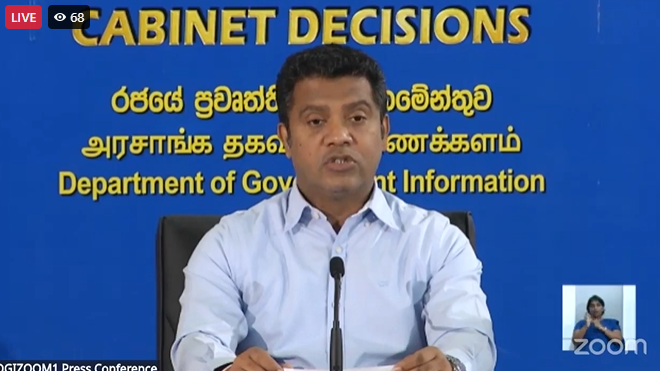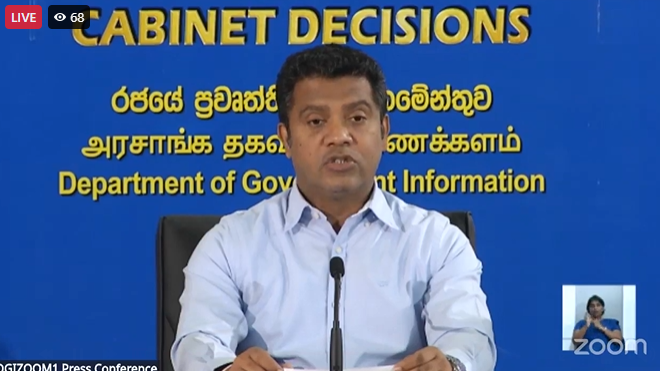
The Cabinet has approved an agreement with the OPEC Fund for International Development for a US$60 million loan towards the second phase of the Mahaweli Water Security Investment Programme — a phase estimated to cost US$536.5 million in total.
Minister Nalinda Jayatissa announced the decision at the post-Cabinet briefing, EconomyNext reported at 4.51 p.m. on Tuesday. The proposal was submitted by the President in his capacity as Minister of Finance, Planning and Economic Development.
The facility comes in two components of US$48 million and US$12 million. Cabinet had approved opening negotiations with the fund on 20 July 2026; the fund has now confirmed its willingness to lend.
The financing gap
The government plans to meet the US$536.5 million cost through co-financing with several development partners. Two commitments are now on the record:
| Lender | Amount | Status |
|---|---|---|
| Asian Development Bank | US$200 million | Already agreed |
| OPEC Fund for International Development | US$60 million | Approved this week |
| Committed so far | US$260 million | |
| Still to be arranged | US$276.5 million | — |
Slightly more than half the cost of Phase 2 therefore remains unfunded on the published record. The filing does not name the other partners the government has in mind, or give a timetable for closing the gap.
What the money builds
Phase 2 is largely a conveyance programme — moving water, rather than storing it:
- Completion of the remaining section of the main tunnel, about seven kilometres of excavation
- 68 kilometres of open and covered canals, conduits and short tunnels
- An eight-kilometre canal section for the Ellapothana Irrigation Project
- Around 13 pressurised distribution networks to supply irrigation water for high-value and field crops
Jayatissa framed the objectives as “enhancing food security in the Dry Zone, strengthening water resource management, improving resilience to climate change, and alleviating poverty.” The Cabinet paper also describes “transforming agricultural production systems by introducing climate-resilient value chains and expanding farmers’ access to financial services.”
The pressurised distribution networks are the part that changes farming practice rather than infrastructure. Pressurised supply supports drip and sprinkler systems, which is what commercial cultivation of high-value crops requires and what gravity-fed canals cannot reliably deliver.
Not reported
The filing gives no interest rate, tenor or grace period for either component of the OPEC Fund loan, and does not say why it is split into two tranches.
It does not give a start or completion date for Phase 2, state how much of Phase 1 has been delivered, or say what the remaining seven kilometres of tunnel represents as a share of the whole. It does not name the districts the 68 kilometres of canals will serve, or say how many farming households the programme is expected to reach.
It does not identify the other co-financing partners, say whether negotiations with them are under way, or state what happens to the scope of Phase 2 if the remaining US$276.5 million is not raised.
On sourcing: this report rests on a single verified newsroom. The Daily Mirror’s breaking-news listing carried no filing on this Cabinet decision when this was written, nor did the NewsFirst rail. Ada Derana has returned a CloudFront block to this desk for 47 consecutive days. The arithmetic in the table above is this desk’s own, drawn from the two figures EconomyNext reports.