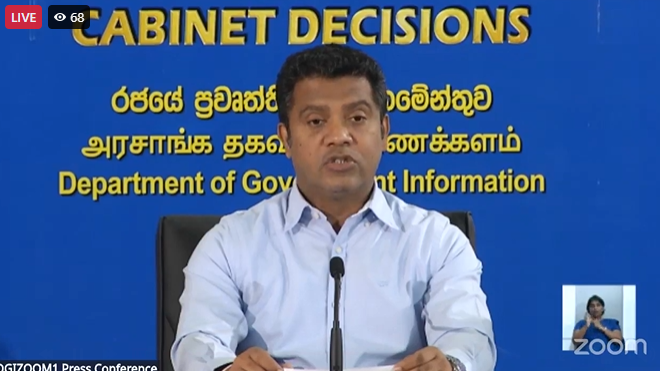
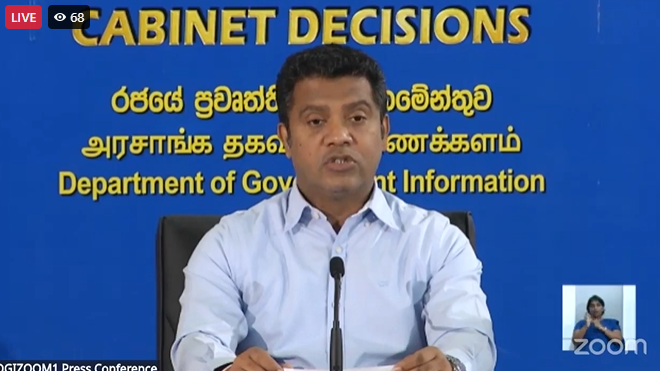
Inflation will stay at or slightly above 8 per cent through the rest of this year and into the first quarter of 2027 before falling back to the Central Bank’s 5 per cent target, Governor Nandalal Weerasinghe said — and he disclosed that a recent government dollar bond issuance was unsuccessful.
The Governor gave a broad assessment of the economy, NewsFirst reported on Wednesday.
The inflation path
“What we see now in our projections is that inflation, around 8 percent or slightly above 8 percent, will remain towards the end of this year as well as during the first quarter of next year. Then, partly because of the base effect and based on current assumptions, particularly if petroleum prices remain around current levels, we can expect inflation to come back to 5 percent from the second half of next year, starting from the second quarter of 2027.”
Two conditions are attached to that forecast, and both are worth reading literally. The return to 5 per cent depends partly on the base effect — the arithmetic of comparing against an already-elevated period rather than on prices actually falling — and on petroleum prices staying near current levels, which is outside the Central Bank’s control.
Weerasinghe was explicit that price shocks do not unwind quickly: “Once inflation goes up and prices increase due to energy and transport price shocks, they do not come down immediately. It takes time to stabilise before returning to our targeted level of 5 percent.”
The bond issue that failed
The Governor’s account of reserves contains a disclosure not previously reported to this desk.
“What we expect is that by the end of this year reserves will be very close to 8 billion dollars. Initially, we expected to exceed 8 billion dollars comfortably, but a recent government dollar bond issuance was unsuccessful. Even so, with the IMF tranche, funding from the Asian Development Bank and the World Bank, together with our market operations, we expect reserves to reach close to 8 billion dollars.”
That explains a shift in language this desk had recorded but could not account for. When the Governor spoke on Tuesday the year-end figure was given as “around US$8 billion”; the target had previously been put at US$9 billion in Parliament in August. A failed dollar bond sale is a concrete reason for the softer formulation.
He also updated the level itself: reserves have risen from about US$1.9 billion at the 2022 low to US$6.9 billion in the latest published figures, and “we have already moved above 7 billion dollars,” with updated figures to be published soon.
Reaching “close to” US$8 billion from above US$7 billion in two months is a materially smaller task than the US$1.1 billion gap implied by the last published number — which is why the updated figure matters as much as the target.
Remittances, tourism and revenue
- Remittances grew more than 20 per cent last year and are still growing strongly. “This year, it appears we will record close to 9 billion dollars in remittances, equivalent to almost 9 per cent of GDP.” He called this “one of the key reasons we are seeing a favourable current account position.”
- Tourism was hit around April by disruption to Middle Eastern air traffic but “has since moved back in line with last year’s trend and is now performing at almost the same level as last year.”
- Government revenue collection was described as a remarkable turnaround, having fallen to around 8 per cent of GDP across 2020, 2021 and 2022.
Weerasinghe cautioned against reading the recovery as finished: “Given global developments and other uncertainties, it is important for us to build the strongest possible buffers so that we are able to absorb potential shocks.”
The figure cuts both ways
The 8 per cent inflation projection is also the number at the centre of an analysis published the same morning, which argues that Sri Lanka’s indirect taxes are themselves pushing prices up. The Governor attributes the elevated rate to energy and transport shocks; the analysis attributes a share of it to fiscal policy. Both accounts are of the same 8 per cent.
Not reported
The filing does not name the event at which the Governor spoke, give a date or venue, or say whether he took questions.
On the bond issue it gives no date, size, tenor or pricing, does not say whether it was a sovereign bond or another instrument, and does not say whether it will be reattempted. It does not quantify the shortfall against the “comfortably above 8 billion” expectation.
It does not say whether the reserve figures are gross or usable, or whether they include the swap facility with the People’s Bank of China. It gives no size or date for the IMF tranche, ADB or World Bank funding cited, and no current inflation reading against which the 8 per cent projection can be placed.
On sourcing: this report rests on a single verified newsroom. EconomyNext filed on the Governor’s reserve remarks on Tuesday but not on the inflation projection or the bond issuance; that filing is cited in the linked article above rather than here, as the two accounts cover different material.