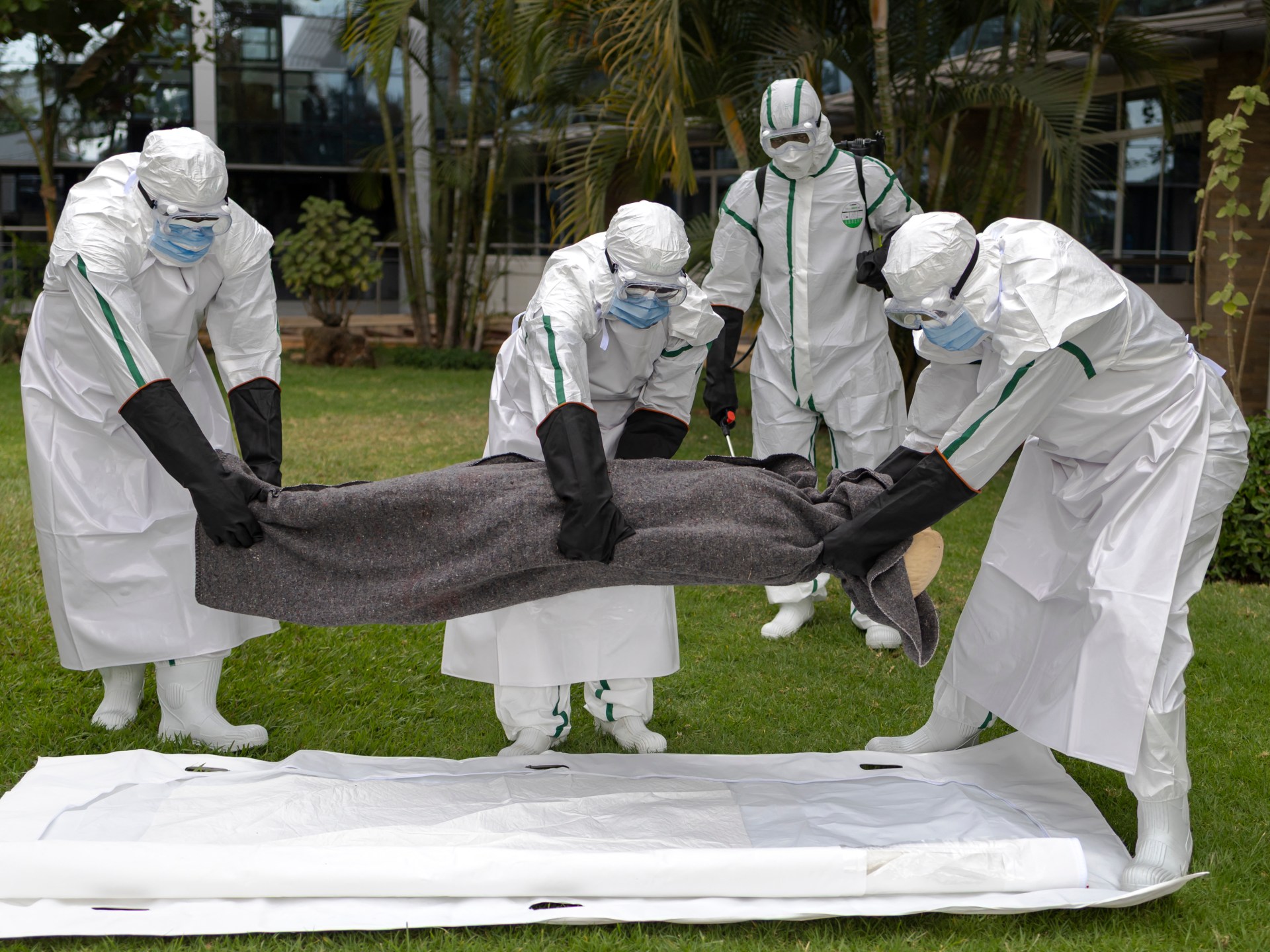
Confirmed Ebola infections in the Democratic Republic of the Congo have passed 10,000, with 4,887 deaths — roughly half of all confirmed cases. The outbreak, caused by a rare strain for which no vaccine or treatment has been approved, is the largest and deadliest the country has recorded.
Government data released on Tuesday put confirmed cases at 10,060 and deaths at 4,887, Al Jazeera reported, citing the DRC’s Ministry of Public Health. Hiru News carried the same figures in Colombo on Wednesday afternoon, attributing them to Reuters reporting on the country’s public health institute.
The strain is the problem
The outbreak is caused by the Bundibugyo virus, a rare Ebola strain for which no vaccine or treatment has been approved. That is the central difficulty: the vaccines stockpiled and deployed in previous Congolese outbreaks were developed against the Zaire strain and are not approved for this one.
That is not the same as there being nothing in development. The World Health Organization announced the launch of a first clinical trial on Friday, in which the Tumaini vaccine is being administered.
The speed of spread reflects the gap. The 2026 Bundibugyo outbreak reached 1,000 confirmed cases in 40 days; the 2018 Zaire-strain outbreak took 235 days to reach the same figure.
Two accurate descriptions that sound contradictory
Hiru describes this as the largest and deadliest Ebola outbreak recorded in Congo, exceeding the country’s 2018–2020 outbreak. Al Jazeera describes the wider outbreak as the second-largest and second-deadliest on record.
Both are correct, and they are not in conflict. Hiru is ranking it within the DRC’s own history; Al Jazeera is ranking it globally, where it sits behind the 2014–2016 West African epidemic, which infected 28,600 people and killed more than 11,000 in two years.
It has already crossed borders
Hiru’s headline warns of a risk of spread across Africa. Al Jazeera’s reporting shows that has partly happened: cases have been confirmed in Uganda (20 cases, two deaths), Kenya (nine cases, two deaths), Nigeria and Switzerland.
Within the DRC, cases have been recorded in 66 health zones across eight provinces.
Why containment is not working
The clearest measure of control is how many new cases are already known to health authorities before they appear — a case arising from a monitored contact is a case the response anticipated.
About 80 percent of new cases are coming from outside the chains of transmission that health authorities are monitoring. The Africa CDC has said that at least 95 percent of cases must come from known contacts for an outbreak to be considered under control.
The outbreak was declared on 15 May.
Not reported
Neither filing gives a case-fatality rate as calculated by health authorities, the number of people currently under monitoring, or the size of the response workforce. Neither states how many doses of the Tumaini vaccine are available, where the trial is being conducted, how many participants it involves, or when results are expected.
Neither says what containment measures are in force, whether any travel restrictions apply, or what international funding has been committed. No filing addresses whether the cases in Switzerland were travel-associated, or what screening is in place at regional borders. Neither reports any advisory for Sri Lankan travellers.
Corroborated — two verified newsrooms. Al Jazeera and Hiru News agree on the case count, the death toll, the strain and the May declaration. Al Jazeera alone carries the geographic breakdown, the transmission-chain figure, the Africa CDC threshold, the cases outside the DRC and the vaccine trial. Hiru credits Reuters as the originating wire for its figures; this desk could not reach a Reuters page directly to cite it, so the wire is named here rather than listed as a source.