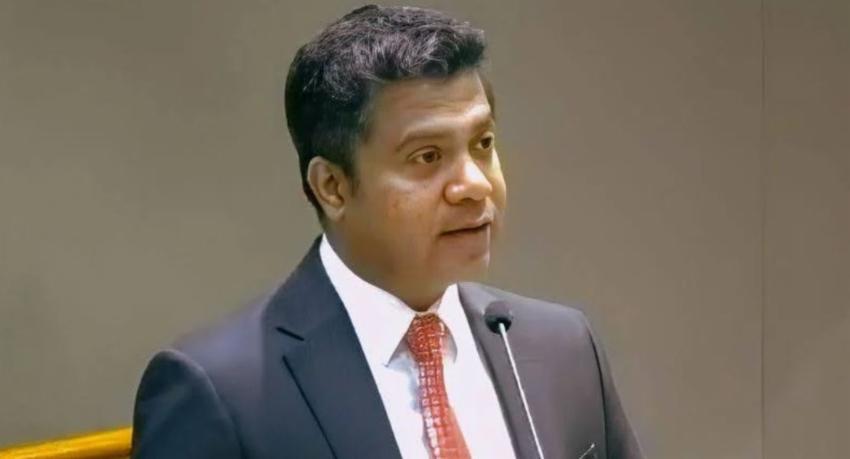
Health and Mass Media Minister Dr Nalinda Jayatissa told a UN ministerial conference in Bangkok that the challenge in space technology is not advancing capability but making sure its benefits reach developing countries facing resource and capacity constraints.
He was addressing the Fifth Ministerial Conference on Space Applications for Sustainable Development in Asia and the Pacific, organised jointly by the UN Economic and Social Commission for Asia and the Pacific (UNESCAP) and the Royal Thai Government, NewsFirst reported.
What Sri Lanka said it has been doing
Jayatissa said Sri Lanka has been an active participant in the Regional Space Applications Programme and its intergovernmental consultative processes for more than fifteen years, including successive sessions of the Intergovernmental Consultative Committee.
(The filing abbreviates the programme as “RSEP” throughout, including inside the minister’s quoted remarks, though the name it gives would not produce those initials. This desk has used the full name and reproduced the abbreviation only where it falls inside a direct quotation.)
That engagement, he said, has provided “valuable opportunities for knowledge sharing and capacity building among national institutions in irrigation, agriculture, meteorology, natural resources management, and disaster risk reduction.”
Space technology and AI
The minister said Sri Lanka “attaches particular importance to the growing convergence of space technologies and artificial intelligence.”
Speaking from his health portfolio, he said the technologies “can strengthen public health systems through disease surveillance, assessment of climate-related health risks, disaster preparedness, and improved health care access,” adding that such applications “demonstrate how the benefits of space technologies extend across sectoral boundaries.”
The ask
“Our challenge is not merely to advance technological capabilities but to ensure that their benefits reach all countries, particularly developing countries facing resource and capacity constraints,” Jayatissa said.
He called for that to be met through sharing operational tools and platforms, adapting them to national requirements, and sustaining capacity building and technical cooperation — and closed by committing Sri Lanka to “regional cooperation that translates technological advances into tangible development outcomes.”
Not reported
The filing is an account of a speech and carries no commitment, agreement or funding. It does not say what Sri Lanka asked the conference to decide, whether any declaration or outcome document was adopted, or what the conference itself resolved.
It names no Sri Lankan institution, satellite, data agreement or project arising from the fifteen years of participation it describes, so the practical results of that engagement are not on the record. It does not say what Sri Lanka currently spends on space applications, which agency leads the work, or whether the country has its own earth-observation capacity or buys data.
It gives no dates for the conference, does not say how many countries attended, and quotes no other delegation. It does not explain why the Minister of Health and Mass Media rather than a science or technology minister led Sri Lanka’s delegation.
Single source. This desk checked the Daily Mirror’s breaking-news listing, the Hiru News homepage rail and the EconomyNext homepage directly; no other verified newsroom had filed on the address at the time of writing. Conference speeches by Sri Lankan ministers abroad are routinely carried by a single outlet. Ada Derana has returned an HTTP 403 block to this desk for some 48 consecutive days.