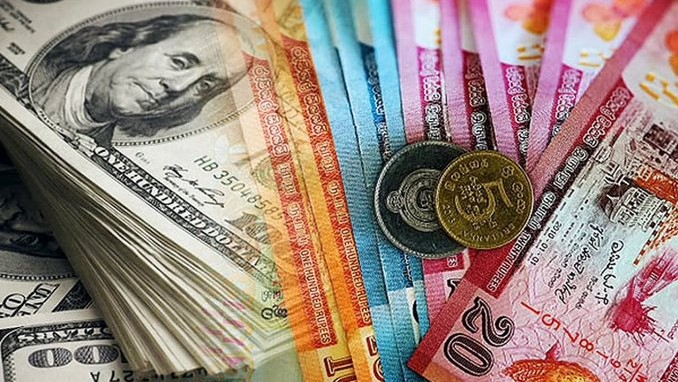
The rupee weakened further against the US dollar on Thursday, with the dollar’s selling rate rising to Rs 337.13 — and separate Central Bank data showed foreign investors selling rupee government bonds for the first time in four weeks.
Thursday’s rates
The Central Bank’s indicative rates moved up on both sides, the Daily Mirror reported:
| Wednesday | Thursday | |
|---|---|---|
| Buying | Rs 327.99 | Rs 328.02 |
| Selling | Rs 337.00 | Rs 337.13 |
The buying rate rose 3 cents and the selling rate 13 cents — a marginal move, and one in which the spread widened by 10 cents to Rs 9.11. The rupee also recorded slight movements against several other currencies, including Gulf currencies.
These are the Central Bank’s indicative buying and selling rates, which bracket the interbank spot market rather than reporting it. Their midpoint of about Rs 332.58 is consistent with the spot rate of 332.52/60 that this desk recorded on Wednesday.
The bond outflow
Offshore investors sold a net Rs 2,818 million (US$8.5 million) of rupee bonds in the week under review, EconomyNext reported from Central Bank data — the first weekly outflow in four weeks, and net selling in three of the last 19 weeks.
- Net outflows over the last six weeks: Rs 13.8 billion
- Net buying over the previous three weeks: Rs 5.5 billion
- Net inflow so far this year: about Rs 58.3 billion
- Net inflow in 2025: Rs 71.5 billion
So the week’s selling interrupts a run of buying without reversing the year: foreign holdings of rupee bonds are still substantially up on where they started 2026, though this year’s inflow is tracking well below last year’s full-year figure.
Analysts quoted by EconomyNext attributed the selling to “slight downward pressure on the local currency” — the same pressure the Daily Mirror’s rate table records.
A note on the date: EconomyNext’s report is internally inconsistent about which week it covers. Its opening paragraph gives the week ended 23 October; a later paragraph gives the week ended 22 October. This desk cannot resolve the discrepancy from the filing, and neither date changes the figures.
Why the rupee is under pressure
The rupee had been steady for more than three years before the sharp depreciation that began in May, which the Central Bank attributes to higher oil and vehicle imports amid the continuing Middle East conflict. It has fallen 6.7 per cent through 27 October — up from the 6.6 per cent this desk reported on 24 October.
The Central Bank raised its key policy rate by 100 basis points in May to curb inflationary pressure from higher demand. Before that increase, rates had been held steady since May 2025, following 825 basis points of cuts over 24 months from June 2023 — a long easing cycle during which foreign investors were buyers of rupee bonds.
Fuel prices have risen around 50 per cent since the conflict began, with the government raising prices again in the last week of September after cutting them in June and August. Governor Nandalal Weerasinghe said this week that a prolonged oil price spike would push inflation higher than its current 40-month high of 8.1 per cent.
Not reported
Neither filing gives the interbank spot rate for Thursday, the day’s traded volume, or whether the Central Bank intervened. The Daily Mirror does not name the other currencies it refers to or give their rates.
EconomyNext does not give the total stock of foreign-held rupee bonds, break the outflow down by tenor or maturity, or say whether the selling was concentrated in a small number of holders. It names no analyst, gives no bond yield levels for the week, and does not say whether the outflow continued after the period it covers.