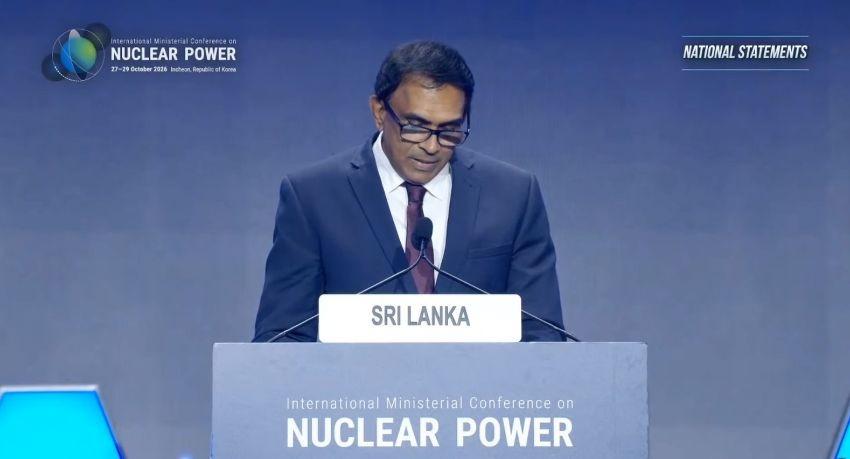
Sri Lanka has not decided to introduce nuclear power and is still completing the first phase of the assessment that would allow it to make that call, Minister of Science and Technology Prof. Chrishantha Abeysena said in a national statement delivered in South Korea.
Nuclear generation is already written into the Ceylon Electricity Board’s planning. “Nuclear power is included in the base case of the Sri Lanka Electricity Board’s Least-Cost Long-Term Generation Expansion Plan 2025–2044,” Abeysena said. “However, this is not a final national decision to proceed.”
Where the assessment stands
Sri Lanka is following the International Atomic Energy Agency’s milestone approach, a staged framework for countries considering a first nuclear programme.
“Sri Lanka is in the final stage of Phase One, assessing whether nuclear power is appropriate for our country. Our priority is to address outstanding infrastructure issues and provide the government with a sound basis for an informed decision.”
Phase One concludes with a decision on whether to commit — not with construction. Abeysena set out what would still be required even if the answer were yes: site selection, reactor technology, grid integration, financing, regulation and institutional capacity.
He said safety considerations would not be traded off, citing effective regulation, emergency preparedness, radioactive waste management and sustainable financing as fundamentals, and said the country is preparing to develop the skilled workforce a programme would need.
Small reactors and a small grid
Abeysena said Sri Lanka is monitoring small modular reactors, and tied that interest directly to the size of the national system.
“Given our relatively small electricity grid, grid stability, operational flexibility and investment requirements will be important considerations when assessing suitable options. Our approach will remain technology-neutral and evidence-based.”
Grid size is the substantive constraint here. A conventional large reactor can represent too great a share of a small system’s total capacity to be operated safely, which is the engineering reason small modular designs appear in the plans of smaller countries.
He credited IAEA technical cooperation and its International Nuclear Infrastructure Review missions, and said the final judgement would turn on evidence rather than politics.
“If our assessment establishes a compelling case, Sri Lanka will consider moving forward responsibly and in accordance with international standards. If it does not, that conclusion must be respected.”
The forum
The NewsFirst report places the minister “in South Korea” without naming the event. The conference backdrop visible in the photograph published with the report identifies it as the International Ministerial Conference on Nuclear Power, held 27–29 October 2026 in Incheon, Republic of Korea, with the minister speaking from a podium marked “Sri Lanka” under a “National Statements” caption.
That detail comes from the image rather than from the text of any filing, and is recorded here on that basis.
Not reported
The filing gives no figures at all — no target capacity, no cost estimate, no date by which Phase One is expected to conclude, and no indication of when a government decision might be taken.
It does not say where the five candidate sites reported in earlier years now stand, whether the drafted nuclear legislation has been presented to Parliament, or what share of generation nuclear occupies in the base case of the 2025–2044 plan. It names no potential vendor or partner country.
On sourcing: this is a single-source article. A search of the other verified newsrooms found no independent Sri Lankan filing on the minister’s statement. Earlier reporting on Sri Lanka’s IAEA engagement exists but predates this speech by more than a year and was not used.
