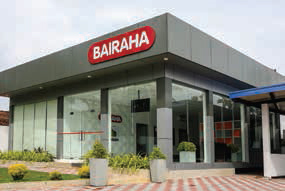
Bairaha Farms PLC’s profit fell 49.7 per cent to Rs 213.7 million in the September quarter, even as revenue grew — the decline driven by a sharp rise in income tax, higher finance costs and a swing into loss at its joint ventures.
The poultry producer earned Rs 213.7 million for the quarter ended 30 September 2026, against Rs 424.6 million a year earlier, according to its interim filing to the Colombo Stock Exchange, EconomyNext reported on Friday. Basic earnings came in at Rs 2.49 per share, down from Rs 4.86.
The operating business grew; the profit did not
| Q2 2026 | Q2 2025 | Change | |
|---|---|---|---|
| Revenue | Rs 4.41bn | Rs 4.23bn | +4.2% |
| Cost of sales | Rs 3.44bn | Rs 3.29bn | +4.4% |
| Gross profit | Rs 975.3mn | Rs 942.6mn | +3.5% |
| Distribution costs | Rs 280.6mn | Rs 228.9mn | +22.6% |
| Administrative expenses | Rs 231.2mn | Rs 255.8mn | −9.6% |
| Finance costs | Rs 58.5mn | Rs 33.9mn | +72.3% |
| Share of JV results | −Rs 75.3mn | +Rs 32.9mn | swing to loss |
| Profit | Rs 213.7mn | Rs 424.6mn | −49.7% |
Revenue growth was supported by sustained market demand, and gross profit rose with it. The problem lies below the gross line. Gross profit improved by about Rs 33 million year on year, while distribution costs rose by roughly Rs 52 million, finance costs by about Rs 25 million, and the joint-venture contribution deteriorated by about Rs 108 million — a swing larger than the entire gross-profit improvement several times over. A Rs 25 million saving on administrative expenses did not offset it.
The company’s trading operation, in other words, was modestly stronger this quarter than last. The halving of profit came from financing, tax and the associates.
The joint ventures
The group’s share of results from joint venture companies swung to a loss of Rs 75.3 million, from a profit of Rs 32.9 million a year earlier.
Managing Director Yakooth Naleem attributed those losses to severe raw material cost pressures and policy constraints on animal feed inputs — a pressure specific to the feed supply chain rather than to demand for the group’s own products, which EconomyNext reports as sustained.
Finance costs rose 72.3 per cent to Rs 58.5 million, driven by higher working capital requirements and expanded lease and financing facilities.
Not reported
The filing as reported does not give the income tax charge for the quarter in figures, despite a sharp rise in it being named as a principal cause of the profit decline — so the single largest stated driver cannot be sized from this reporting. It does not state the effective tax rate, or whether the increase reflects a change in rate, in allowances, or in the mix of taxable income.
It does not give six-month or year-to-date figures, a balance-sheet position, or net asset value per share. It does not name the joint venture companies, state the group’s holding in them, or specify which feed inputs or which policy constraints are involved.
No volume or pricing data is given, so it is not clear how much of the 4.2 per cent revenue growth came from higher prices and how much from higher sales volumes.
Single source. This is an interim earnings filing reported by EconomyNext. A search of other verified newsrooms found no independent report at the time of writing. Company interim results are routinely covered by only one or two business desks, and the underlying document is the company’s own CSE filing rather than a statement reported at second hand.