The Parliamentary Caucus for Persons with Disabilities has proposed that a separate budget line for persons with disabilities be written into the estimates of every ministry, rather than left to a single welfare vote — a change intended to make each ministry account for disability spending in its own numbers.
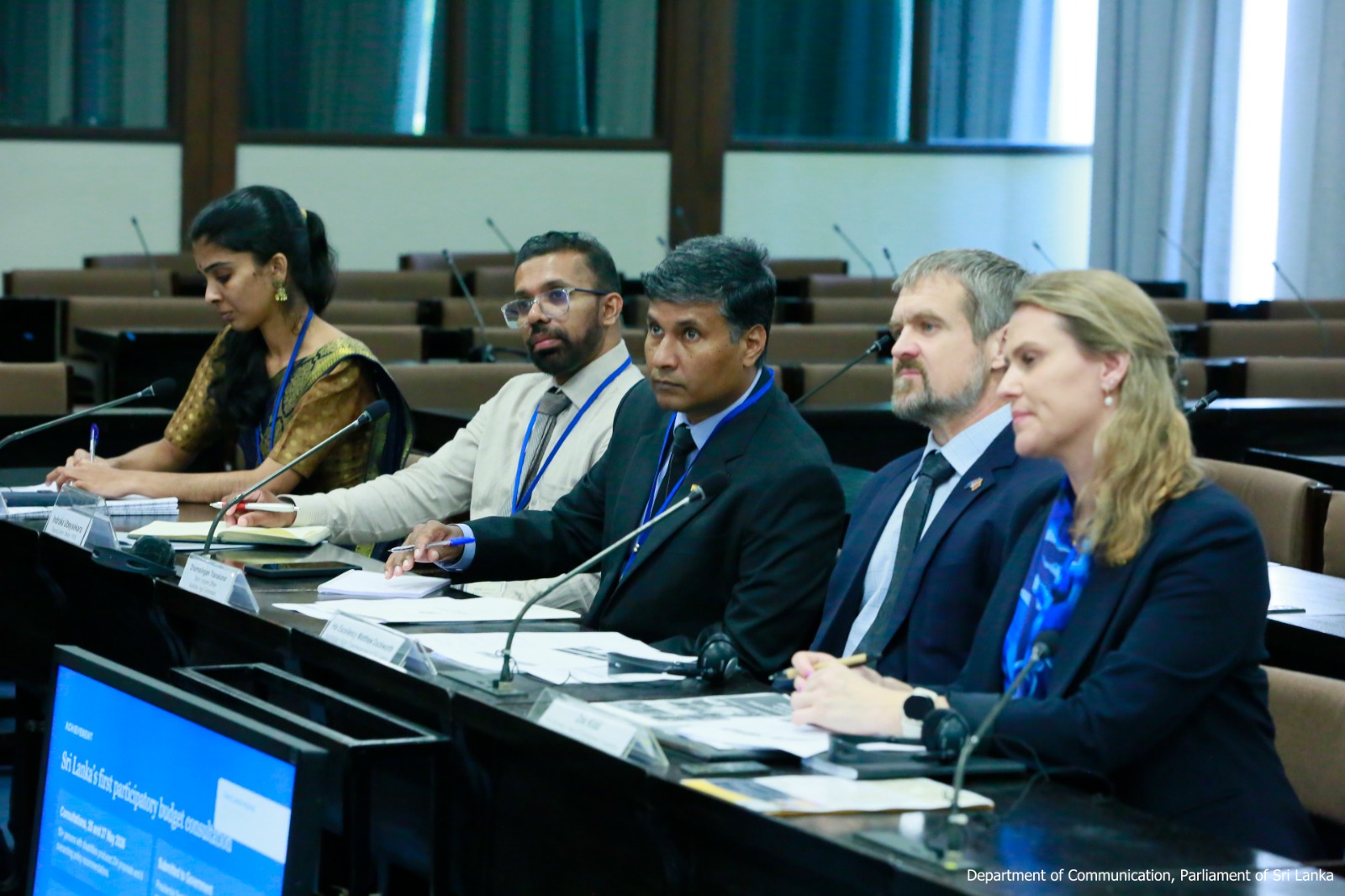
The proposal emerged from a special meeting at Parliament chaired by MP Sugath Wasantha de Silva, attended by Australian High Commissioner Matthew John Duckworth and officials, together with representatives of the International Foundation for Electoral Systems (IFES).
What the caucus has been doing
Deputy Co-Chair MP Dr. Pathmanathan Sathiyalingam presented the caucus’s work over the past year and a half.
District-level consultations bringing together persons with disabilities and government officials have been completed in the Northern Province and Kalutara District, with similar programmes planned for six more districts. Budget proposals for next year were gathered with the participation of more than 50 organisations representing the disability community.
Three pieces of legislation
The caucus is working on a new Disability Bill drawn to international standards, to replace the Protection of the Rights of Persons with Disabilities Act, No. 28 of 1996 — a statute now three decades old. Work is also under way on a Sign Language Act and on reforms to the special education sector.
One measure is already running. A WhatsApp video call service has been launched allowing people with hearing impairments to reach the Police Emergency Service on 119 using sign language, staffed by officers trained in sign language. Parliament’s account credits the caucus chair’s intervention for it.
Australia’s position
Duckworth told the meeting that ensuring persons with disabilities advance alongside everyone else is a core objective of democratic governance and of Australian foreign policy. He said Australia was interested in providing long-term support for policy and legislative reform, including developing data systems and preparing a sign language dictionary.
That is an expression of interest, not a funding commitment: no amount, instrument or timeframe is attached to it in either account.
The chair
Parliament’s release notes that de Silva received the 2026 Commonwealth New Parliamentarian Award from the Commonwealth Parliamentary Association, and that he entered the Tenth Parliament as a representative of the disability community. The Daily Mirror’s version carries neither detail.
De Silva told the meeting a comprehensive Action Plan covering the disability community’s needs and priorities had been presented to guide the caucus’s future work.
A note on the sourcing
These two sources are one statement in two places, not two independent reports. The Daily Mirror’s filing is a close relay of the Parliament Communications Department release, following it paragraph by paragraph and adding nothing of its own; the parliamentary version is the fuller text. Both are verified domains, but readers should not read the pair as two newsrooms independently confirming the same account. No other verified outlet had filed on the meeting at the time of writing.
Parliament’s own release is internally inconsistent on the Deputy Co-Chair’s name, giving “Dr. Pathmanathan Sathiyalingam” at first mention and “Dr. Padmanathan Sathyalingam” later. The first spelling is used above, matching the Daily Mirror and this desk’s archive.
Not reported
Neither account says when the meeting took place — both say only “recently” — nor which MPs attended beyond those named. Neither gives a figure for current disability spending, for what the caucus wants allocated, or for what a separate budget line would cost.
Neither says when the new Disability Bill or the Sign Language Act will be tabled, whether either has been drafted, or whether Cabinet has approved the policy behind them. The six districts earmarked for further consultations are not named, and no date is given for the 2027 Budget debate at which these proposals would be tested.
It is not reported whether the Treasury or the Finance Ministry has responded to the separate-budget-line proposal, which is the body that would have to implement it.