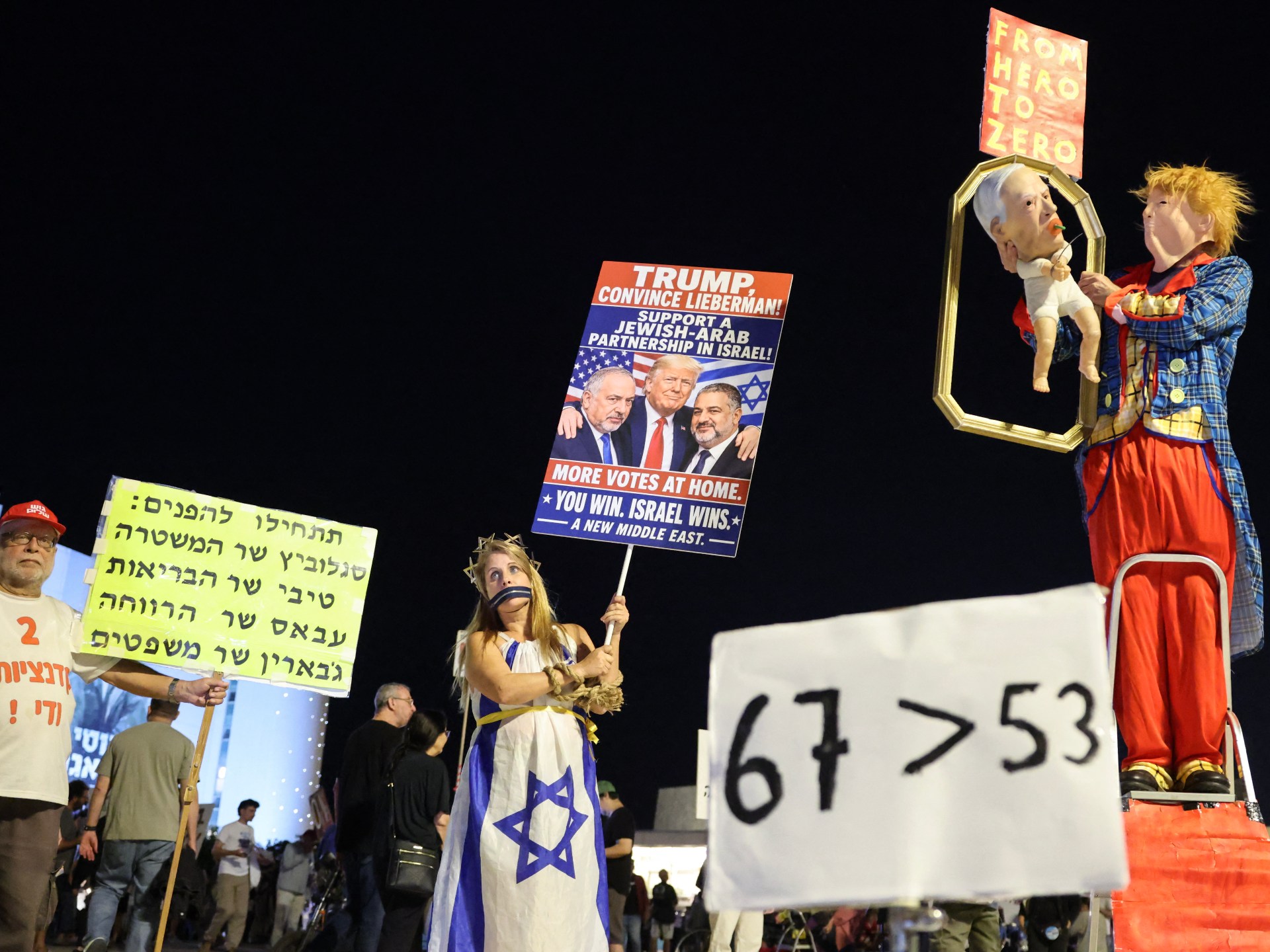
Thousands of Israelis rallied on Saturday night to demand that the country’s opposition parties strike a deal with Arab-led parties and form a government — a protest aimed not at Benjamin Netanyahu but at the rivals who have so far refused to use the majority the election handed them.
The demonstrations were organised by Standing Together, a left-wing grassroots group, and were held in five cities: Tel Aviv, Jerusalem, Haifa, Beersheba and Tayibe.
The arithmetic the protest is about
Tuesday’s election produced a parliament in which neither main bloc can govern alone. In the 120-seat Knesset, Netanyahu’s bloc won 53 seats and the bloc led by Gadi Eisenkot won 48, Al Jazeera reported. Israel’s three Arab-led parties won 19.
That is the whole of the dispute. Eisenkot’s 48 plus the Arab parties’ 19 comes to 67 — a comfortable majority, and more than Netanyahu’s 53. But Eisenkot has previously ruled out a coalition with the Arab parties, and without them he has no path to a government.
Those figures match this site’s report of the final count on 29 October exactly, and Hiru News independently gives the same 53 and the same 67 in its own filing. One of the placards at the Tel Aviv rally put it as plainly as the arithmetic allows: “67 > 53”.
What the protesters are demanding
Marchers gathered at Tel Aviv’s Habima Square before moving to Rabin Square, chanting “Jews and Arabs refuse to be enemies” and “no to racism, yes to partnership”, and carrying signs reading “there’s a majority for change”.
Hiru News reported, crediting the Indian newspaper the Times of India, that the demand is directed at opposition leaders Gadi Eisenkot, Naftali Bennett and Yair Lapid, who are being asked to use the existing parliamentary majority — together with the Arab parties — to form a government and end Netanyahu’s tenure.
Al Jazeera correspondent Nour Odeh, reporting from Ramallah, said protesters believe “Gadi Eisenkot and other leaders of the Jewish-Israeli parties need to listen to their voice”. For many Israelis, she said, the idea of siding with Arab parties remains politically unpalatable.
A contested turnout
The Arab-led parties’ 19 seats rest on a sharp rise in participation. Nearly 840,000 people voted for Ra’am and the Joint List, a 64 percent increase on the 2022 election, according to the Central Election Committee.
Netanyahu has accused Palestinian-Israeli parties of “stealing” the election and of taking Qatari funding to do so. Qatar has rejected the allegation, calling it a disinformation campaign. Odeh said Israeli right-wing circles have characterised the turnout of Palestinian Israelis as “electoral terrorism”.
Counter-protesters also turned out on Saturday, with Netanyahu supporters demanding that Israel should not have a government that includes what they called terrorists.
A note on how this was headlined
Hiru’s English headline describes the rallies as “demanding Netanyahu’s resignation”. Its own Sinhala text does not say that, and neither does Al Jazeera’s account: the protesters are pressing opposition leaders to form a government, which would remove Netanyahu as a consequence rather than by his resignation. The distinction matters, because the decision the protesters are trying to force belongs to Eisenkot, not to Netanyahu. The body of the Hiru filing is accurate; the headline overstates it.
Not reported
Neither filing gives a crowd figure for the four cities outside Tel Aviv, and the two accounts differ in emphasis on size — Al Jazeera says “thousands” in Tel Aviv without a total. Neither reports any response from Eisenkot, Bennett or Lapid to Saturday’s rallies, and neither says whether coalition talks with the Arab parties have begun or when the president will task anyone with forming a government. No date is given for the deadline to form a coalition.