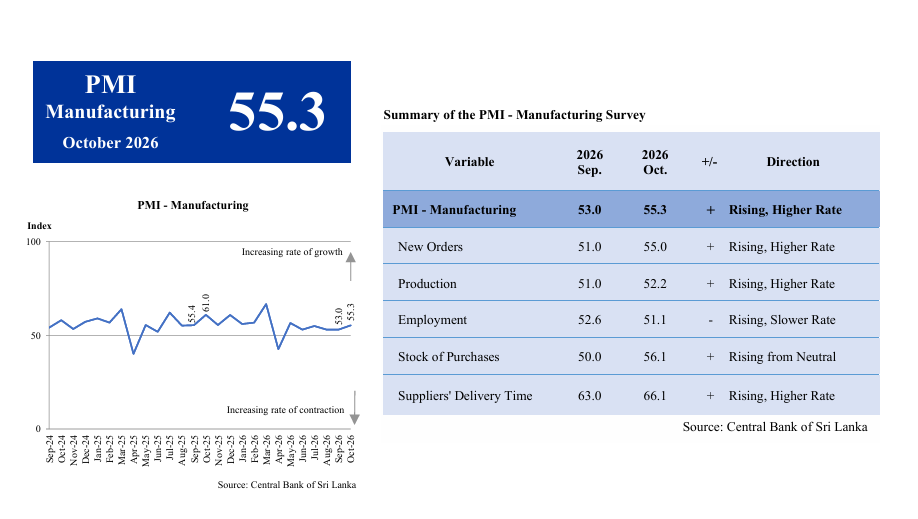
Both of Sri Lanka’s Purchasing Managers’ Indices rose in October, with manufacturing at 55.3 and services at 62.5, according to the Central Bank’s monthly survey — the manufacturing reading its strongest in several months, driven by festive-season orders in textiles, apparel and food.
A PMI above 50 indicates expansion against the previous month; below 50, contraction. Both sectors have now been above that threshold for the full period covered by the Central Bank’s published chart.
Manufacturing: 55.3, up from 53.0
The manufacturing index rose to 55.3 in October from 53.0 in September, EconomyNext reported.
“This expansion was broad-based, with all sub-indices remaining above the neutral threshold,” the Central Bank said, adding that the outlook remained favourable on anticipated demand during the coming festive season.
The Central Bank’s own summary table gives the sub-indices as follows:
| Sub-index | Sept 2026 | Oct 2026 | Direction |
|---|---|---|---|
| PMI – Manufacturing | 53.0 | 55.3 | Rising, higher rate |
| New Orders | 51.0 | 55.0 | Rising, higher rate |
| Production | 51.0 | 52.2 | Rising, higher rate |
| Employment | 52.6 | 51.1 | Rising, slower rate |
| Stock of Purchases | 50.0 | 56.1 | Rising from neutral |
| Suppliers’ Delivery Time | 63.0 | 66.1 | Rising, higher rate |
New orders and production were both lifted by seasonal demand in textiles and wearing apparel and in food and beverages. Employment continued to rise but more slowly than in September. Stock of purchases moved up off a neutral September reading, and suppliers’ delivery times lengthened further — which the Central Bank attributes to increased demand for inputs rather than to any supply disruption.
Hiru News carried the same release in Sinhala, confirming the 55.3 headline figure, the textiles/apparel and food-and-beverage drivers, the rise in employment and stock of purchases, the lengthening of supplier delivery times, and a positive three-month outlook.
Services: 62.5, up from 60.5
The services Business Activity Index rose to 62.5 from 60.5, EconomyNext reported separately. Business activity was driven “primarily by improvements in other personal services, with notable contributions from financial services and goods transportation,” the Central Bank said.
| Sub-index | Sept 2026 | Oct 2026 | Direction |
|---|---|---|---|
| PMI – Services (Business Activity) | 60.5 | 62.5 | Rising, higher rate |
| New Businesses | 60.9 | 59.8 | Rising, slower rate |
| Employment | 54.0 | 56.1 | Rising, higher rate |
| Backlogs of Work | 49.4 | 48.1 | Falling, higher rate |
| Expectations for Activity | 76.2 | 74.7 | Rising, slower rate |
New businesses continued to expand but at a slower rate than in September, with gains in financial services, other personal services, accommodation, food and beverage services and goods transportation. Employment rose on “recruitment across several sub sectors to meet rising operational requirements.”
Expectations for the next three months remained firmly positive, supported by anticipated increases in tourist arrivals and the festive season — though the expectations sub-index itself eased from 76.2 to 74.7. The Central Bank added the caveat that “prevailing global uncertainties continue to pose downside risks to the outlook.”
The figures reconcile with September
Both September readings quoted in Monday’s release — manufacturing 53.0 and services 60.5 — match exactly the figures this desk published on 15 October from the previous month’s survey. The month-on-month series is internally consistent.
A discrepancy between EconomyNext’s text and its own chart
EconomyNext’s manufacturing report gives New Orders at 52.2 and Production at 51.0. The Central Bank summary table published as the image on that same article gives New Orders at 55.0 and Production at 52.2 for October, with 51.0 being the September value for both.
The figures in the table above are the Central Bank’s, taken from its published summary. The sub-index values EconomyNext’s prose carries for employment (51.1, from 52.6) and stock of purchases (56.1) match the table; only the new orders and production lines diverge, and they do so in a way consistent with a one-row shift. EconomyNext’s services report contains no such discrepancy.
Not reported
Neither filing gives the survey’s sample size or response rate, the construction PMI for October — reported separately and on a different schedule — or any breakdown of the services index by individual sub-sector beyond the categories the Central Bank names. Neither sets the festive-season lift against last year’s October, so it is not possible to say from these filings whether the seasonal pattern is stronger or weaker than usual.
Sourcing
Two EconomyNext filings and one Hiru News filing, all from 16 November, reporting a single Central Bank release. The Central Bank’s own summary tables, published as the images on the EconomyNext reports, were read directly and are the source of the sub-index figures above.
