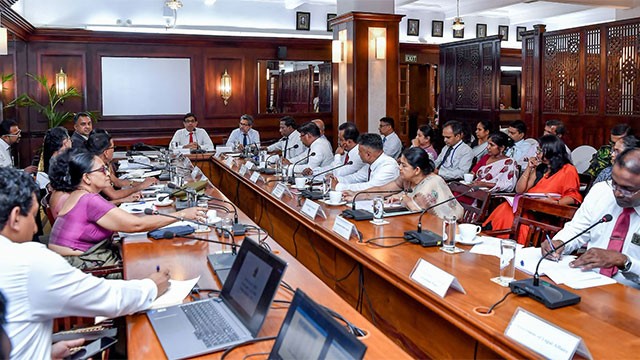
A review meeting on the implementation of ministry-level projects and key policy initiatives under the 2026 Budget proposals was held on June 17 at the Presidential Secretariat under the patronage of Secretary to the President Dr. Nandika Sanath Kumanayake, the President’s Media Division said.
Discussions focused extensively on the challenges encountered in executing approved projects and the urgent measures required to address those issues and accelerate progress, the PMD said in a statement summarised by Ada Derana and NewsFirst.
The meeting comes amid sharply slow progress in capital investment projects. EconomyNext, citing Finance Ministry data, reported that Sri Lanka has spent only 17.4 percent of the allocated Rs.1,380 billion total capital expenditure for 2026 so far this year — about Rs.240 billion. Deputy Finance Minister Anil Jayantha told reporters on Wednesday that most capex is typically spent in the second half. “In certain areas, some delays are there in the procurement, and now we’ll try our level best to expedite and achieve the targets by the year end,” he said, citing technical and procurement-cycle reasons. He pointed out that 2025 capital execution had collapsed to about 45 percent (Rs.591.4 billion deployed) before being boosted by infrastructure-loan repayments.
Progress and bottlenecks were reviewed individually across a sweeping list of ministries: Defence; Finance, Planning and Economic Development; Digital Economy; Foreign Affairs, Foreign Employment and Tourism; Agriculture, Livestock, Land and Irrigation; Transport, Highways and Urban Development; Ports and Civil Aviation; Public Administration, Provincial Councils and Local Government; Trade, Commerce, Food Security and Cooperative Development; Justice and National Integration; Women and Child Affairs; Rural Development, Social Security and Community Empowerment; Public Security and Parliamentary Affairs; Youth Affairs and Sports; and Environment and Housing, Construction and Water Supply.
Addressing the meeting, Kumanayake stressed the importance of all relevant stakeholders working in close coordination to resolve existing challenges without delay. He told participating officials that expediting implementation and ensuring the public receives the intended benefits of the budget allocations is a “collective responsibility.”
The review comes against the backdrop of AKD’s commitments earlier this cycle to focus 2026 Budget execution on rural roads, drinking water and waste management, and follows the establishment of a Parliamentary Budget Office to give MPs independent fiscal analysis capacity. Kumanayake has been the recurring inter-ministry coordinator on cross-government delivery projects this cycle, most recently chairing the WCO Integrity sub-committee review of the 360-strong Internal Affairs Units network.
Sources: Ada Derana, NewsFirst, EconomyNext.