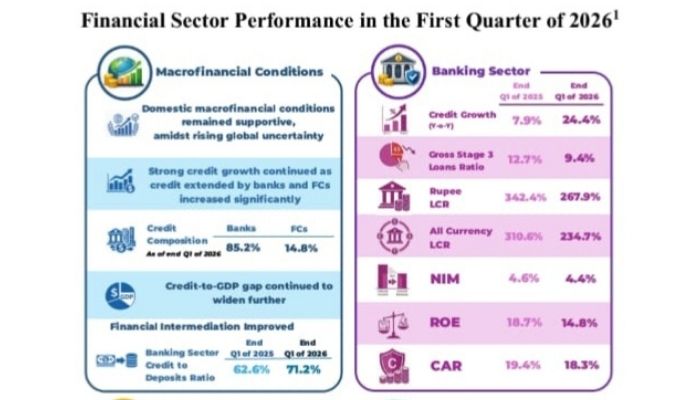
Sri Lanka’s financial system remained resilient through the first quarter of 2026 despite Middle East tensions, exchange rate volatility and growing global economic uncertainty, the Central Bank of Sri Lanka said in its latest Financial Stability Review released on Friday.
Banking sector credit grew 24.4 percent year-on-year at the end of the first quarter, sharply up from 7.9 percent a year earlier, with lending increasingly tilted toward the private sector while exposure to the government and state-owned enterprises moderated slightly. The Stage 3 non-performing loan ratio improved to 9.4 percent from 12.7 percent a year earlier, although profit after tax in the sector fell 7.1 percent year-on-year on higher operating expenses.
Finance company credit expanded 52.4 percent year-on-year, driven mainly by vehicle financing (up 52.8 percent) and gold-backed lending (up 69.2 percent). The Central Bank said finance companies maintained satisfactory liquidity and profitability despite a slight moderation in capital adequacy.
Financial markets were under more visible pressure. The Colombo Stock Exchange saw elevated volatility, with net foreign outflows from equities reaching US$103.4 million by end-May. Government securities yields rose, particularly after the Central Bank raised the Overnight Policy Rate by 100 basis points to 8.75 percent in late May. The rupee remained volatile against the dollar amid external sector pressure, even as surplus liquidity persisted in the domestic money market.
In response to rapid growth in collateral-based lending and rising asset price volatility, the Central Bank confirmed two new macroprudential measures introduced in May: a maximum loan-to-value ratio of 70 percent on gold-backed loans, and tighter lending limits for vehicle financing.
Looking ahead, the regulator flagged elevated energy prices, commodity market volatility, adverse weather, exchange rate pressures and rising inflation as risks to financial stability, and said continued fiscal consolidation and stronger external buffers would be essential to safeguard the system.