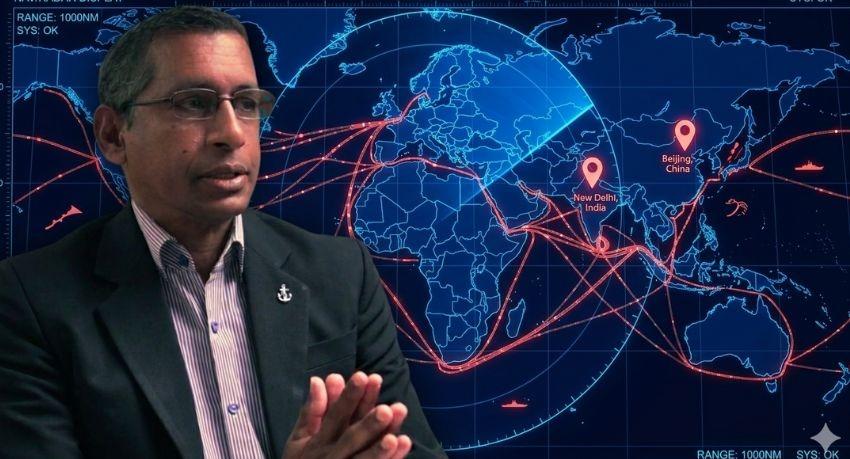
The rivalry between China and India over the next decade could become “alarming” for Sri Lanka, with both powers interpreting Colombo’s foreign-policy decisions through the lens of their strategic competition, former Chief Hydrographer of the Sri Lanka Navy Rear Admiral (Retd) Y.N. Jayarathna has warned.
Speaking on the geopolitical environment facing Colombo, Jayarathna said Sri Lanka cannot prevent the strategic ambitions of major regional powers but can strengthen its position through deeper awareness. He observed that recent public remarks by both the Indian High Commissioner and the Chinese Ambassador had signalled their respective strategic interests — including in connectivity and marine scientific research — but warned that these signals “may not be fully understood or addressed at the state level.”
Jayarathna said his own view had evolved over time. By 2010 he believed Sri Lankans needed a strong understanding of India. By 2013, he realised equal attention had to be paid to Beijing’s strategic thinking. He noted that current Indian strategies now mirror approaches previously adopted by China as New Delhi extends its economic and industrial influence outward.
He pointed to the 1974 demarcation of the International Maritime Boundary Line through four agreements, predating the 1982 UN Convention on the Law of the Sea, as evidence that historical awareness of negotiation processes places Sri Lanka in a stronger position internationally.
Jayarathna also offered new framing on the Hambantota Port. The 2005 cabinet decision to build deep-water harbours at Colombo South and Hambantota predated China’s Belt and Road Initiative by eight years, he said, and was guided by a 2005 US consultancy report by Bruce Allen Hamilton, “Energy Routes of Asia,” submitted to the US State Department. The concepts were later adapted into the BRI in 2013 and India’s Maha Sagar programme in 2015.
The retired admiral concluded that the deeper problem was domestic rather than external — Sri Lanka’s “own inefficiency and inability to make timely decisions” — and called on academia, officials and the wider community to engage collectively on the country’s strategic environment.
The comments land alongside Admiral Colombage’s disclosure of China weapons supplies during the war years and a recent CPA policy push on the India-Sri Lanka land bridge, each underscoring the contested strategic environment around Colombo.