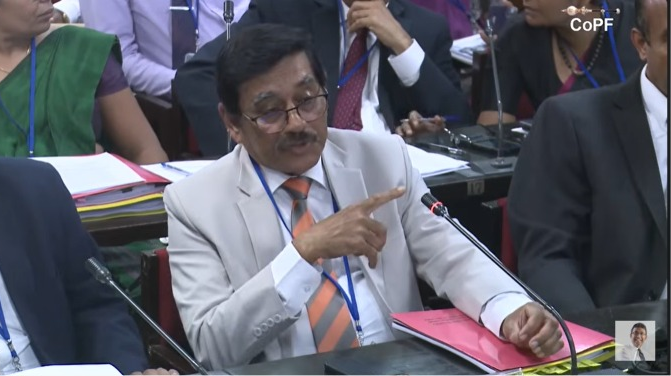
Parliament’s Committee on Public Finance (CoPF) grilled Central Bank Governor Nandalal Weerasinghe and senior CBSL officials on Saturday over the regulatory blind spots that let a Rs.13.2 billion internal fraud at National Development Bank PLC run undetected for close to a decade, with the regulator’s Deloitte India forensic team now expected to file an interim report within two weeks and a final report by July 18, EconomyNext reported.
CoPF Chairman and opposition MP Harsha de Silva used the hearing to challenge the competence of CBSL’s Bank Supervision Department, asking how successive years of unusual variance in NDB’s balance sheet escaped off-site supervision and why NDB itself was permitted to help draft the initial investigative scope of the probe. The line item that masked the fraud — labelled “Other Financial Assets/Receivables” — expanded from Rs. 1.5 billion to Rs. 4 billion before ballooning to the final Rs. 13.2 billion, anomalies the committee said should have triggered supervisory red flags. R.R.S. De Silva Jayatillake, the Bank Supervision Department’s Director, confirmed NDB had collaborated with CBSL to outline the investigative boundaries. “Is the accused asked to draft the scope of the investigation?” the CoPF chair asked, slamming the choice. Governor Weerasinghe countered that while NDB prepared the preliminary draft, the final mandate rested with the Central Bank.
The technical post-mortem drew the sharpest exchange. The perpetrator operated as a low-level “inputter” inside NDB’s transaction reconciliation unit, exploiting legacy gaps to manipulate the bank’s internal general ledger against the LankaPay Sri Lanka Electronic Fund Transfer System (SLEFTS) netting cycle. When pressed, the CEO of LankaPay told the committee that because interbank netting clears every two hours, it is structurally impossible for legitimate clearing to leave a residual balance of Rs. 13.2 billion — confirming the fraud had to be a deliberate insider construction rather than an unsettled-position artefact. Because the inputter’s tenure spanned nearly ten years, Jayatillake said the forensic scope has been expanded to a decade-long historical audit.
De Silva raised a separate conflict-of-interest concern: a current NDB board director was previously a senior partner at PricewaterhouseCoopers (PwC) Sri Lanka, whose local practice was later integrated into Deloitte. “The question is, could there be any sort of undue influence?” he asked. CBSL officials told the committee they had secured guarantees that Deloitte India’s six-member team deployed in Colombo would operate independently of its local Sri Lankan partner network for the full duration. The regulator said it would defer formal punitive enforcement against NDB until the forensic report concludes.
The committee also accused the Central Bank of acting as a passive “post-box” by signing off on NDB’s market debenture issuances raising Tier 2 capital without verifying the accuracy of the underlying financial statements. CBSL replied its in-principle approvals were strictly limited to baseline capital-adequacy compliance under Securities and Exchange Commission guidelines — an explanation the committee rejected, ordering CBSL to formally table all endorsement and approval letters issued to NDB for independent parliamentary scrutiny. The International Monetary Fund has separately mandated an urgent, comprehensive overhaul of operational risk and AML/CFT frameworks across Sri Lanka’s regulatory network as a condition of its programme. The Saturday hearing escalates the May 8 CoPF session that surfaced the audit-failure framing and follows Fitch’s downgrade of NDB to A-(lka) after the fraud was disclosed.
Source: Sri Lanka CoPF grills CB officials on oversight lapses in NDB scam — EconomyNext, June 13.