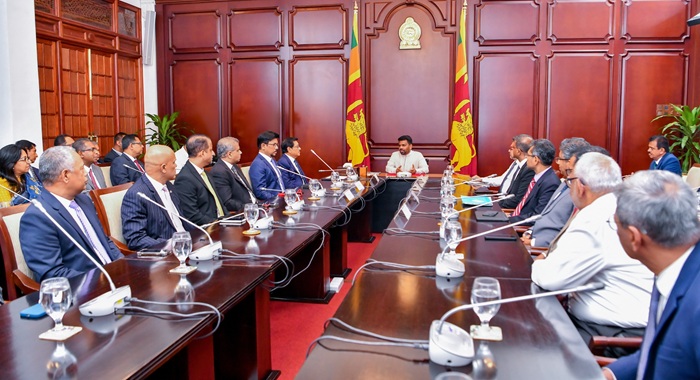
President Anura Kumara Dissanayake officially launched the National QR Payment Promotion Programme on Monday and convened the heads of Sri Lanka’s largest banks at the Presidential Secretariat to accelerate adoption.
Chairmen and chief executives of People’s Bank, Bank of Ceylon, Commercial Bank, Sampath Bank and Hatton National Bank attended, alongside representatives from additional state and private lenders. Central Bank Governor Dr. Nandalal Weerasinghe, the Deputy Minister of Digital Economy and the Senior Presidential Adviser on Digital Economy also participated.
Under the programme, merchant service fees on LankaQR transactions up to Rs. 5,000 have been removed effective April 6, eliminating a key cost barrier for small vendors. More than 20 financial institutions support LankaQR, which is now accepted at 450,000 merchant locations nationwide.
Weerasinghe told the meeting that cash handling through ATMs imposes significant operating costs on the banking system and argued digital transactions would be “more efficient, reliable and secure.” Bank of Ceylon Acting CEO Y.A. Jayathilaka pledged the sector’s “fullest support” to steer the country toward a digital economy.
The scale of the uptake challenge remains stark. LankaQR transactions averaged only about Rs. 395 million per month in the third quarter of 2025, against Rs. 1.48 trillion of physical currency in circulation, according to data cited by Xinhua. By contrast, Sri Lanka’s broader CEFTS electronic transfer system handles roughly 68 million transactions worth Rs. 6.3 trillion per quarter.
To spur adoption, the government has launched a nationwide awareness campaign in Sinhala, Tamil and English along with a raffle scheme offering prizes of up to Rs. 1 million to both consumers and merchants.
Cutting cash dependency is politically linked to the broader foreign-exchange squeeze: reduced ATM handling costs and lower banknote import requirements would ease pressure on the banking system at a moment when Sri Lanka is navigating both the Middle East energy shock and the impending 44 per cent US tariff.