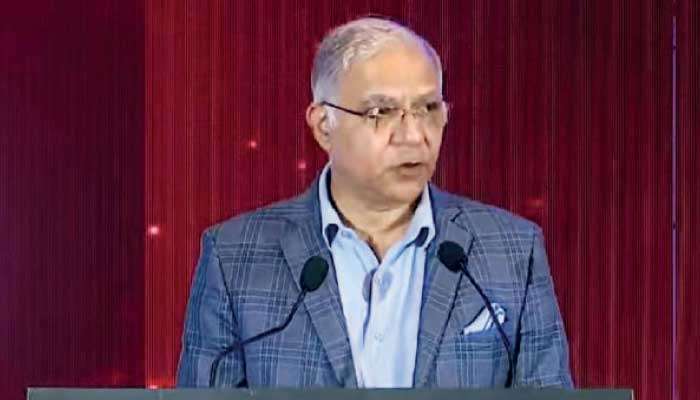
Indian High Commissioner Santosh Jha has called for a “bold reset” in India-Sri Lanka economic and strategic engagement, urging both governments to move beyond symbolism and accelerate long-discussed agreements on trade, connectivity, energy and digital integration.
Delivering the keynote at the Global Innovation and Leadership Summit in Colombo on Saturday, organised by Z Media and WION, Jha framed the bilateral relationship as “a civilisational bond,” recalling Prime Minister Narendra Modi’s “civilisational twins” description from his April 2025 visit. He said the world was entering a period of weaponised supply chains, geopolitical competition and weakening confidence in global institutions, and that trust built “over centuries, not decades” gave the partnership unusual resilience.
Jha said Indian-linked investments accounted for 50% of Sri Lanka’s total foreign direct investment inflows last year, including capital routed through third countries. India is also Sri Lanka’s largest trading partner and largest source of tourists. On the bilateral Free Trade Agreement, he said more than 65% of Sri Lankan exports use FTA benefits while only 5% of Indian exports do, and that Sri Lanka has run a trade surplus on FTA-enabled trade for over a decade. India is now the island’s second-largest export destination.
He warned, however, that both sides had “spent too long talking about” upgrading the FTA — a reference to the long-stalled Economic and Technology Cooperation Agreement (ETCA) — “sometimes renaming it; but not actually moving with purpose and required political will to forge a new framework.” Each year of delay, he said, was “a year of opportunity lost.”
A central theme of the address was Palk Strait connectivity. Jha noted that while Colombo and Chennai are 300 km apart by sea, Rameswaram and Talaimannar are just 30 km apart with no road, no railway, no scheduled ferry, no grid interconnection and no pipeline. “It is, frankly, an anomaly. The time for wavering is over,” he said, arguing that a permanent land link by bridge or tunnel would reshape the region’s economic geography.
He pushed for a submarine electricity interconnection, petroleum pipeline arrangements and tank-farm cooperation, drawing parallels with India’s regional power links to Nepal, Bhutan and Bangladesh, and pointed to UPI and Aadhaar as digital public-infrastructure templates Sri Lanka could plug into. Jha said India’s post-Cyclone Ditwah support amounted to USD 450 million, and cited the Indian Housing Project’s roughly 55,000 homes as a foundation for deeper ties.
“This is not a partnership of big and small; there is no big brother here but two civilisational twins,” he said in closing.
Source: Daily FT.