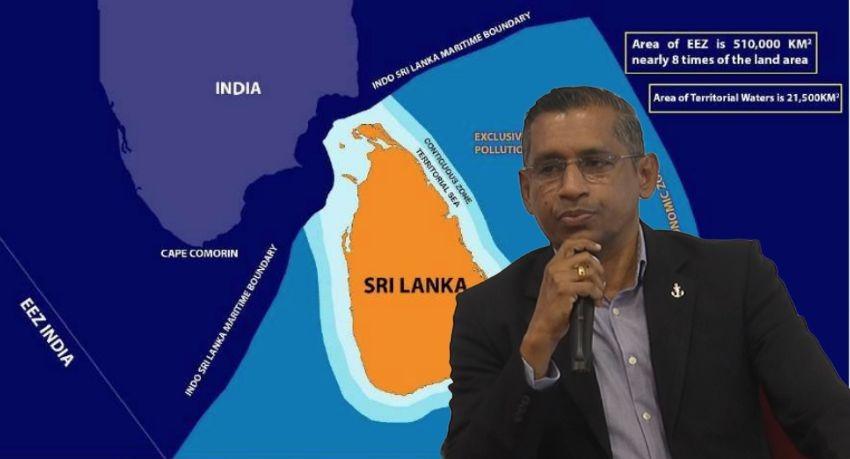
Sri Lanka and other nations bordering the Indian Ocean must take primary responsibility for securing the region or risk outside powers stepping in to shape its future, retired Rear Admiral Y. N. Jayarathna, the former Chief Hydrographer of the Sri Lanka Navy, warned on Tuesday.
“If you don’t stand by for it, someone else will,” Jayarathna said, arguing that the responsibility for the Indian Ocean ultimately belongs to the countries that lie within it. He said national interest must guide Sri Lanka’s “decisive and proactive statecraft” at a moment when great-power friction is reshaping the region.
Jayarathna challenged conventional threat perceptions by asking whether Iran posed any genuine threat to India, Sri Lanka or Pakistan, and whether the United States should be seen as a threat to either India or Sri Lanka. Examined that way, he said, the answer pointed to a clear conclusion: regional security cannot be outsourced.
He cited recent maritime developments to illustrate how interconnected security challenges have become. Referring to naval exercises by the Iranian vessel Iris Dana off Visakhapatnam in the Bay of Bengal, he noted that as the vessels moved south Sri Lanka’s Maritime Domain Awareness tools continued to track them — and asked whether anyone had considered that these vessels effectively became potential targets when the war broke out on February 28.
The intervention lands at a politically sensitive moment. Iran’s IRIS Bushehr was interned at Trincomalee in March, Indian External Affairs Minister Jaishankar publicly described Hambantota as a “foreign military base” earlier this month, and the US Pacific Fleet commander recently hosted Sri Lanka Navy officers in Honolulu — three converging signals that the Indian Ocean is now a contested space.