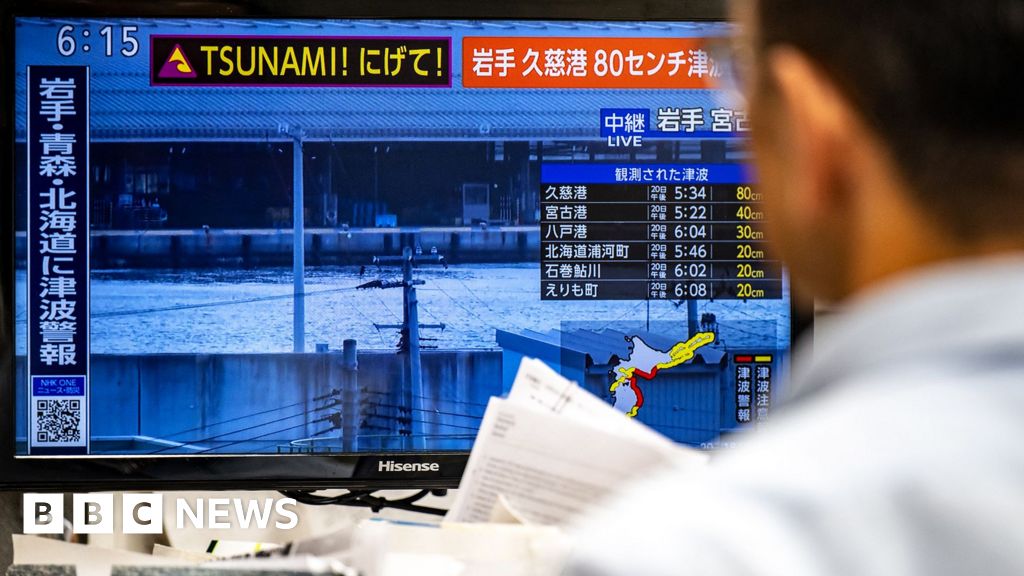
Japan’s Meteorological Agency has warned that the risk of an earthquake measuring 8.0 magnitude or higher is “relatively higher than during normal times” over the next seven days, after Monday’s 7.7 magnitude quake struck off Iwate Prefecture in the country’s north-east.
Tsunami warnings and advisories issued after the undersea quake were lifted hours later, with the final alert removed shortly before midnight local time, the BBC reported. But the JMA said further quakes “causing even stronger shaking” could occur in the coming week, potentially producing larger waves than Monday’s 80-centimetre maximum.
Monday’s quake struck at 16:52 local time at a depth of 10 kilometres, roughly 530 kilometres north of Tokyo. More than 170,000 people across several prefectures were ordered to evacuate as warnings of tsunami waves up to three metres were issued along the Pacific coasts of Honshu and Hokkaido. Tremors were felt as far away as Tokyo.
Cabinet Secretary Minoru Kihara said there were no immediate reports of major damage or injuries. A number of bullet trains were temporarily halted and around 100 homes lost power, with services resuming by Monday night.
The seven-day elevated-risk advisory is a distinct alert type beyond the standard post-quake tsunami response, signalling sustained tectonic instability along Japan’s Pacific trenches. It comes amid public memories of the 2011 Tōhoku earthquake, a magnitude-9.0 event off the same Iwate coastline that killed more than 18,000 people and triggered the Fukushima Daiichi nuclear disaster.
Japan sits on the Pacific Ring of Fire and records roughly 1,500 earthquakes a year, accounting for about 10% of all quakes measuring 6.0 or above globally. The JMA issued a similar “megaquake” advisory last year along the Nankai Trough.
The tsunami warnings were lifted after Monday’s initial 7.7-magnitude quake prompted evacuations across five prefectures.
Sources: BBC, Ada Derana.