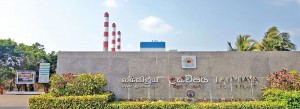
The National Audit Office has confirmed that South African coal supplied by Trident Chemphar caused repeated operational failures at the Lakvijaya Power Plant, including mill blockages, a fire on March 5 and severe capacity drops across all three 300MW units, the Sunday Times reported.
The audit found the coal’s gross calorific value (GCV) consistently fell below the required standard of 6,150 kcal/kg, and in some shipments dropped below the absolute rejection threshold of 5,900 kcal/kg. To compensate for the weaker heat value, operators had to push coal feed rates regularly beyond the safe operational limit of 115-116 metric tonnes per hour.
High pyrite content, which cannot be ground by the mills, overwhelmed the pyrite reject system, causing accumulation, mill blockages and overheating. On March 5, the pyrite hopper of one Unit 3 mill caught fire while operating at a flow rate of 29-30 tonnes per hour. Operators were forced to cut the feed rate to about 26 tonnes per mill and run oil burners to stabilise combustion while the affected mills were cleaned.
Excess ash exceeded design specifications and deposited inside air preheaters, restricting the primary air flow. High moisture caused coal to stick to internal grinding surfaces, reducing efficiency and raising the risk of mill choking.
Log books cited by the auditors show cascading capacity losses. On January 27, Unit 1 was capped at 290MW because of the new South African coal. On February 6, Unit 2 was cut to 270MW after coal feed rates could not be maintained. Daily system reports repeatedly listed “coal quality issue” as the reason for Unit 1, Unit 2 and Unit 3 being limited to 236MW, 240MW, 246MW or 262MW during night peaks. Unit 1 fell as low as 214MW in mid-March and to zero on March 7 and 9 for emergency maintenance.
Unit 2 was eventually taken off the new coal and restricted to a pre-existing stock of Russian coal from February 1 to March 1. Between 2020 and 2025, the audit noted, no recorded problems had been attributed to coal quality.
The findings run in parallel with the emergency tender awarded to Taranjot Resources to plug Trident’s shortfall, the government’s move to withhold Rs. 9 billion from the supplier over quality penalties, and the 250 GWh generation loss documented by PUCSL.