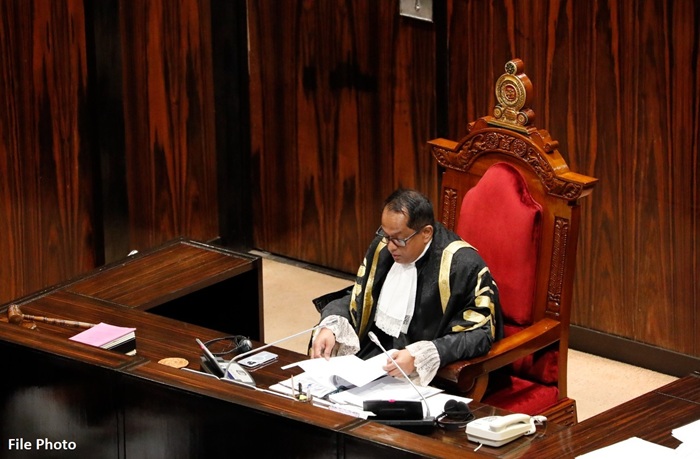
The Supreme Court has ruled that the Prevention of Money Laundering Amendment Bill can be passed by a simple majority in Parliament except for two clauses, which require a two-thirds special majority unless amended, Speaker Jagath Wickramaratne told the House on Tuesday.
The Speaker said the determination, communicated to Parliament under Article 121(1) of the Constitution, identified Clause 14 — which introduces proposed Sections 12A and 12B — and Clause 18 — which introduces proposed Sections 17A, 17B and 17C — as the provisions requiring a special majority in their current form. The Court further held that the same clauses could be passed by a simple majority if amended as proposed in its determination, giving Parliament a choice between a two-thirds vote and rewriting the disputed sections.
The bill had been challenged in the Supreme Court under Article 121(1), the constitutional pre-enactment review mechanism. The procedural fork now sits with the government, which can either marshal a two-thirds vote or move the amendments suggested by the bench before the second reading.
The Prevention of Money Laundering Act is one of the core statutes underpinning Sri Lanka’s anti-corruption architecture, used alongside the Bribery Act and the Anti-Corruption Act in cases including the Yoshitha Rajapaksa money-laundering proceedings and the Ousmand–Padme staged-feud money-laundering investigation. Amendments to the parent law typically tighten predicate-offence definitions and asset-recovery powers, with Article 121 challenges most often targeting provisions touching due-process or fundamental-rights guarantees.