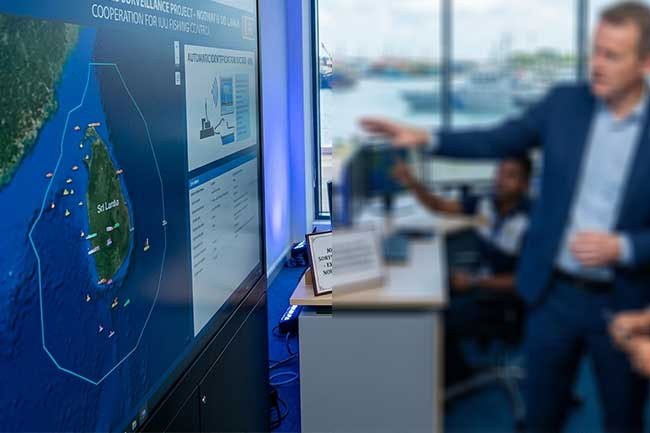
Norway has agreed to give Sri Lanka free access to its satellite-based vessel tracking system to monitor fishing fleets and combat illegal, unreported and unregulated (IUU) fishing in Sri Lankan waters, according to the Ministry of Fisheries, Aquatic and Ocean Resources.
The arrangement was discussed during a Sri Lankan delegation visit to Oslo on April 23, led by Fisheries, Aquatic and Ocean Resources Minister Ramalingam Chandrasekar. The delegation met officials from the Norwegian Ministry of Trade, Industry and Fisheries, including Gunnar Stølsvik, head of the “Blue Justice” initiative — Norway’s global programme against transnational fisheries crime.
The Blue Justice initiative provides member countries with Automatic Identification System (AIS) data, allowing real-time satellite monitoring of vessel positions inside Exclusive Economic Zones. Norway will also offer specialised training to officers of the Ministry and the Department of Fisheries to operate the system, the ministry said.
Sri Lanka’s 517,000 sq km Exclusive Economic Zone is regularly contested by foreign vessels, and IUU fishing has long been a flashpoint with neighbouring fleets. Independent satellite tracking would let authorities verify vessel movements without depending on transponder data the operators themselves provide.
Sri Lanka was also formally invited to join the Norway-led Food Nutrition and Composition Group, opening research collaboration channels for institutions including the National Aquatic Resources Research and Development Agency (NARA).
Minister Chandrasekar described the talks as part of a broader effort to modernise the fisheries sector, which contributes around 1.3 percent of GDP and supports more than 600,000 livelihoods. The visit also covered technical exchanges on aquaculture and post-harvest handling.
No timeline was announced for when the AIS data feed will be activated for Sri Lankan authorities.