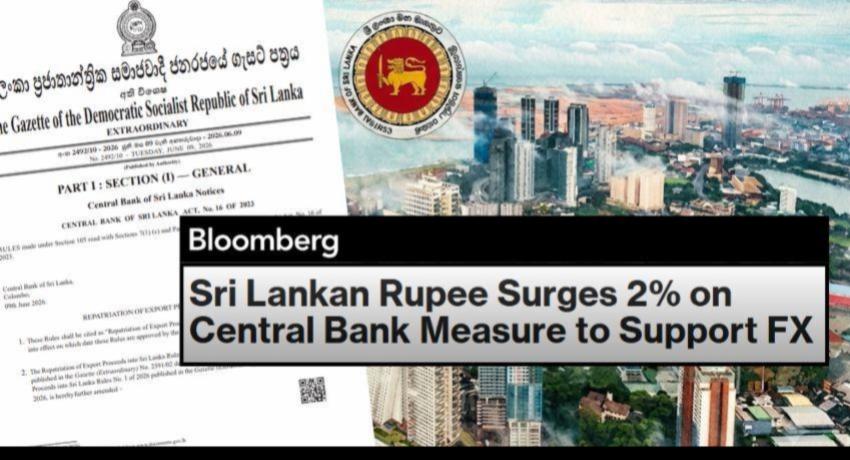
Sri Lanka’s rupee surged more than 2 percent on Wednesday in its sharpest single-day gain in months, after the Central Bank gazetted a rule forcing exporters to convert residual foreign exchange earnings into rupees on a tight monthly schedule.
The currency climbed as much as 2.1 percent to reach 330.15 against the US dollar, Bloomberg reported and NewsFirst cited. EconomyNext, citing dealer quotes, said the spot rate touched a low of 328.00 in the trading day from a high of 336.50, and was quoted at 332/334 by midday, down from the previous day’s close of 337.00/75.
The rally followed the Central Bank’s Tuesday gazette of new repatriation rules, issued under “Repatriation of Export Proceeds into Sri Lanka Rules No. 2 of 2026,” which compels exporters to convert any residual foreign currency proceeds into Sri Lankan rupees on or before the 10th day of the month following receipt.
Under the revised framework, exporters may continue to use foreign currency earnings for a limited menu of approved payments — current business operations, servicing of foreign currency loans, dividends to non-resident investors, expatriate salaries, and export-related travel — and may invest up to 10 percent of proceeds in government foreign currency-denominated debt securities. Anything left after those uses must be converted by the monthly deadline.
The rule also extends to indirect exporters: local suppliers who provide inputs to primary exporters and receive foreign currency payments are required to convert remaining funds within the same 10-day window.
The intent of the policy is to break what dealers had described as a hoarding loop, in which exporters delayed conversion in anticipation of further rupee weakness, deepening the daily spot-market shortfall and feeding the depreciation cycle. The Central Bank used US$211 million in May alone to defend the spot rate, EconomyNext reported, and the rupee had been down around 8 percent against the US dollar since the start of the year before Wednesday’s move.
The gazette is the first formal tightening of Sri Lanka’s foreign exchange repatriation regime since the post-restructuring normalisation began, and is the second exporter-side action this quarter. The Treasury directing CBSL on FX market clearing was publicly questioned in late May by IMF Sri Lanka mission chief Peter Papageorgiou, who said the central bank should be the first line of defence on the currency.
Whether Wednesday’s bounce holds will depend on how steadily forced conversions feed back into the spot market in the coming weeks, and on the size of residual foreign currency balances exporters now hold. The Central Bank has not disclosed the aggregate residual pool.